“Shoot, Jim, shooot!” Simon Callow does a fine impression of producer Ismail Merchant desperately trying to get director James Ivory to bring urgency to the proceedings.
The received wisdom was that Ismael thought Jim was going to bankrupt Merchant Ivory Productions commercially by insisting on perfection, while Jim was sure that Ismael would bankrupt it artistically by insisting on every possible economy.
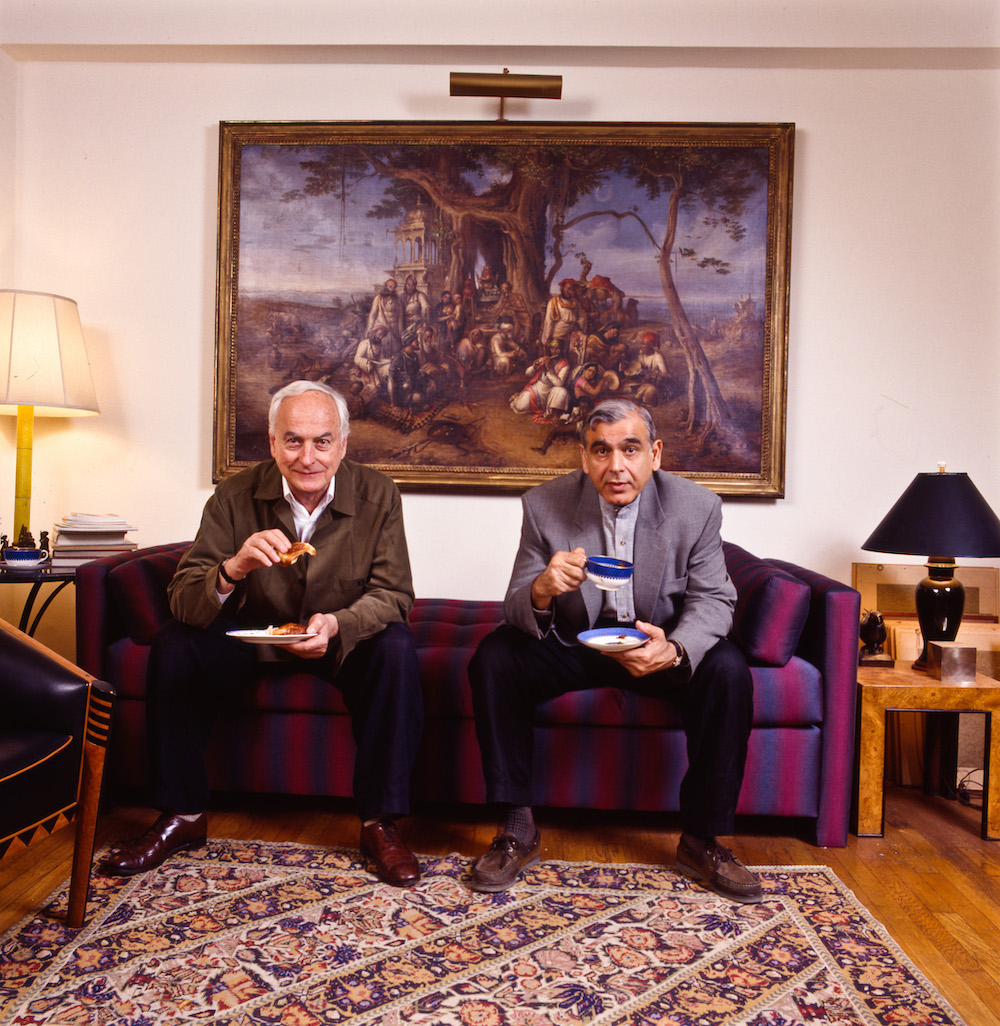
Theirs was a volatile, complex relationship, as director Stephen Soucy’s honest, fascinating documentary, full of talking heads from the Merchant Ivory family, as they liked to call it - Helena Bonham Carter, Rupert Graves, Greta Scacci, an argumentative Vanessa Redgrave and many more - makes clear. Their rows were legendary. Jim would shriek, Ismael would turn a deep shade of purple and bellow. Sometimes neighbours called the police.
Yet somehow they kept on working and living together, in New York City and in a large house in Claverack, upstate New York, from 1961 to 2005 (Merchant died suddenly during surgery for abdominal ulcers at the age of 68, during post-production for The White Countess in London).
Their relationship, as Kit Hesketh-Hardy puts it, “was never alluded to, and you were too polite to ask,” partly because Merchant’s Muslim Indian family was very conservative. “It would have been too upsetting for them,” says Ivory. “I was just his American friend. So in his lifetime we never talked about it.” Of course everyone on set knew. “The crew called us Jack and Jill.” Ivory also never came out to his family, though, “I never felt uncomfortable about being gay. I never had the sense of guilt.”
 It was an extraordinarily productive collaboration: 44 films, many of them Oscar winners, with 23 scripted by Ruth Prawer Jhabvala, who lived downstairs, starting with her adaptation of her novel The Householder (1963), set in India. Satyajit Ray gave it an uncredited re-cut and made the entire film into a flashback. Twenty-one of them were scored by Richard Robbins, who was also Merchant’s lover. This caused complications, especially as he too lived close by, but Ivory wouldn’t let the two move in together. But, “I was never going to leave him because of his temporary infatuations.” People asked why he didn’t but those people, he said, weren’t making films with him. And Ivory had his own affairs, one of them with Bruce Chatwin.
A Room with A View (1985), one of three EM Forster adaptations, was a smash hit, though budgets remained tight. “We were a bit like the US government,” says Ivory. “I’m the president, Ismael’s the congress and Ruth is the supreme court.” It wasn’t easy, says Emma Thompson (Howard’s End, 1992, for which she won an Oscar; the wonderful Remains of the Day, 1993). “You always said, never again. The low budgets…it was just tough.” But she loved the lack of cosseting. Ivory leaned into the carriage where a scene had just been shot. “It was boring,” he told her. “Let’s do it again.” And Merchant was extraordinarily charming, providing wonderful meals and picnics in exotic locations, which made up for the lack of money.
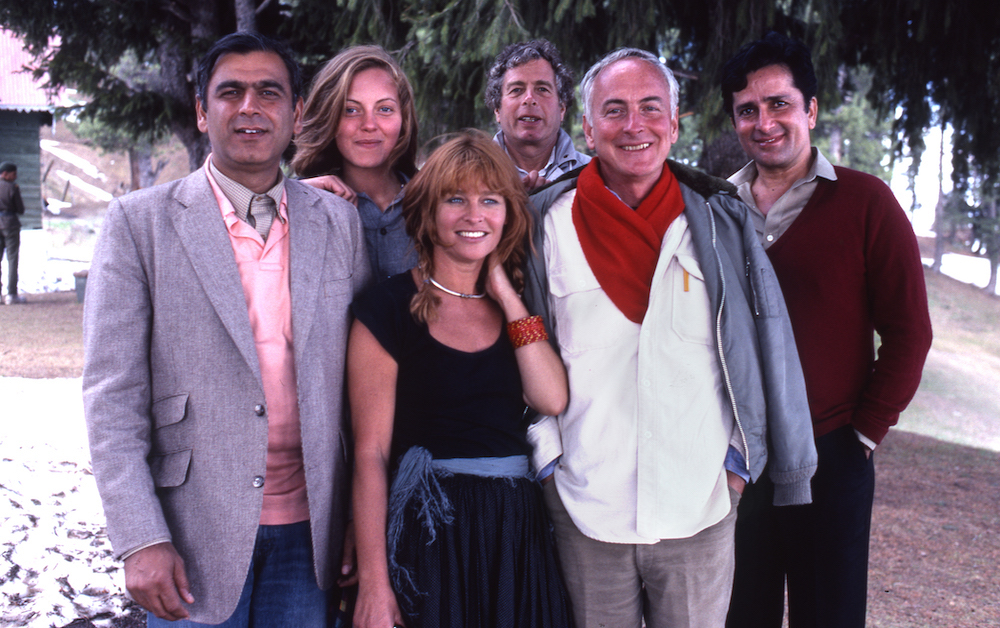 There was often no funding at all. Jhabvala says she’d look for the nearest jail on location and tell Merchant, “One day I’m going to visit you in there.” But, as Ivory comments, “every producer is a con man.” Caterers and crew almost walked out on Heat and Dust (Merchant, Ivory and some of the cast pictured above). Anthony Hopkins sued for lack of payment on The City off Your Final Destination in 2010, Ivory’s first film without Merchant, and the company was almost brought down. Robbins died in 2012, Jhabvala in 2013.
Hugh Grant describes almost saying no to the ground-breaking Maurice (1987), made at the height of the AIDS crisis (it's stood up to the test of time very well, perhaps seeming more impressive now than then). But his brother told him he should do it because Merchant Ivory films were classy. Grant was hardly acting at all at the time, just doing comedy sketches. But Julian Sands, who starred with Helena Bonham Carter in A Room with a View, dropped out at the last moment and went to Hollywood, and through various permutations Grant got the part of Clive. “The film sets crackled with subliminal lust,” he says, laughing nostalgically. “Nowadays everyone is just looking at their phones.”
The script is by Kit Hesketh-Hardy, who died last year and to whom the documentary is dedicated. It wasn’t really Ruth’s territory, he says, and she was in the middle of a novel at the time. But even so she made a clever, radical change which, says Ivory, improved on EM Forster’s book, always seen as second rate and in which Clive has an unconvincing change of heart about being gay.
“James always seemed relaxed and un-neurotic,” says Rupert Graves. “Oh, he doesn’t direct, he’s just really nice,” a young Natascha McElhone, who played Francoise Gilot in Surviving Picasso (grander in scale, released by Warner Bros, but like other later films, dismissed by critics in 1996) told a journalist. Later he told her that perhaps that wasn’t the best thing to say.
After Merchant’s death, says Hesketh-Hardy, “Jim was lost.” But in 2018 he won an Oscar - at 89 the oldest person to win an Academy Award - for best adapted screenplay for Call me by your Name. In his acceptance speech he mentions all the people who come up to him on the street to thank him for having made Maurice. “I don’t think I’ve seen him happier,” says Helena Bonham Carter. “He’s getting younger in spirit. Maybe he’s been able to grow in a dimension that he wouldn’t have, had Ismael lived.”