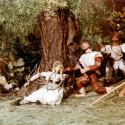
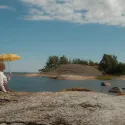
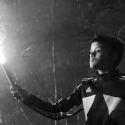
Creative rebirth or belated midlife crisis? That is the question that hovers over Francis Ford Coppola’s decision to turn his back on lucrative studio fare in favour of personal pet projects with an arthouse bent. The director of The Godfather trilogy has been here of course, his 1982 flop One From the Heart leading him to declare bankruptcy and spend a decade or more doing derivative hack work to pay off his debts. This time around, though, he has taken a self-sufficient route, using profits from his Californian vineyard and other businesses to finance modestly budgeted indies that enable him to be as experimental, indulgent and pretentious as he likes.
That last adjective certainly applied to 2007’s Youth Without Youth, a tedious fable about an ageing academic miraculously rejuvenated by a lightning bolt. (Having seen daughter Sofia embraced by the filmmaking establishment, Coppola must have surely savoured the Ganymedean paradox at the heart of philosopher Mircia Eliade’s source novella.) With Tetro, though, the director has returned to more familiar territory - a story of two estranged American brothers reunited in Buenos Aires, his first original screenplay since The Conversation in 1974 – recalling earlier Coppola films that dealt with entrenched family rivalries and fractious relationships between siblings.
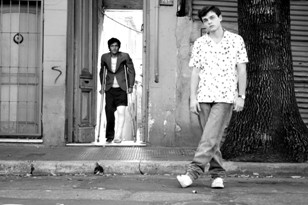 The one that springs most readily to mind is Rumble Fish, the dynamic between Matt Dillon’s alienated wastrel and older brother Mickey Rourke being virtually replicated by that between 17-year-old Bennie (Alden Ehrenreich) and the revered sibling Tetro (Vincent Gallo, pictured right with Ehrenreich) he hasn’t seen in a decade. Like its 1983 predecessor, Coppola’s new work is shot almost totally in black and white, bar some fleeting sequences in vibrant colour that pay elaborate homage to Powell and Pressburger. There was also a chance that Dillon might have played Tetro, a casting choice that would have made the filmic connection even more explicit.
It is apparent, though, that Coppola has also drawn on tensions within his own brood to inform those on screen – specifically his dealings with his late brother August, his sometimes combative relationship with musician father, Carmine, and the latter’s own rivalry with his younger, more successful sibling. All these are played out not only in Bennie’s dealings with Tetro but also in Tetro’s memories of his tyrannical conductor father – Klaus Maria Brandauer, who also portrays his character’s ineffectual, broken brother. The result is a heady Oedipal concoction, reminiscent of both classical Greek tragedy and the Southern Gothic of Tennessee Williams. Yet it also feels at times like an extended therapy session – a way for Coppola to exorcise deep-seated demons and nagging bugbears that have festered for decades behind an ebullient façade of bearded bonhomie.
For all its weighty themes, though, Tetro has a surprisingly light touch – typified by a third act in which Gallo and Ehrenreich trade the bohemian bustle of BA’s La Boca district for a Patagonian theatre festival presided over by Carmen Maura’s hilariously monikered literary critic “Alone” (pictured below). (Could this be a sly caricature of Pauline Kael, the doyenne who initially championed Coppola’s work before turning against him?) The ghost of Fellini floats freely through a hedonistic sequence that eventually reaches heights of operatic passion we have not seen since the end of The Godfather Part III. Tonally, however, it is so separate from what has gone before it feels like a different movie altogether – a delirious fever dream infused with some of the same fantastical illogic that characterised Apocalypse Now.
 As much as Coppola wants to start afresh, then, Tetro seems inextricably linked to his other movies. (Even Gallo’s moody posturing belongs in a tradition established by the Coppolian triptych of Brando, Pacino and De Niro.) Yet there is no denying the film has a sprightliness, a brio and a youthful energy that, if not quite a new beginning, at least represents a new chapter for a director who, like so many of his contemporaries, can’t help but be defined by past glories and former triumphs. Wherever he goes from here – further down his own idiosyncratic furrow, back into the bosom of Hollywood or a mixture of the two – his future work can only be energised by his commendable drive to make films for their own sake, rather than to satisfy a corporate bottom line.
Watch the Tetro trailer