

There are certain film-makers who like to give themselves a headache. Buried confined its only character to a coffin. Phone Booth stuck Colin Farrell in – what else? – a phone booth. Essential Killing imposes another kind of confinement on its main character: it maroons him in silence. It could be argued that cinema has long experience of keeping its mouth shut. They did without dialogue until 1927. But give or take the odd bravura exception – say, the eloquent first 15 minutes of Once Upon a Time in the West - film has lost the habit of making do without words.
The actor tasked with carrying Essential Killing without opening his mouth other than to scream or howl in pain is Vincent Gallo. We find him marooned in a parched ravine in an unnamed country, presumably Afghanistan. When three American soldiers enter it on reconnaissance, he kills them all in self-defence with a single rocket-propelled grenade.
An overhead chopper swiftly swoops in and apprehends the killer. Soon’s he’s stuck in an orange suit, waterboarded, bound, hooded and suffers extraordinary rendition to the frozen wastes of rural northern Europe - like him, we are never told where (the film was shot in a Norway where the natives speak Polish). However, when the jeep in which he is being transported slithers on ice and tumbles down a hill, he contrives to escape despite being shackled and manacled.
It’s difficult to call Gallo’s character a protagonist when his every action is an improvised response to circumstances. Indeed, the question hanging over his odyssey as he flees barefoot into pine woods which stretch endlessly across snowy undulations is an existential one: how can this possibly end other than in oblivion? Nonetheless, what follows is a leanly plotted survival story in which Gallo’s nameless fugitive – listed as if generically in the credits as Mohammed - is presented with a lethal equation: kill or be killed. Hence the title. On each occasion the implement of despatch is different: a knife for one of his pursuers (and his poor sniffer dog), a chainsaw for another man he chances upon in the forest. This is not an action movie. It’s a reaction movie.
And yet despite the spattering blood, Essential Killing is not an essentially violent film. In another director’s hands, perhaps in a less oppositional era, Gallo might look like an art-house Rambo bent on slaughter. As told by the veteran Polish director Jerzy Skolimowski, his story has something in common with Son of Babylon, another non-American response to the War on Terror in which NATO’s men on the ground are seen as impersonal enforcers of victors’ justice. As they hunt him down, we hear the voices of disembodied helicopter pilots spouting inanities which casualise sex and death. Later the voices in the woods are Polish, but still depersonalised.
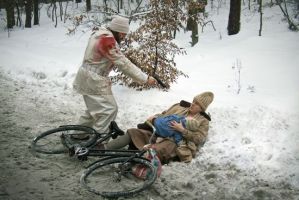 It’s not made explicitly clear whether Gallo’s character is actually deaf, but an early sound effect hints that questions in any language sound like tinnitus. When Mohammed, wounded and terminally exhausted, stumbles into a remote farmstead and at last finds a friendly welcome, it’s from a woman (Emmanuelle Seigner) who is herself symbiotically mute. Skolimowski has said that he is not interested in pushing a political agenda. But while of course not articulated, either by him or his characters, the film’s argument would seem to be that between East and West there is no possibility of communication other than through the language of violence.
There are buried hints that Gallo’s character need not be seen exclusively as a Muslim. Depleted by starvation and bitter cold, at one point he accosts a woman by the roadside who has stopped to feed her baby (pictured above). The disturbing image of a grown man fastening for dear life on a lactating nipple evokes nothing so much as St Bernard of Clairvaux suckling the milk of the Virgin (albeit not, as here, at gunpoint). Skolomowski’s feel for Christian symbolism doesn’t stop there. While the film has enough vestigial elements of a thriller to discourage revelation of the ending, it gives nothing away to say that the last stage of Gallo’s journey involves a white charger reminiscent of an Arthurian knight’s celestial mount.
Beautifully shot by Adam Sikora, with a performance of feral intensity from Gallo, Essential Killing is as determined to work creatively within its own parameters as Mohammed is to survive within his. But for all its allegorical heft, it never finally shucks off the impression that it is a well-made oddity.
Watch the trailer for Essential Killing


