

Two years after the release of Fantastic Beasts and Where to Find Them, we return to the Wizarding World once again for the next, somewhat convoluted, chapter in the five planned prequel instalments, with Fantastic Beasts: The Crimes of Grindelwald.
film reviews
Nick Hasted

The first Suspiria was a sensation, and spectacularly, monomaniacally new. Its young heroine Susie Bannon’s ride from an innately hostile airport through eldritch woods in which a panicked girl ran from her destination, the Markos Academy of Dance, as Goblin’s rock score gibbered and pounded at the senses, was hysterical, relentless film-making.
Nick Hasted

Steve McQueen’s progress from video artist to Oscar-winning director has been deceptively smooth. The chasm between Bobby Sands’ emaciated martyrdom in his feature debut, Hunger (2008), and a star-packed heist film seems still greater.
Adam Sweeting

The trailer for Overlord promises havoc, horror, evil, madness, terror and rage, and to be fair it delivers on most of those.
Graham Fuller

A revelatory moment comes hallway through Wildlife when frustrated American housewife Jeanette Brinson (Carey Mulligan) is observed standing alone in her family’s backyard by her 14-year-old son Joe (Ed Oxenbould), the film’s anxious, steadfast protagonist. Wearing curlers, an off-white sweater and jeans, her face made-up to go out, Jeanette has a harsh, fatalistic look on her face that is new.
Veronica Lee

Considering how the UK prides itself on having created the "Mother of Parliaments" and its citizens having once chopped off a king's head for thwarting its will, remarkably little is taught in our schools about one of the seminal events on the way to fully democratising this country: the Peterloo Massacre.
Tom Baily

The Yukon Assignment tracks a 500-mile canoe journey along a remote river in Canada taken by a British adventurer and his father.
Marina Vaizey

What a charmer! An irresistible combination of diffidence and confidence, Michael Caine is so much more than Alfie, and this surprising book, his second after a delightful autobiography, is multi-layered, filled with tips for acting, on stage and screen.
Owen Richards

If a Queen biopic called for drama, scandal and outrage, then Bohemian Rhapsody spent its fill in production. Several Freddies had been and gone, rumours swirling about meddling band members, and then director Bryan Singer’s assault accusations caught up with him. In a way, it’s impressive the film came out so coherent.
David Kettle

Matthew Holness clearly knows a thing or two about low-budget British horror from the early 1970s. In TV comedy Garth Marenghi’s Darkplace he was as merciless as he was affectionate in ripping the genre apart. His debut feature as writer-director is an odd, woozy creation that pays just as overt homage, but Possum is in another tonal world altogether – one that’s brooding, clammy and unremittingly grim.
Former children’s entertainer Philip – disgraced, though we’re left to guess precisely how – makes a physical and psychological return to the charred, crooked remains of his boyhood home, carrying a big, brown leather bag. Try as he might, however, he cannot rid himself of the bag’s appalling contents, his most grisly and most personal creation: a spider-bodied, human-headed monstrosity of a puppet he names Possum. Philip unearths the book in which he detailed Possum’s dark mythology as a boy – and faces another dark ghost from his childhood, his repulsive uncle Maurice.
Holness gets exceptional performances from his two leads in what’s essentially an extended two-hander. Sean Harris is compulsively watchable as the wiry, nervy, deeply troubled puppeteer Philip, gifted with a stare so empty it’s ghastly, and with jerky, mechanical movements that make him seem much like a marionette himself. (How a figure so shambling, withdrawn and damaged could ever have been a children’s entertainer, however, is hard to imagine.) Arguably playing the role of Philip’s puppet master is Alun Armstrong (pictured below) as the wheedling, needling Maurice, spitting out opaque, Beckett-like lines with a snarling contempt, and always ready with the skin-crawling offer of a treat from his sweetie jar.
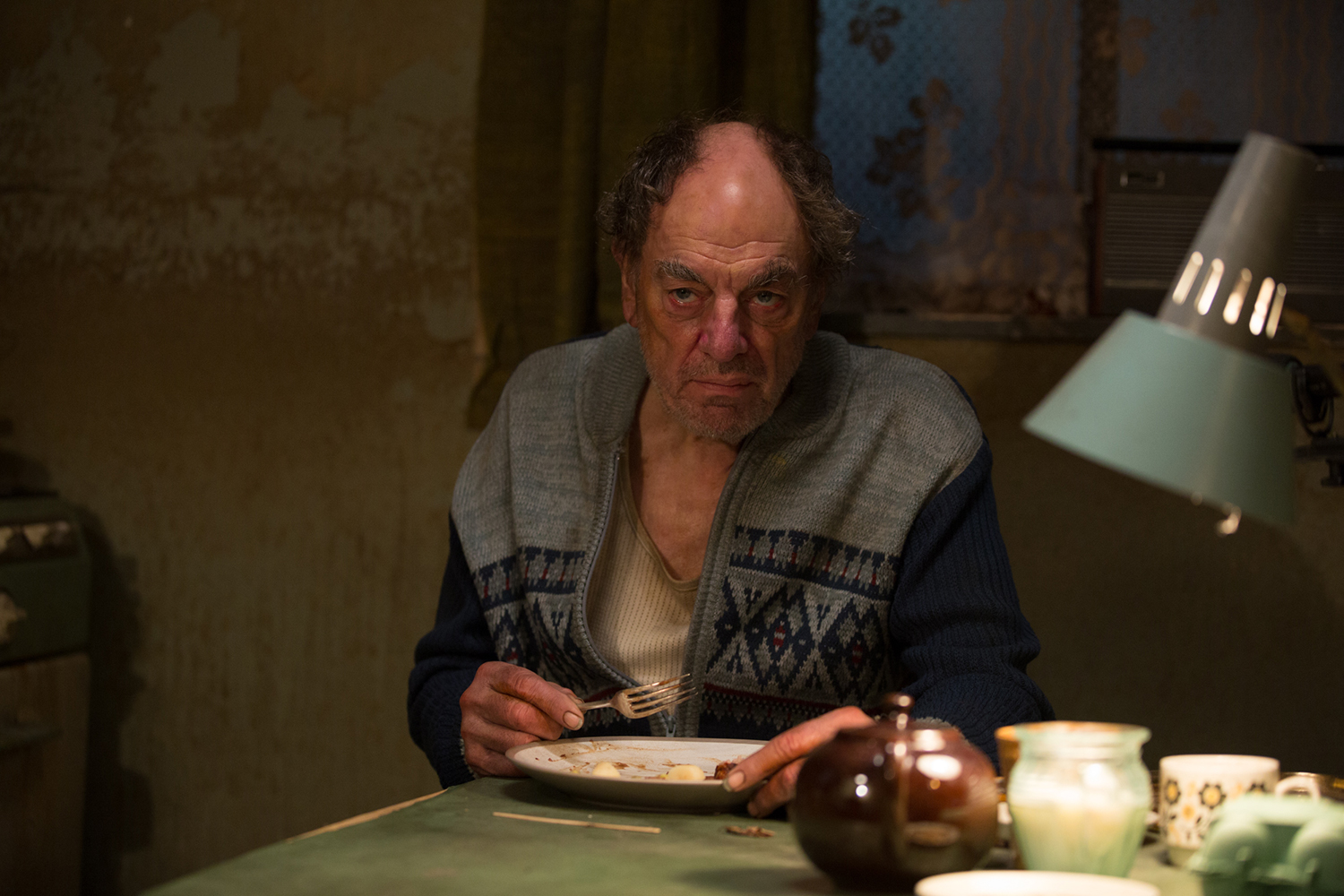 Despite his two compelling leads, however, Holness struggles to deliver on the film’s slow-burning and quite lengthy set-up. Indeed, despite its relatively brief 85-minute length, Possum feels more like a short film that’s been stretched than a fully fledged feature. Moreover, its cloying evocations of atmosphere and dread, and its suggestions of imminent jump-scares (few of which, thankfully, materialise), end up far stronger and more memorable than its brief but brutal pay-off.
But despite its unapologetic cap-doffs to the 1970s – its music from the Radiophonic Workshop, nods to the well-meaning terrors of public information films, stylised opening credits and stomach-churning palette of sickly greens and browns – what emerges in Possum is an examination of neglect and abuse that feels entirely of our own times. It’s a theme that’s only emphasised by the film’s own relentless, inescapable cycles of horror and dread, even if they finally make the movie rather repetitive.
Possum is far from flawless, but its suffocating journey into a shadowy maze of abuse and regret serves to infect the mind long after the movie’s over.
Overleaf: watch the trailer for Possum