
Echoes of Phil Kaufman’s 1983 classic The Right Stuff resonate through Damien Chazelle’s new account of how Neil Armstrong became the first man to walk on the moon.
film reviews
Tom Birchenough

For all the bleakness of its subject matter, there’s considerable exhilaration to Ali Soozandeh’s animation feature Tehran Taboo. That’s due, in part, to the film’s breaking of many of the official “rules” of Iranian society, the myths of the theocracy that can’t, and don’t conform with the realities of human life. But there’s something wider as well, almost Dickensian, as the director presents his varied cast as players in a big city drama in which the Iranian capital itself becomes a protagonist, an entity bubbling with life, most of it “not conforming to Islamic virtues”.
But what otherwise might end up as a piece of dark realism, thanks to its technique becomes a varied and somehow irrepressible viewing experience. The film’s use of rotoscoping – it was shot by Austrian cinematographer Martin Gschlacht, who filmed live images that were redrawn by computer animation into visual forms – gives it a remarkable fluidity and lightness. It also has the undoubted advantage, for a film made in Europe by a longterm exile form Iran, of giving its participants anonymity; location shooting in Tehran would clearly have been impossible, but the drawn street scenes we see here are a creative reinterpretation that absorbs us no less.
The immediate consolation that 'Tehran Taboo' offers is aesthetic
Animation also surely offers a different level of engagement for viewers than strict realism; while the result is not exactly sanitised, it certainly has us perceiving what we see – which is frequently difficult or painful material – in a different light, though critique is never lost. A decade ago, Marjane Satrapi and Vincent Paronnaud’s Persepolis gave a somewhat similar glimpse into an earlier generation of Iranian society, while this summer Nora Twomey’s The Breadwinner revealed the oppressions of a girl’s life in Taliban-controlled Kabul.
Soozandeh’s opening scene certainly gives a hint of what is to come, as we witness a taxi-driver bargain with his passenger for sex, the difference here being that the prostitute concerned, Pari (Elmira Rafizadeh), has her five-year-old son, Elias, in the back seat, a (literally) mute witness to everything going on around him. Then, their business bathetically underway, the driver catches sight of his daughter walking with a man he doesn’t know, and launches into a tirade at her lack of respect for the codes of society.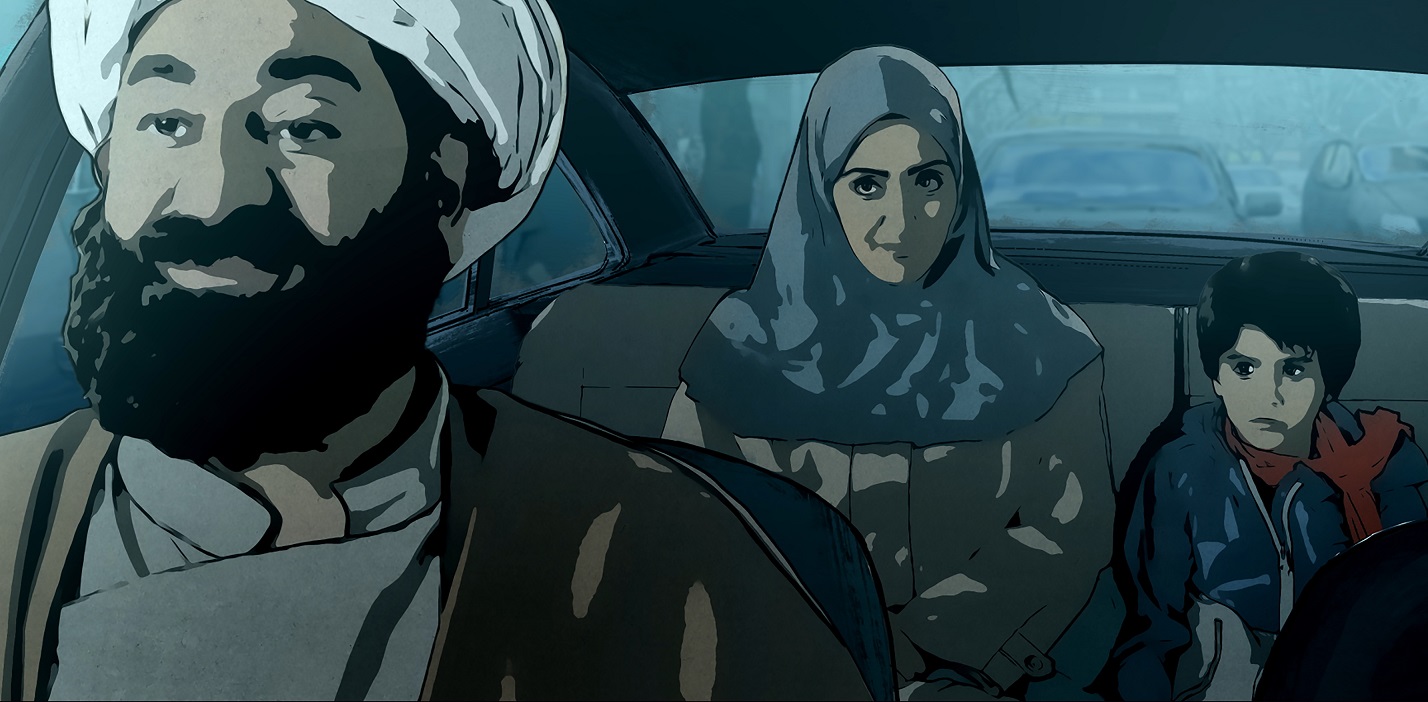 That hypocrisy, covering the male half of the population and its almost total control over women’s lives, is indicative. Pari has a drug-addict husband in prison, but her divorce can’t proceed until he signs the papers. Her appeal to a Revolutionary Court judge is met with the counter proposal that she become his concubine, and he sets her up in an apartment (pictured above, the judge, Pari, Elias). The neighbours there are a respectable family – though there’s male hypocrisy there, too – and a friendship grows between Pari and Sara (Zara Amir Ebrahimi), the daughter-in-law of the house, while Elias comes to feel at home in both apartments.
But even in that secure, cultured family environment, Sara’s life is heavily restricted: she can’t take a job without written permission from her husband, who expects her to stay home and prepare for the birth of their child. While Pari seems to have an invincibility that makes her able to resist everything that fate throws at her – her heavy make-up is both disguise and protection – Sara is more vulnerable. The sense of the bonding between these two women from very different worlds is the best thing in Tehran Taboo, caught in a lovely scene where they go out for a meal, unaccompanied by men (pictured below).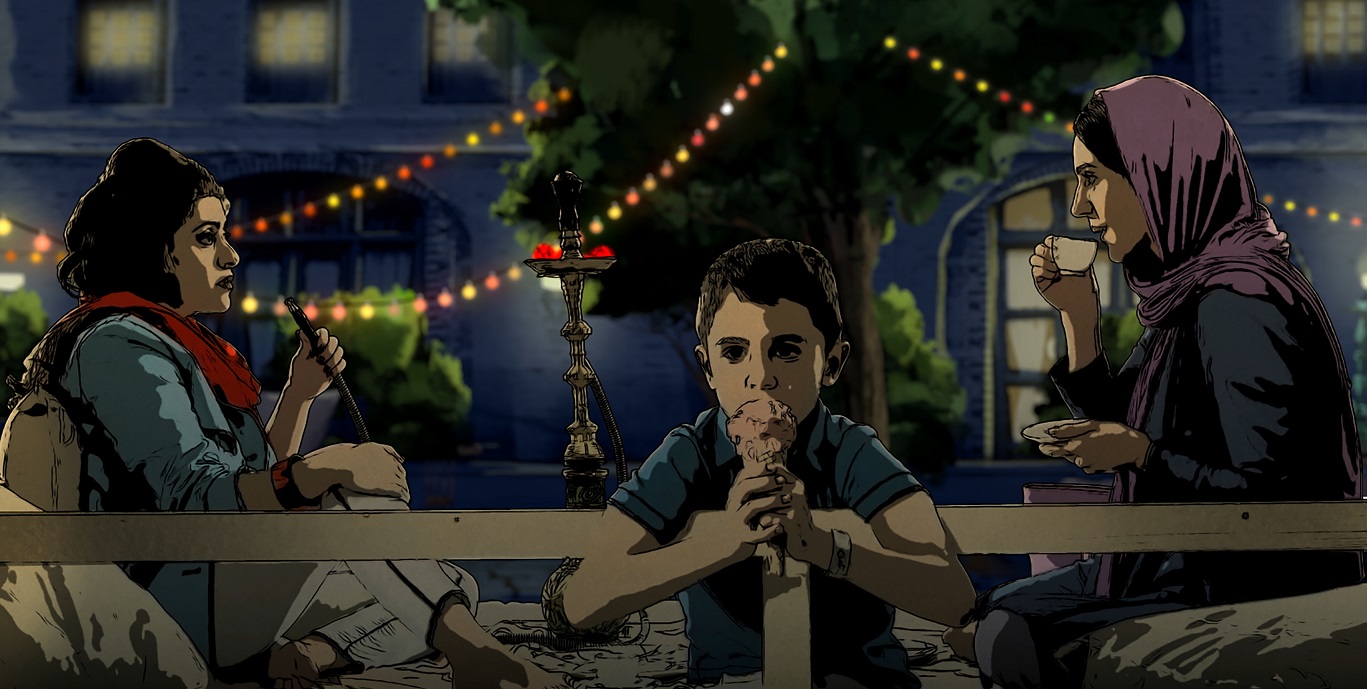 A third story strand, about a young musician, Babak (Arash Marandi), starts separately, before it gradually enmeshes with the world of the two women. Babak belongs to the underground music world, where clubs provide a place of release for the otherwise restrained energy of the young. Relaxing after playing at a rave, he encounters Donya (Negar Mona Alizadeh); encouraged by pills, the two have uninhibited sex. Hardly what you expect of life in Iran? Perhaps. What follows is, however, when she tells him the next day that she is about to be married, and needs to have her virginity restored for her husband-to-be. So begins a frantic search – the fact that Babak acknowledges his responsibility is the only time a man behaves nobly here – which takes in everything from black-market, Chinese-made hymen restorers to the sleaziest depths of under-the-counter surgery. (Pictured below, Babak and Dounya)
At every stage in Soozandeh’s saga, whenever his characters encounter authority, their only remedy is corruption: the only way life can be ameliorated in so nominally strict a society is bribery. Authority, and the absurdity of its tenets, ends up mocked in the form of anecdote, to which it responds by bringing punishment into the open: we witness a public hanging. It’s a society so controlling that escape appears the only option, if you're lucky enough to be able to arrange that. But flight comes in different forms… 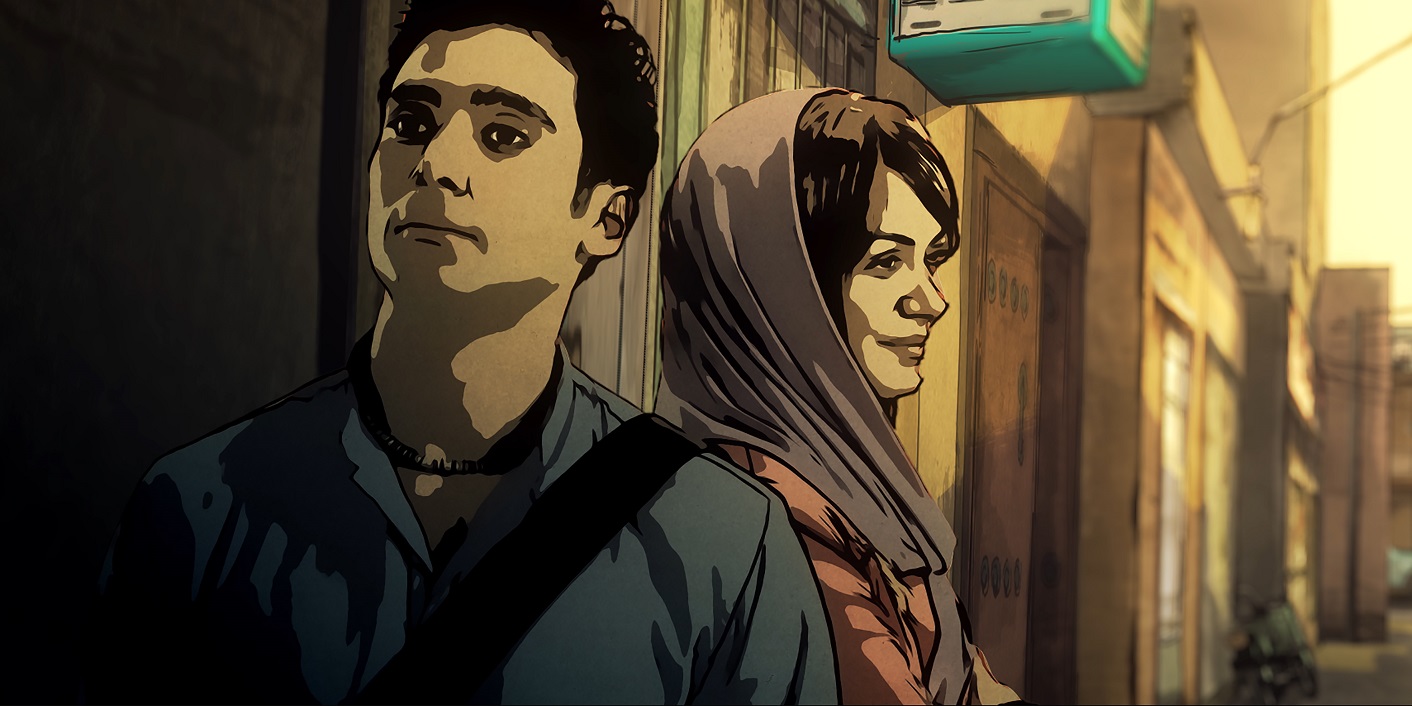 Strange though it may sound, the immediate consolation that Tehran Taboo offers is aesthetic. The chaos of Tehran’s street world is something viewers know from contemporary Iranian cinema (not least Jafar Panahi’s Taxi Tehran: the somewhat episodic nature of Soozandeh’s film, landmarked by recurring photographer’s images, recalls that work), but animation presents it all in a different light. The sheer range of colours – the yellow of the city air, the green of dawn, the red neon roof light that marks one key location – are somehow hues of comfort. The brushwork with which Tehran Taboo draws both its characters and visual world is beautiful, but it’s only the ebullience of the latter that overcomes the desperation of the former.
Overleaf: watch the trailer for Tehran Taboo
Matt Wolf

"It's the same old story, told over and over forever": So remarks the redoubtable Sam Elliott late in the most recent reboot of A Star is Born, which itself manages to take an oft-told story and reinvent it very much afresh.
Sarah Kent

Wearing a red dress covered in black polka dots and a bright red wig, Japanese artist Yayoi Kusama sits drawing, a look of intense concentration on her face. It takes her three days, she says, to finish one of these huge repeating patterns (main picture) and ideas pour out faster than she can realise them, even though she works all day, six days a week.
Matt Wolf

Veronica Lee

Even for those with only a passing acquaintance with Irish history, the Famine – or the Great Hunger – looms large, when British indifference to the failed potato crop in large parts of Ireland resulted in the deaths or emigration of nearly a quarter of the country’s population in the 1840s and 1850s.
Markie Robson-Scott

“Let’s get a clip, Long Island.” One New York skateboarder encourages another, who’s from the ‘burbs, to show off ollies, pop shuvits and kick-flips for a YouTube video. But hang on: “There are too many penises in the way.” This is a posse of young women, a rare sighting in the male world of the skate park.
Jasper Rees

Domnhall Gleeson needs to watch it. In Goodbye Christopher Robin he played AA Milne, the creator of Pooh and co. To achieve the correct level of period English PTSD, it was as if he’d folded himself up into a neat pile of desiccated twigs. And now he’s gone and done it again in The Little Stranger, only more so.
Owen Richards

Why is M.I.A. such a problematic pop star? Why can't she just shut up and release a hit? Tellingly, this is the very question the singer poses at the start of Matangi/Maya/M.I.A - a question she's been asked throughout her career, from interviewers to management.
Tom Birchenough

On the eve of her tenth decade, the marvellous Agnès Varda embarked on the enchanted journey that we see in Faces Places. For admirers of the great French director – of whom there are a great many: indeed, it is hard not to be won over by her resolutely independent, profoundly humanistic substance and style – its spirit will recall her two earlier documentary films of the century, The Gleaners & I (2000) and the more autobiographical The Beaches of Agnès (2008), though the mélange between personal and social is here complete. This is a journey that celebrates a life richly lived as well as the human interaction, the delight in the sheer richness of humanity, that has always been inseparable from that existence.
The difference from those previous films is that in Faces Places Varda does not travel alone, her companion here the vivacious photographer JR, a half century her junior: she has seen “88 springtimes”, he is 33. (Quite how they met is shrouded in a whimsical series of opening episodes charting how they didn't meet, including an irresistible disco scene with the veteran Varda gamely bopping the dance floor.) JR’s speciality is large-scale photo portraiture, created in the most democratic style possible: he drives a special photo-camion, designed to resemble a camera, complete with photo booth and equipment which produces, directly out of the side of the truck, huge prints for pasting on walls,. Or any other suitable surface, since his speciality (aided by a team of assistants) is plastering his images – which can be anything up to ten times human scale – on anything, from gasometers to train wagons. Portraits in landscape, as never before.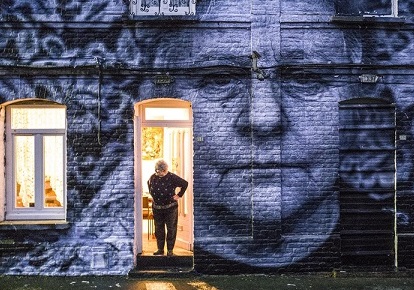 It’s their shared interest in their subjects – hardly the right word, when collaboration is so close – that makes this pairing ideal; these are not artists working on their own, but creators of events. “To meet new faces,” is how Varda expresses the resolve behind their road trip, its destinations better caught by the film’s French title, Visages Villages. No big city monotony here, rather an exploration of rural France, its singularities and personalities relished to the full.
Was there a guiding concept behind their journey, as they travel from the declining mining communities of the North to the villages of the South, where a sense of profound permanence seems to reign? Hard to say, when chance (“We enlist it as an assistant!”) so clearly played a role. In each location, JR and his team create small monuments to individuality, putting the sitters in a spotlight that nevertheless seems a natural part of their environment: they range from Jeanine, the last remaining resident in a whole row of miners’ dwellings (pictured above), through portraits of the wives of three Le Havre dockers that are emblazoned, almost 100 meters in height, across the sides of shipping containers, to the collectif of a Provence chemical factory (pictured below, with Varda and JR).
Change is a recurring motif, a level of dehumanisation noted in working life
That last detail brings home that the Varda-JR tandem does not consciously seek out any sort of rustic idyll; modernity is a natural element in these worlds, even if politics remains distant (notwithstanding any reflections we may have that some of the communities visited would surely have voted for Le Pen). And change is a recurring motif, a level of dehumanisation noted in working life: where once whole communities would have brought in the harvest, now a single farmer attends to 2,000 acres on his own, sitting atop a tractor/harvester that is fully controlled by computer.
“What is the subject, actually?” Varda muses at one point. For her, perhaps, it is in the conviction that whatever activity a human being may engage with, it should not dwarf the humanity of the individual(s) involved. Faces Places teaches us quite a lot on matters caprine, including that today’s goats often have their horns removed (burnt away, or “disbudded”, at an early age). That’s ostensibly to reduce damage when they fight, but Varda is affronted: how she rejoices when she finds a smallholder who resists all that, a place where milking by hand rather than machine is seen as the natural process. To treat someone or something as mere “product” is the worst thing of all.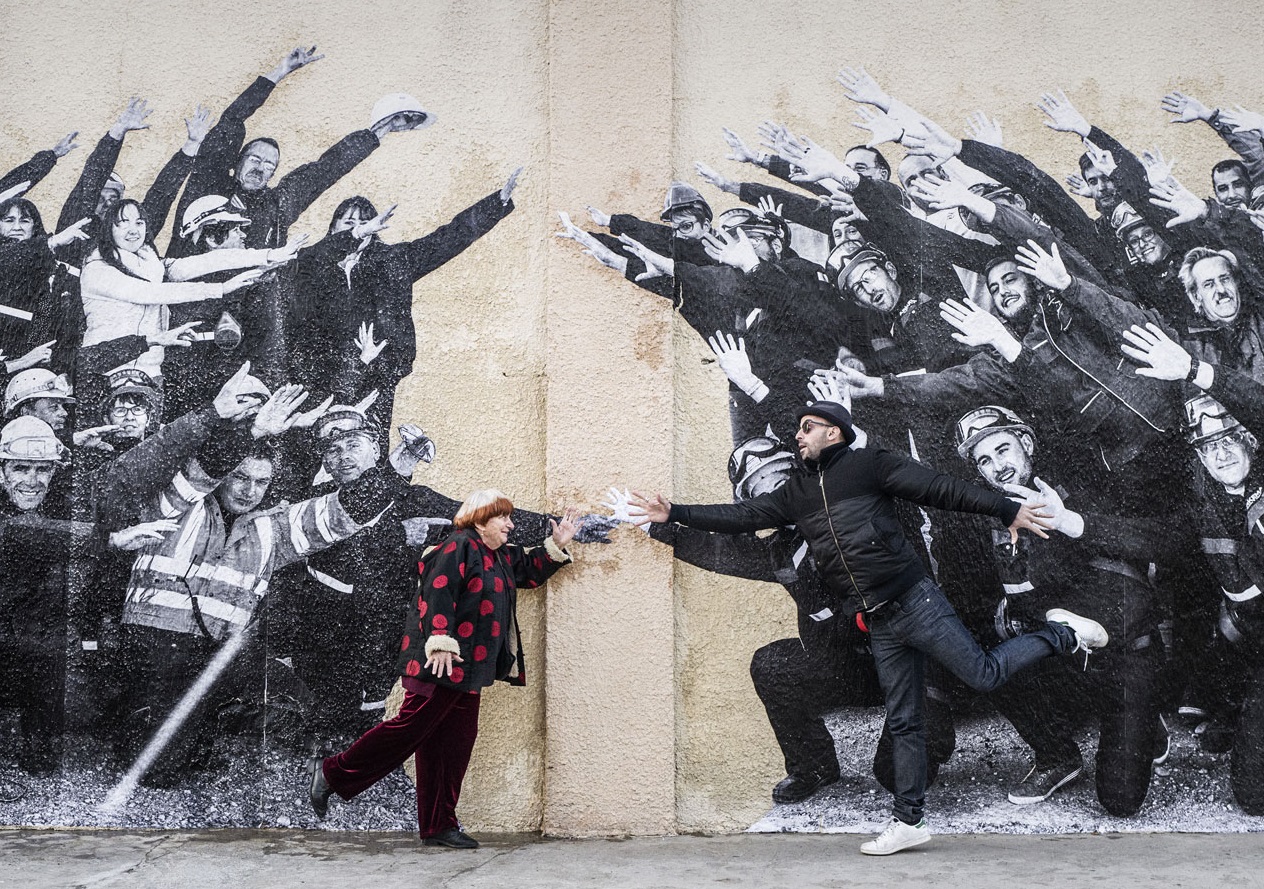 By loose extension, art becomes a catalyst that can transform the everyday. Asked by one railwayman why JR has pasted images of Varda’s eyes (and toes, too) onto the sides of chemical-storage train tankers, she replies that it is to endorse the “power of imagination”. We may perhaps wonder whether there is nevertheless an elitist concept involved somewhere, in this conscious idea that “art is for everyone”, especially when promulgated by France’s generous funding regime. But Varda’s film brings home how that can never be the case when everyone is involved (the film’s crowdfunding element is surely as appropriate here as the concept has ever been).
Faces Places is also a picaresque story of bonding between two individuals, their symbiosis of engagement with those whom they encounter reinforced by the gentlest of teasing. Both look with such curiosity at the world around them, that issue of vision associated both with Agnès’s failing sight and JR’s reluctance to take off his dark glasses. That latter strand harks back naturally to Varda’s 1961 burlesque film-within-a-film, Méfiez-vous des lunettes noires (Beware of dark glasses), in which Jean-Luc Godard, no less, starred with a Keatonesque charm, a quality singularly lacking in his behaviour in the final scene of Faces Places. It proves a rare moment of sadness in a work where these two presences, perfectly accompanied by Matthieu Chedid’s string score, are so entrancingly life-affirming. If ever a film could promise you une bonne journée, it’s Faces Places.
Overleaf: watch the preview for Faces Places