We have plenty to be paranoid about in the most surveilled country in the world. British contributions to the conspiracy thrillers that bloomed so fruitfully in the US around Watergate have, though, stayed slim. Maybe that’s one reason Closed Circuit’s extreme Secret Service behaviour in the aftermath of a bomb atrocity at London’s Borough market feels so fake.
CIA agents snuffing out inconvenient people on city streets is cinematic second nature. MI5 hunting Eric Bana and Rebecca Hall’s high-powered barristers through Dalston back-alleys takes more swallowing. So does some of the dialogue in Steve Knight’s bumpy script, despite having Jim Broadbent, Anne-Marie Duff, Ciaran Hinds and Julia Stiles to help speak it.
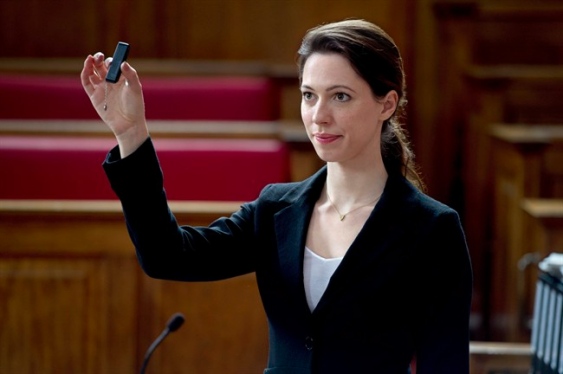 Bana and Hall (pictured right) are excellent as ex-lovers Martin Rose, the defence for surviving bomb plotter Farroukh Erdogan (Denis Moschitto), and Claudia Simmons-Howe, the Special Advocate defending him in closed court. The potential for abuse and fundamental unjustness of the latter process when dealing with alleged terrorists is one of the film’s most fascinating themes, if it only had the courage to stick with it. Aussie Bana particularly enjoys Rose’s blowhard articulacy, barely hiding bitter vulnerability after a work-wrecked marriage, and theatre aristocrat Hall (Sir Peter’s daughter) matches his comfort at posh, powerful sparring. Riz Ahmed’s nervy, dangerously idealistic MI5 man, Ann-Marie Duff as his venomous boss and Jim Broadbent’s oily Attorney General (pictured below), with so many Tory and New Labour apparatchiks to inspire him as he bullies and lies with a beaming smile, are also fine. But though writer Knight’s work include London thrillers Eastern Promises and Dirty Pretty Things and Brum gangland saga Peaky Blinders, there are leaden lines the cast deserve danger money for lifting.
 Closed Circuit’s head-thumping improbability as a thriller also stands in stark contrast to its great efforts at legal realism. MI5’s reasons for a post-bombing cover-up which develops into an attempted mid-trial massacre of anyone who knows what they’ve been up to are convincingly extreme, and the idea of British agents being so ruthless on British streets is usefully challenging. James Bond’s sprint down Whitehall to protect the liberty of the British state in Skyfall is turned inside-out. But when the intended victims are Julia Stiles’ top New York Times reporter, and Bana and Hall’s elite lawyers on what is repeatedly called the Trial of the Century, Stalin’s KGB seem better candidates for the job. As blundering hitmen attack our heroes the night before the trial, a phone-call to any newspaper would make their deaths instantly unthinkable. D-notices be damned. They’d have to blow up the printing presses (and the internet) to stop that coming out.
Director John Crowley’s previous film Is Anybody There? combined bleak, comic and sentimental moods as Michael Caine declined in an old people’s home. Closed Circuit feels compromised and half-cooked. Walking out of one of Closed Circuit’s inspirations, the fine British conspiracy thriller Defence of the Realm, in 1986, newsstand headlines of the nearly government-toppling Westland affair greeted me, and film and murky reality seemed to merge. No chance of that here.
Overleaf: watch the trailer for Closed Circuit


 There's an equally economical set-up sequence of the Somali pirates ashore. They're depicted as impoverished, desperate and driven to bloody competition by bandit leaders to fight for places on the hijacking boats, which amount to their own brutalised version of the National Lottery. They're all zapped on khat, which they chew perpetually. The convergence of the twain unfolds inexorably amid steadily-ratcheting tension, with Greengrass deploying juddering hand-held camerawork and seasickness-evoking speed-cutting to formidable effect.
 A battle of wits ensues as Phillips lures the pirates, led by the sinister and skeletal Muse (Barkhad Abdi), away from where the rest of his crew are hiding, and tries futilely to buy them off with the wad of cash in the Alabama's safe. Fast forward to the skipper in the lifeboat with the bandits, heading back to the Somali coast, as the episode escalates into a major international incident. Soon the little craft is surrounded by a US Navy task force, while a SEAL team (appropriately led by Max Martini, reprising his character from TV's The Unit) is parachuted in to take control. As the pirates grow increasingly hysterical and unstable, the Navy remorselessly turns the screw. The director subtly plants the question of how much force is too much, and lets you take it away with you.