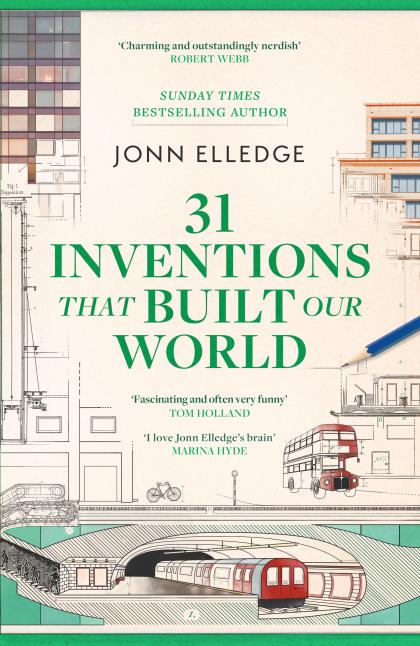
Jonn Elledge has two main virtues as a writer of general interest non-fiction: an insatiable curiosity about the world, and an ability to share the fruits of this curiosity like the best kind of pub companion. He’s knowledgeable and interesting, but never patronising nor highfalutin. 31 Inventions that Built our World, the thoroughly enjoyable follow-up to his A History of the World in 47 Borders (the progression of the titles suggests that in two books’ time he will be into negative numbers), has a similarly wide sweep geographically and historically, with the central mission here to explain how the things that make modern city life possible came to be. He does this through short chapters on the emergence of features such as water supply, heating, lighting and urban transportation.
He largely focuses on the physical world, eschewing services and utilities (or the list would have to have been much longer than 31), although it does feel like “money” and “government” are considerably more essential to the flourishing of cities than, say, lifts and escalators. But Elledge sets his own terms, and that is fine. Historically he goes back as far as 5000 BCE to identify Uruk in Sumeria as the first city, but much of his attention is focused on New York and London of the 19th century, hotbeds of innovation, for advances such as sewerage systems and underground railways. Elledge’s conversational tone – he likens a medieval pope deliberately handing out contradictory instructions as “a messy bitch” – and eye for a story are what keeps the book moving. The story of Charles Julius Guiteau’s assassination of President James Garfield is not entirely germane to the development of air-conditioning, but it was clearly too extraordinary for Elledge to resist.
Throughout this book, which slips down like a cool drink on a warm day, Elledge is the most genial of companions, his tone conversational and confiding. As well as the big picture he offers delightful insights and asides. I’m not going to tell you what invention biologist Steve Jones thinks might be “the most important event in recent human evolution”, the derivation of the word “curfew”, and how buses are like crabs, but they are all revealed in the book. What is also enjoyable to spot is how history, as they say, rhymes: the (loutishly criminal) public response to the installation of Belisha beacons on Britain’s roads was exactly the same as to the fixed cameras that enforce the London Ultra-Low Emission Zone.
Elledge is at his most impassioned and polemical in the chapter on cars, which though essential to the development of cities (especially in America), have also, in Elledge’s view, done untold harm, not just to the health of the population but also in turning the streets from a shared space into the exclusive realm of motor vehicles. Regardless of how you feel about Elledge’s views on cars (to my mind he is unarguably correct, but there are of course millions who idolise the automobile) it is refreshing to have these heartfelt chapters (on the cars themselves, and the freeways, and the issue of parking in cities) alongside the lighter chapters on, say, the London Tube map, which give Elledge ample opportunity to nerd out to his full extent.
- 31 Inventions that Built of Worldby Jonn Elledge (Wildfire, £25)
- More book reviews on theartsdesk