“How easily one thing grows into another,” sings abandoned Ariadne on her desert island before the advent of Bacchus quells her morbidity and rekindles her lust for life. In Richard Strauss’s Ariadne auf Naxos, all sorts of things have convincingly to change shapes and swap places for the opera to soar: comedy and tragedy, of course, but also fidelity and frivolity, heroism and slapstick, the lyrical and the louche. Above all, art and love must achieve the “mystery of transfiguration” that enables rebirth.
When Glyndebourne brought their new production to the Proms last night, the music – and the singing, delivered by a vocally outstanding squad – triumphantly mastered those magical metamorphoses. Laurent Pelly’s over-emphatic production sometimes got in the way, although Paul Higgins’s semi-staging for the Royal Albert Hall seemed to me to have softened some of the indigestible pseudo-comic gristle that stuck in my colleague David Nice’s throat in Sussex last month. I found enough credible pathos and mixed emotions in the acting too – however, I never want to see any supernumerary wheelbarrows trundled pointlessly over an operatic stage again. Comedy, dear directors, is about bringing out what’s already suggested in text and score, not chucking in random wheezes.
The Prologue, in which a high-minded opera seria troupe and a cabaret outfit discover that they have to mash up their respective offerings into the same show for a plutocrat’s soireé in Vienna, summoned for me the shade of the much-missed Tom Stoppard. Not only a miracle-worker at scrambled genres and dramatic gear-shifts, Stoppard was also an admirer of Strauss’s librettist Hugo von Hofmannsthal – almost the sardonic presiding spirit of his final play, Leopoldstadt. What an adaptation of Ariadne he might have devised (he did once write a narration for a Glyndebourne Merry Widow, spoken by Dirk Bogarde).
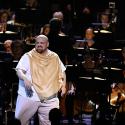
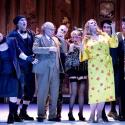
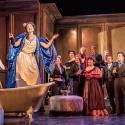
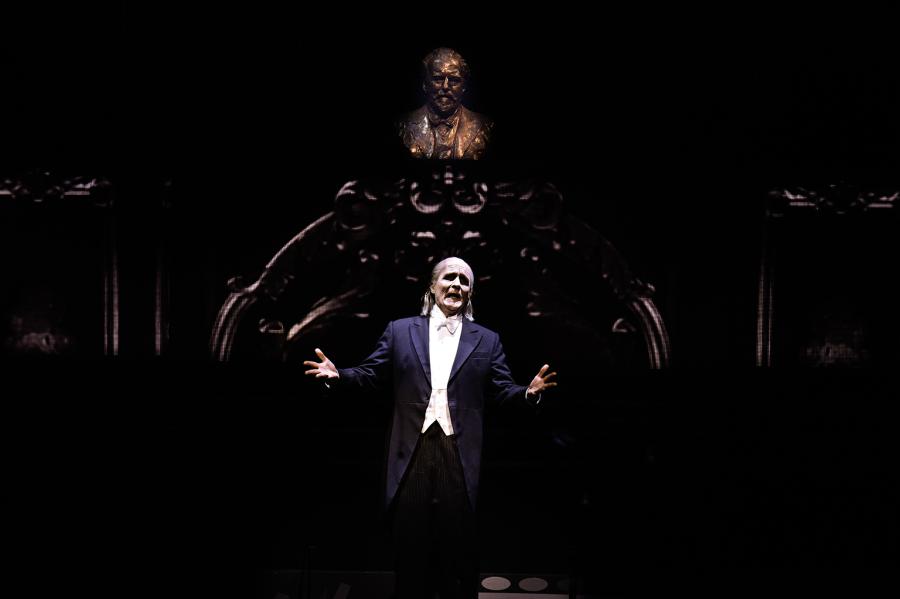
You do need a deft Stoppardian touch for these backstage, meta-theatrical shenanigans, as posh and pop art collide before (apparently) coming to a reconciliation. Michael Kraus’s strongly-sung Music Master showed almost too much restraint for this farcical milieu, while William Relton – in the spoken role of the Major-Domo (pictured above) – robustly earned his laughs as rasping household bully but sometimes edged too far into pure Cabaret territory.
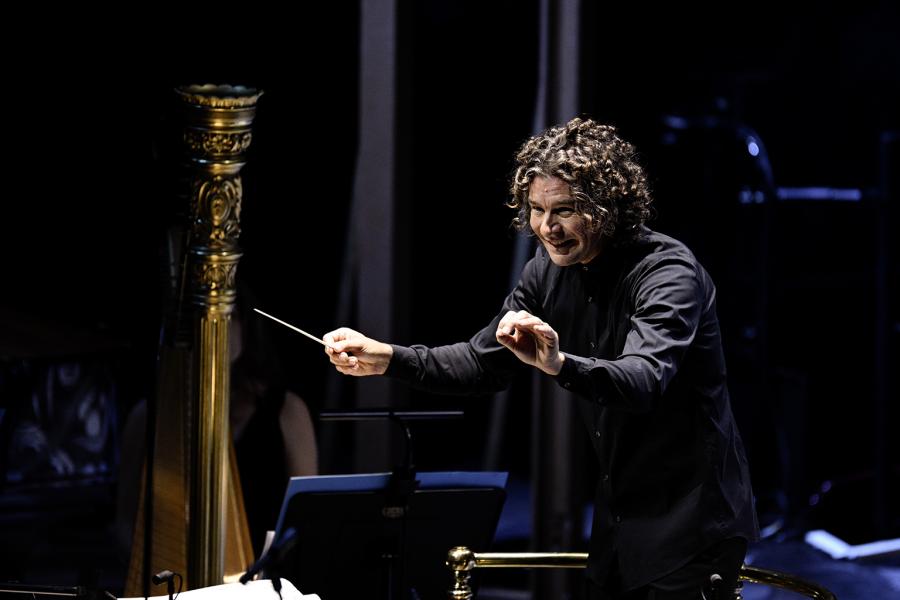
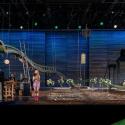
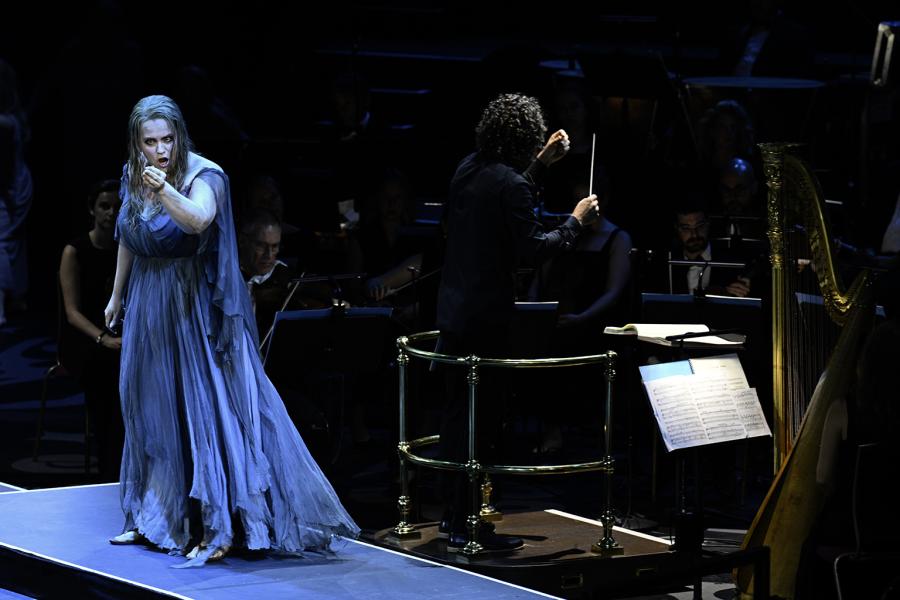
The onstage doorway added little to the action, and the bustling to-and-fro of flunkeys injected more stage busy-ness pretty much for its own sake. However, from the opening bars, Robin Ticciati (pictured above) conducted the string-light, woodwind-heavy London Philharmonic Orchestra in a truly ravishing rendition of the score. Given their stage prominence, their quality made the whole performance more of an audible collaboration of singers and players that a procession of accompanied set-pieces. Voices and orchestra established, and kept up, a satisfying equilibrium. No singer sounded overwhelmed by the vast hall.
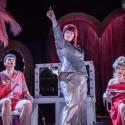
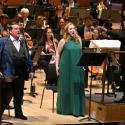
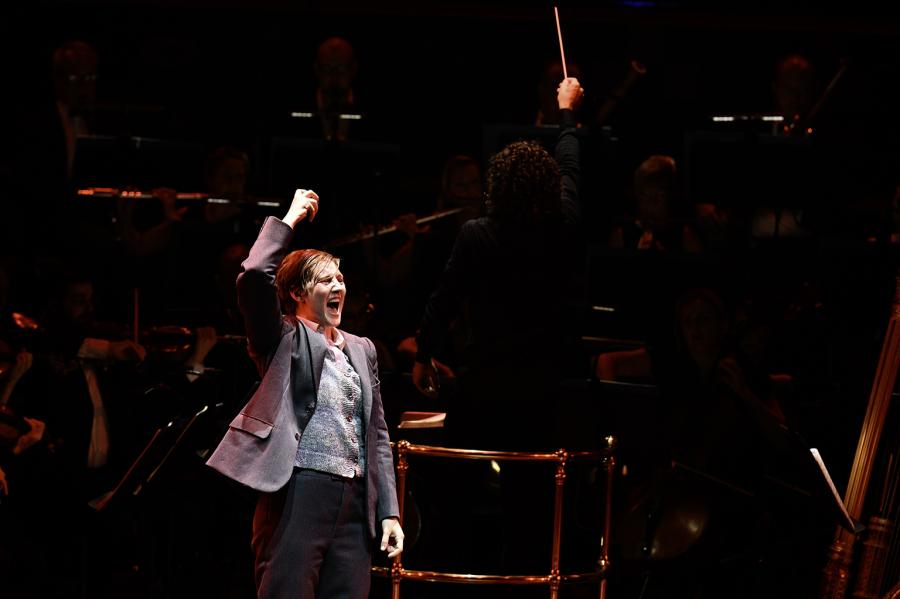
However, it’s the outraged pride and vehement aesthetic idealism of the Composer that must command the Prologue. Samantha Hankey’s ardent, full-bodied mezzo did (pictured below). She rose gradually from petulance into a kind of grandeur, although we know that, in this binary-busting opera, the claim that the votary of high art has “nothing in common” with the world of vulgar entertainment will not stand. Her aria “Sein wir wieder gut” had compelling presence, poise and authority.
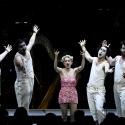
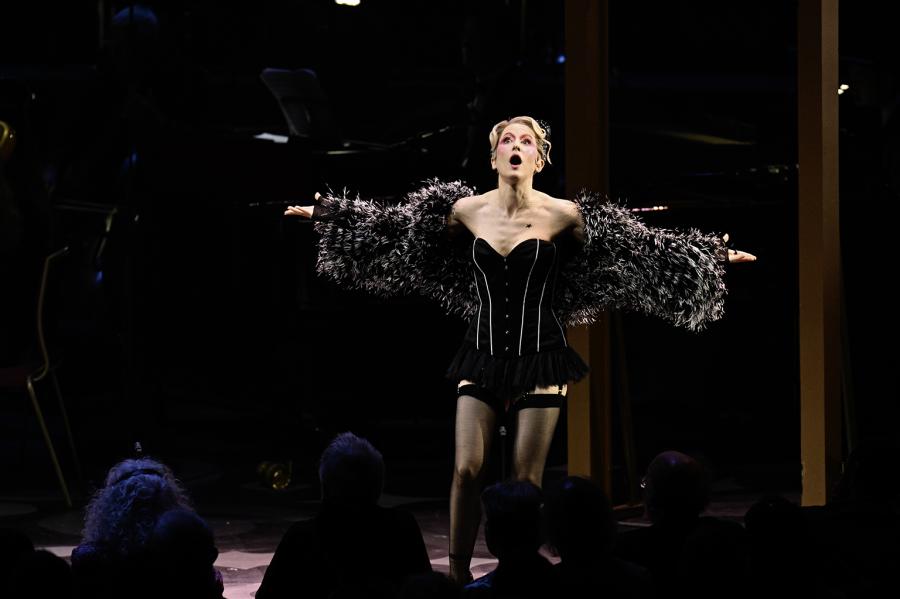
As Zerbinetta, sassy and worldly leader of the commedia dell’arte clowns, Alina Wunderlin’s queen of showgirls bounced around with bags of impudent charm (pictured below). In her exchanges with the Composer, she did nevertheless start to show the deeper layers of emotion that the Opera will develop. Early on, we glimpsed the woman behind the flighty minx. In their backstage incarnations as Tenor and Prima Donna, David Butt Philip and Rachel Willis-Sørensen both hinted at glories to come, although their garish outfits and flouncing movements – as with Ru Charlesworth’s nicely executed Dancing Master – again appeared to be trying a little too hard. Audiences can see, and hear, gags without this degree of frantic prompting.
In the Opera, forsaken Ariadne yearns for death after Theseus’s desertion, only for Zerbinetta and her quartet of vaudeville chums to break in with their cheer-up act. Soon the young god Bacchus lands to galvanise the glum princess, and confirm the showgirl’s maxim that a new squeeze can always wipe out regrets for the old. Once more, we need a Stoppardian agility to leap through these abrupt tonal transitions, and the staging didn’t always supply it. Acting and singing, however, did – all boosted by Ticciati’s dexterous direction of a score rammed with bittersweet ambiguities that the LPO players projected with unflagging relish. Horns, strings, bassoons, clarinets, flutes, not to mention the reduced string team led by the inimitable Pieter Schoeman: we heard biting irony and lush sincerity, wit and depth, sparklingly combined, whatever might be happening front-of-stage.
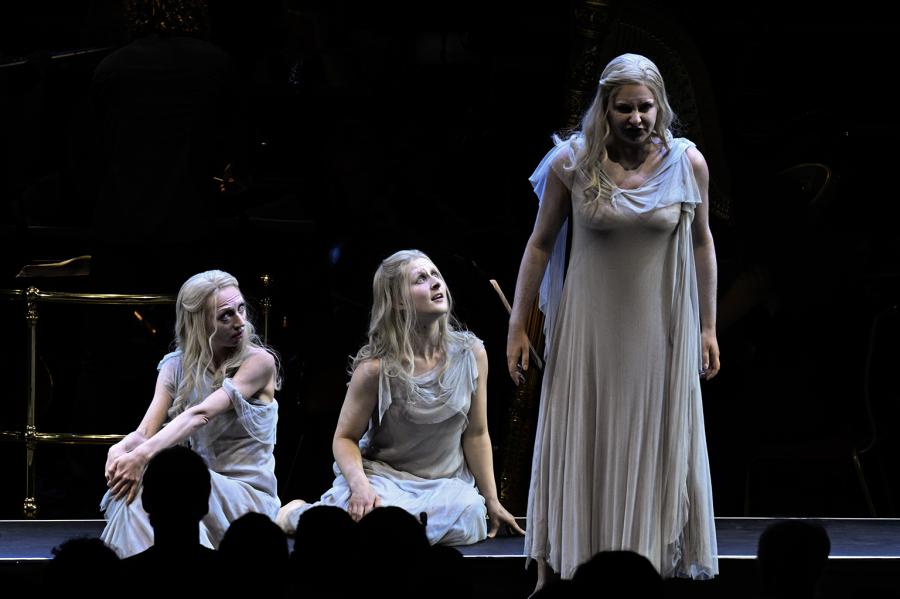
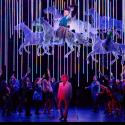
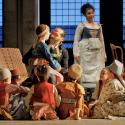
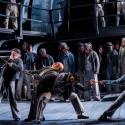
Although, as Ariadne and Bacchus, Willis-Sørensen and Butt Philip didn’t perhaps gel as fully as they might have done, as individual performers both excelled. I used to listen to Jessye Norman owning “Es gibt ein Reich” long before I knew its opera, and if this Ariadne couldn’t exactly reach those heights (who could?), Willis-Sørenson’s exquisite invocation of death’s kingdom was both imperious across her range and deeply touching. As her distraught, exhausted-looking handmaidens, the nymphs – Anna Denisova, Ekaterina Chayka-Rubinstein, Eirin Rognerud (pictured above) – sang with polish and poignancy. But, soon enough, we meet Zerbinetta and her top-hatted, white-suited, white-faced quartet of entertainers, with Mikhail Timoshenko’s baritone Harlequin and Caspar Singh’s tenor Scaramuccio both voices to savour. Ticciati whisked us with nerveless aplomb from the opera proscenium to the ambience of some cheesy night-club.
As it should, Zerbinetta’s coloratura call to fun, forgetting and the transformative power of desire – “Grossmachtige Prinzessin” – both lifted the spirits and brought the house down. A spectacle herself in feathery pink, like some mishap in a candy-floss factory, Wunderlin and her impeccable vocal acrobatics still left some room for tenderness and vulnerability that grew as the evening progressed. Maybe this is Strauss’s, and Hofmannstahl's, problem: because Zerbinetta should hit it right out of the park (as Wunderlin did), when Bacchus transfixes Ariadne to prove that fresh love can indeed renew the soul, this grand finale can sound like a long-winded anticlimax.
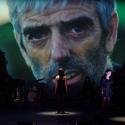
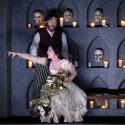
Butt Philip possesses all the heroic post-Wagnerian sumptuous elegance of tone and phrase you could crave, and his prolonged duet with Willis-Sørensen (pictured above) abounded in glorious moments. Still, I never quite felt that we saw everything we heard in these luscious voices – although the final sunrise, cleverly lit, powerfully made its transfigurative point. What we could enjoy was the sidelined Zerbinetta, ever-watchful and sardonic, who before she races into her final clinch with Harlequin gives a little shrug. Vindication? Resignation? Whatever: the new god has descended, and life resumes. Forget about the wheelbarrows. I’ll remember her.