Buxton’s summer jamboree for opera lovers this year offers a brace of baroque works, written 90 years apart, with the character of sorceress as their common feature.
Handel’s Amadigi di Gaula was one of the string of Italian operas created by him for London shortly after his arrival in Britain. First seen in 1715, it has four soloists only and the conventional unities of time and place – though early performances were apparently given with spectacular stage effects.
The sorceress, Melissa, rules a magic island where two young men and one young woman are her captives. She loves Amadigi, he loves Oriana, but Oriana is also loved by his fellow-captive, Dardano. Simple love tangle, then, and extended in typical 18th century operatic fashion, with deception, power play and misunderstanding, to exploit every emotional situation possible between the four of them. It seems obvious, when you see it, that Olivia Fuchs’s production concept of making it a TV reality show on the lines of Love Island is the way to stage it today.
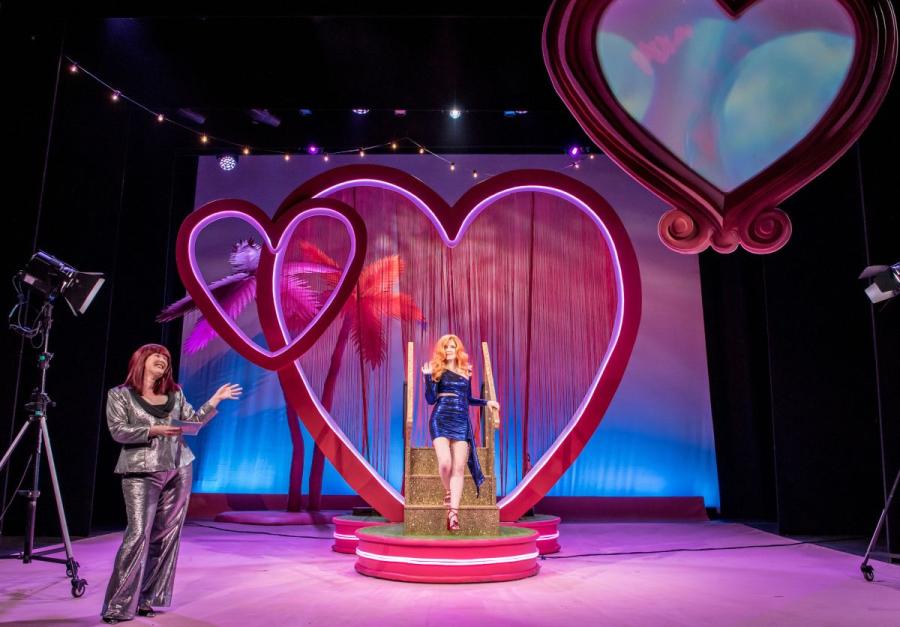
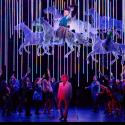
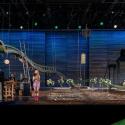
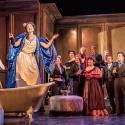
On the Buxton Opera House stage, “Melissa’s Island” as designed by Eleanor Bull (with lighting by Ben Pickersgill) is the bright and gaudy beach location we see being made ready during Handel’s overture (see picture). Camera, lights … contestants pout and pose for their introductory shots, and Melissa, in shining silver suit, is doing the presenter’s spiel (in mime). The two men whose fortunes we are to follow are best mates at the outset, and then the screen prompt tells us we’re shifting to “Day 7”, as things begin to go horribly wrong.
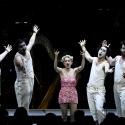
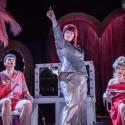
The text Handel set (no one knows for certain who wrote it) calls for a trial by fire in the first Act, as Amadigi seeks to set Oriana free. In this version there are TV “trials” entitled “Cross The Threshold” and “Free Your Love”, as Oriana’s put inside a locked cage (and cardboard “flames” are carried on to set – a rather 18th century type of scene-setting …). In the second Act, things shift off set, to the make-up room and costume store, where Melissa seeks to get her evil way by tying the unfortunate lovers to chairs with silver duct tape (see top picture). So it’s all told tongue-in-cheek with an eye to fun, but within that the music is still free to shine. Handel wrote a succession of arias exploring every “affection” the story provides: Olivia Fuchs ingeniously provides little pieces of business to accompany every da capo repeat, and the illusion is that things are always moving on, even when they’re not.
Erin Helyard conducts the English Concert to provide period sounds in the pit. Speeds are gratifyingly lively when required, and in the performance I saw the slower arias were given full rein to blossom in emotional impact, too.
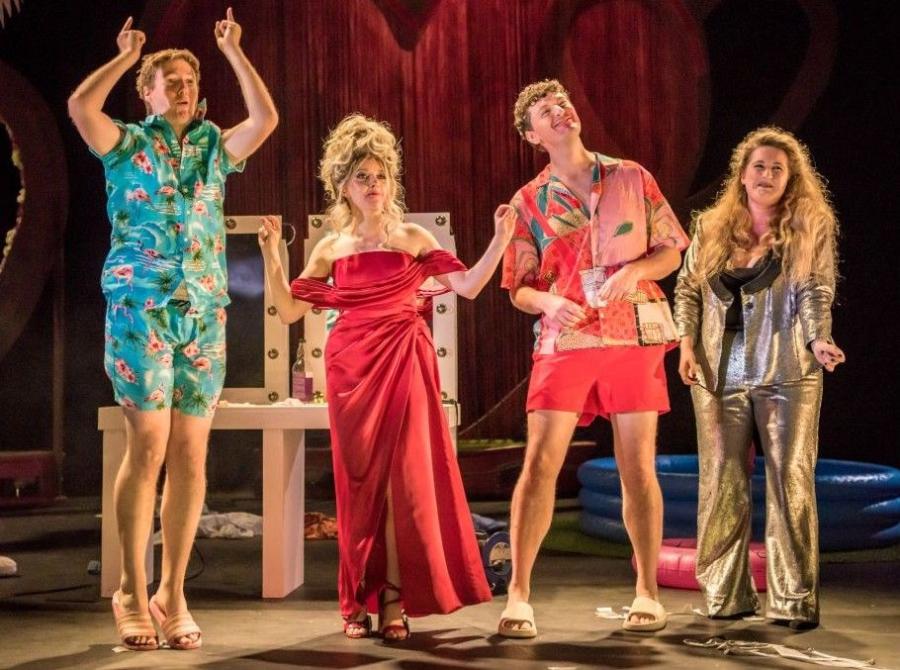
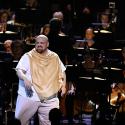
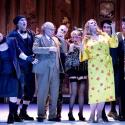
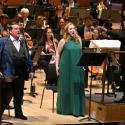
The quartet of performers (see picture) are very strong, and Tim Morgan’s Amadigi is the more impressive for having been formed over just two weeks, after a late cast change, in his warm, controlled tone, with a beautiful messa di voce and neat trills. James Hall is a match for him in passionate intensity (both men’s roles are for high voices) and has excellent variety of tone and intensity. Rowan Pierce acts and sings Oriana as to the reality show born, bristling with young-madam indignation as she imagines her lover has two-timed her; and Hilary Cronin not only goes all-out to give us the smarmy personality of the TV show host but rises to the heights of arias of frustration and fury with richness and virtuosity.
The other work, performed in the much smaller and limited Pavilion Arts Centre, close to the Opera House, is a very early one (and reputedly the first opera by a female composer) – Francesca Caccini’s La liberazione di Ruggiero dall’ isola d’Alcina from 1625. Conventionally shortened to La liberazione di Ruggiero, the full title is a clue to the ambivalent nature of the scenario (based on Ariosto): it tells of a military man temporarily entranced by the delights of another magic island under the enchantment of Alcina, a sorceress who offers fleshly delights but who’s finally given her come-uppance by the call to duty delivered by another Melissa, also a sorceress.
(There’s also a third festival offering in the Pavilion, a salon opera by Pauline Viardot, the great 19th century mezzo singer and teacher, called Le Dernier Sorcier, with a male sorcerer as its feature).
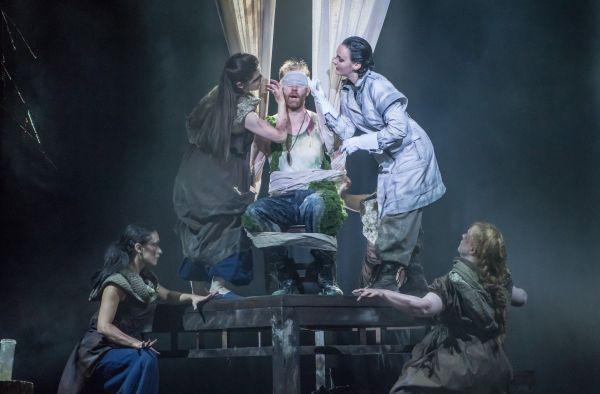
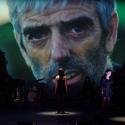
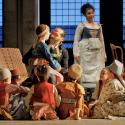
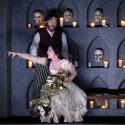
Who is the good sorceress? The text says it’s Melissa, overcoming the temptations of amore – but the work, structurally devoting much more time to Ruggiero’s time with Alcina and her desperate efforts to keep his affections, seems to say otherwise (see picture). Director Eloise Lally sees rather more in it than that, though. Her concept of the story re-interprets the island’s bucolic delights as a place and time in the future where nature is guarded and tended, while the “western world” is ravaged by war and destruction … the “bad” sorceress is a good environmentalist, and the “good” sorceress is one who wants to destroy the island’s plant life (the text talks about maidens enchanted within the trees) and overcomes opposition with a gun. The one main set evokes this with a few suspended bare branches and some logs and stones, and the very effective lighting is by Alex Musgrave.
The quality of the singing and the generous scoring of the instrumental music for violins, viola da gamba, violine, theorbo (switching to guitar for one little number about love), small pipe organ, recorders and sackbuts, directed from the harpsichord by Jonathan Darbourne, made for a warmly engaging experience for the ear. Camilla Seale’s portrayal of Alcina and Jon Stainsby’s of Ruggiero naturally stood out, and the other cast members – Phoebe Rayner as Melissa, Betty Makharinsky as Sirena, Harriet Burns as Nunzia, Aina Miyagi Magnell as Una Damigella, Filippo Turkheimer as Nettuno and Tom Kelly as Pastore and Astolfo – all acquitted themselves with distinction.
- Further performances: Amadigi di Gaula 20 July; Il liberazione di Ruggiero 19 and 21 July
- More opera reviews on theartsdesk