One of the more interesting tracks on Paul Weller’s fascinating new cover versions album Find El Dorado is his interpretation of “When You Are a King,” originally a 1971 hit for White Plains, an ensemble which evolved from the touring version of “Let’s go to San Francisco” hitmakers Flowerpot Men. White Plains, it turns out, are represented on another new release.
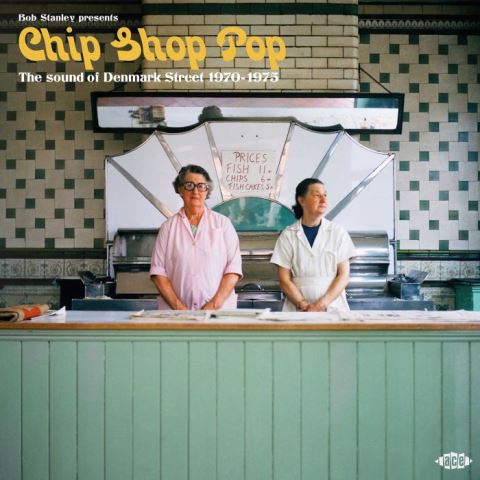
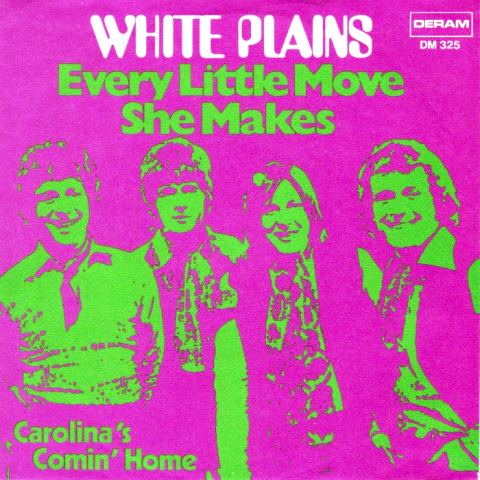
White Plains are on Chip Shop Pop - The Sound of Denmark Street 1970-1975 with the cascading, harmony drenched “Every Little Move She Makes,” the February 1971 non-charting A-side released between charting 45s “Julie do ya Love me” and “When You Are a King.” Though it sounds like a hit, it wasn’t. As with other White Plains singles, it was produced by the Rogers Cook and Greenaway. The co-writer was with the duo was Tony Macaulay. Prime UK music-business back-room hitmaker credits.
 “My Baby Loves Lovin’” and “Julie do ya Love me” were White Plains' biggest hits. Pure-pop, bubblegum-adjacent singles, they captured a particularly British sound: an upbeat, studio-created pop evoking the fug of a smoke-filled social club as much as the clamour of a seaside fun fair. A music where sunniness is occluded. “When You Are a King” is a more melancholy White Plains, in the spirit of other songs on Weller’s album: The Bee Gees' self-lacerating “I Started a Joke” and Brian Protheroe’s dun-toned, Artex-ceilinged “Pinball.” It is the song which counts here, not the nature of its creation or its non-canonical status.
Another band – who, in a rarity for Chip Shop Pop, were an actual gigging band – on this refined collection are Candlewick Green, with the loosely hymnal, New Seekers-esque April 1974 single “Leave a Little Love.” Written by Des Dyer and Clive Scott, it’s a gem. As was its predecessor single, December 1973’s “Who do you Think you Are?” also a Dyer and Scott composition. The latter was covered in 1993 by Saint Etienne. Chip Shop Pop is compiled by Saint Etienne’s Bob Stanley.
Finding this present-day, not-quite sideways congruence between Saint Etienne's and Paul Weller’s perception of music is, perhaps, surprising. Maybe not. It is the song which counts.
 Chip Shop Pop collects 24 tracks issued over the period signified in the title (all but one were singles; there's a music library album track too). It is marketed as “a stellar collection of super-melodic, expertly crafted songs; it gathers two-dozen of the songs that got away, all potential hits written by these Denmark Street-schooled songwriters. You might have only heard these records once or twice before, coming out of a passing kid's transistor radio, or in the background in a cafe, or a chippie, and then they disappeared into the ether never to be heard again – until now.” Stanley provides entertaining yet erudite annotation.
Some of these singles actually were hits: Fortunes’ “Here Comes That Rainy Day Feeling Again” (a hit in the US though), Kincade’s “Dreams are Ten a Penny” (a hit in Germany). Despite their directness and overt poppiness, seven-inchers by Bitter Almond, Currant Kraze, Scorched Earth and Stormy Petrel didn’t click with record buyers.
As the often eccentric names on the record labels attest, most of what’s on Chip Shop Pop was not recorded by bands in the standard sense. The songs were written and produced by figures who were integral to the music publishers and studios operating from Denmark Street in London’s West End. The songs were recorded by the session players and singers (who could also be the writers or producers) haunting the same street. Once a track was completed, a name was conjured up for the credit. It could be Shorty, Liberty Helm. Or maybe Whiskey Mac. Then, the job of selling this to a record label.
 Amongst those in the credits are Cook and Greenaway, Dyer and Scott, John Carter (the most prolific creator of this type of pop), Wayne Bickerton, Lynsey De Paul, Barry Green (aka Barry Blue), Ken Lewis, Tony Macaulay, Barry Mason, Tony Rivers, Tony Waddington. The singer who crops up most – whatever the credit – is Tony Burrows. Most of the records here were made by what Roger Greenway called a “make up band.”
Fabricating a prospective hit was potentially a cold-blooded, hard-nosed job. But what’s saturating these recordings is energy and joy. Everything sounds as if it was as fun to create as it is to listen to. Just like Motown. Take Chip Shop Pop’s opening cut ”Hello, Hello, Hello.” Credited in 1971 to Stormy Petrel, it was a John Carter creation. Fully orchestrated, it has shades of The Bee Gees, Barry Ryan and the 1969 Beatles at their most dramatic.
Then there’s Brotherly Love’s “Tip of my Tongue,” a 1973 single written by Barry Green/Blue and Lynsey De Paul, and sung by the remnants of Sixties vocal outfit The Carrolls. Had David Cassidy recorded it, it would have topped the charts for weeks. “Lady Pearl,” by Currant Kraze, brought together Roger Cook, Roger Greenaway, Tony Burrows and fellow studio veteran Johnny Goodison. It’s soulful in a Stylistics way, and a delight. All of what’s on Chip Shop Pop – irrespective of its chart status – is as wonderful.
 Another of these treats is the “Goodbye Yellow Brick Road”-predicting “A Little Thing Like Love,” which was issued by CBS as a single on 8 September 1972. Credited to River, co-written by The Hollies’ Allan Clarke and Tony Macaulay, it was sung by former Tony Rivers and The Castaways and Harmony Grass lynchpin Tony Rivers. At this point, he was employed by CBS as a producer and worked from their studio along Whitfield Street, just west of Tottenham Court Road.
Two days after “A Little Thing Like Love” was in the record racks, Iggy Pop arrived in Whitfield Street to begin producing what would become the Iggy and the Stooges Raw Power album at the same studio.
If only those walls could speak: from a luscious example of Chip Shop Pop to proto-punk in a matter of days. But that’s the chameleonic nature of the music business – where, however it was conceived, one type of music can be as valid, as vital, as another. An understanding shared by Paul Weller and Saint Etienne.
- Next week: Just Like Gold – the surviving recordings of the challengingly named early psychedelic-era San Francisco band The Final Solution
- More reissue reviews on theartsdesk
- Kieron Tyler’s website