This new collection, compiled by Bob Stanley and Pete Wiggs of Saint Etienne, aurally delineates a period when much that was British had an edge of bleakness. Accordingly, Three Day Week – When the Lights Went Out 1972–1975 ought to be a grim listen, a slog during which the mind is improved and new outlooks are brought on board but is as lively as a tractor reversing through swiftly setting concrete.
Glam rock and sparkly soul may have been on the chart menu, but as the back cover puts it: “In 1973 Britain was still a nation of outside bogs; tens of thousands were housed in wartime pre-fabs. The bright new colours of the post-war Festival of Britain and Harold Wilson’s talk of the ‘white heat of technology’ seemed very distant as strikes, inflation, and oil shortages laid Britain low. Soundtracking the decline were mavericks armed with fuzzy guitars, a primitive synthesiser, drums made of dustbin lids and a pitch-black sense of humour. Three Day Week is the sound of agitation, gleeful irreverence, and a proto-punk sense of frustration.”
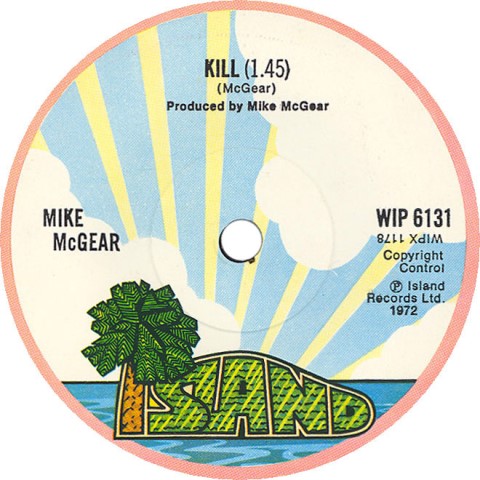
 Take the emblematic “Kill”, a deeply peculiar 1972 B-side by Paul McCartney’s brother Mike McGear. The South African-influenced backing consists of skeletal percussion meshing with chanted, wordless vocals. Over this, McGear intones ”Kill the pope, kill the panthers…use the knife, use the gun use the bomb or just use yourself...kill the lame, kill the sick and the sane…kill the IRA.” McGear outlines his nihilistic agenda in one minute 45 seconds.
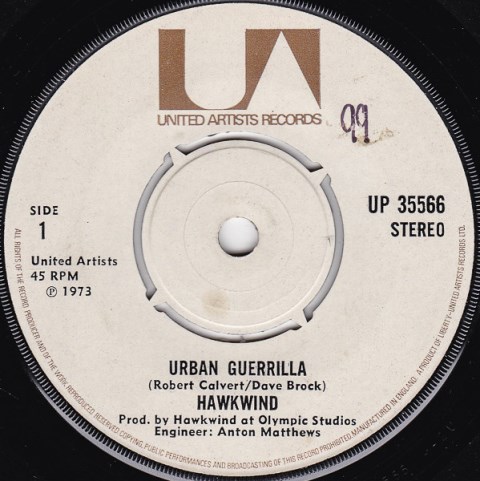
Then there’s Hawkwind’s “Urban Guerrilla”, the swiftly pulled-from-the-shops follow-up to their “Silver Machine” hit single. Declaring the hippy era over and The Beatles a busted flush, Dave Brock’s lyrics run “I’m an urban guerrilla, I make bombs in my cellar, I'm a derelict dweller, I'm a potential killer, I'm a street fighting dancer, I'm a revolutionary romancer, I'm society's cancer, I’m a two-tone panther, So let’s not talk of love and flowers, And things that don't explode, We’ve used up all of our magic powers, Trying to do it in the road.” Perhaps The Clash weren’t so original with their “White Riot” debut single and the “no Elvis, Beatles or The Rolling Stones” refrain of its B-side “1977”.
 Not everything on Three Day Week is as provocative but much of what’s heard is as barely categorisable as Hawkwind and McGear’s exasperated missives – a tongue-in-cheek viewpoint feeds into the tracks selected. Stanley’s engaging essay says “For the (then) younger generation, however, the Three Day Week is not remembered as a period of woe. Power cuts were fun! Who wouldn’t like the idea of a three day week? More time to play!” In this spirit, Stavely Makepeace’s fun, funny and nutty “Don’t Ride a Paula Pillion” and The Troggs’ bumping-and-grinding “I’m on Fire” are hugely entertaining.
Nonetheless, The Sutherland Bros Band’s original version of the Rod Stewart-covered “Sailing” suggests a band engaged in the opposite of play while recording this dirge. They sound half dead. This nautical adventure evokes a burial at sea rather than a much anticipated homecoming.
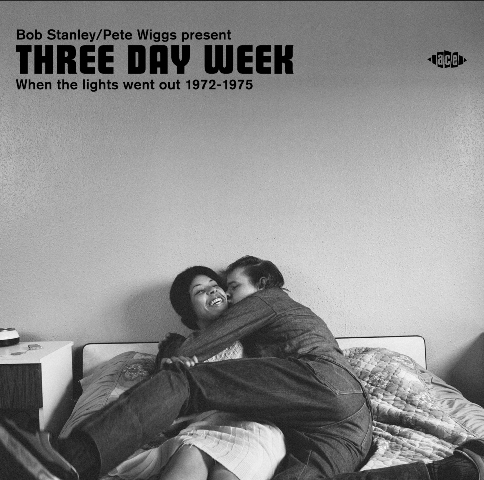
 Some people were having fun though. The couple on the cover in the great humanist photographer Sirkka-Liisa Konttinen's image (actually taken in a stuck-in-time North Shields over the period 1979–1980) are clearly having a ball. However, unlike that image, all the Three Day Week voices are male and black Britain isn't represented either. Of the CD and double-album configurations, the latter is the one to go for as it has an additional pair of tracks and – as it’s on vinyl – as it represents a more authentic Seventies experience. It’s fascinating that three tracks are mono. Who would have thought any singles were issued in mono in 1972 and 1973?
More broadly, a great compilation is a form of legerdemain; the themes have always been there but showing what’s hidden reveals new perspectives. Indeed, now the underbelly represented by Three Day Week has been dragged from the coal scuttle, it makes perfect sense.
The pop music of the day had to have reflected the mood of the times – though this mood was at odds with the clappy, happy, stampy world pop was meant to be. As a result, the adventurous Three Day Week is a pleasure. The standard narratives for the pop music of the period are fine and whatever their validity they are now shown to be stale. Unlike the history which has spurred it into existence, this is a breath of fresh air.
- Next week: Losing Touch With My Mind – box set tackling “Psychedelia in Britain 1985–1990”
- Read more reissue reviews on theartsdesk
- Kieron Tyler’s website