“A rich and occasionally irritatingly gimmicky album…less perfectly realised than Autobahn, though there are some quite pretty tunes. People often charge electronic music with being ‘mechanical,’ confusing machines like clocks and other wind-up toys with devices which operate in ways more analogous to the human brain, which create quite different musical problems from, say, musical-boxes. What is wrong with Kraftwerk, however, is that their music is in fact mechanical, creating a contradiction between form and content which eventually destroys its artistic credibility and any hint of a soul at the heart of it.”
“They sound so detached, the kind of guys who could blow up the planet just to hear the noise it made. The whole album is much more rhythmic than any previous one, but the album degenerates into strange Dr. Who electronic voices muttering stuff in German and playing with the radio dial. Easy listening material for those who live on the 24th floor of luxury tower blocks, jet pilots, etc.”
For the UK music weeklies Melody Maker, quoted first above, and New Musical Express, Radio-Activity, Kraftwerk’s follow-up album to the worldwide-successful Autobahn, wasn’t a thriller.
In the US, Creem was more receptive. “Radio-Activity is a concept album about radio waves, and it's thus also Kraftwerk's typically German affirmation of their thorough understanding of their subject (and objects). These boys are light-years ahead of Autobahn already, and still picking up speed. Or, to put it more directly, this new set of electronic squiggles will kick out all your jams, no matter what preconceptions you bring to it.”
Whatever the Anglophone world's views at the time of Radio-Activity’s release, the album did have an impact. Viz: play Orchestral Manoeuvres In The Dark’s May 1979 first single “Electricity” and then take in Radio-Activity’s title track. It’s clear what was musically reframing what. Furthermore – electricity, radioactivity: geddit?
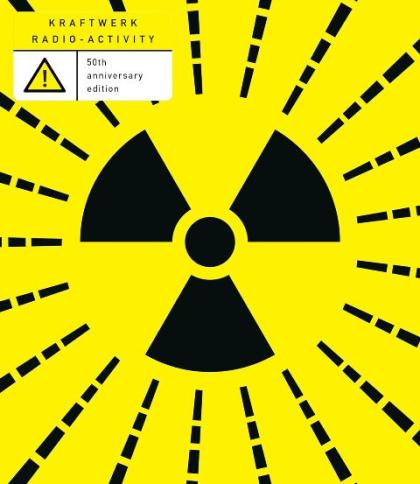
Now, six months out-of-sync with its original release date, a 50th-anniversary reissue of Radio-Activity – Radio-Aktivität was its German-language title: package and annotation-wise, this new release is configured in English – has arrived. As it was with the recent Autobahn reissue, there are new mixes: one as Dolby Atmos, the other a 5.1 surround-sound mix. These are collected on a Blu-ray disc (pictured above right) along with the 2009 stereo remaster of the album. The latter also appears on a picture-disc version of the album (pictured below left).
The Kraftwerk which recorded Radio-Activity was different to that of Autobahn. Recent-ish members Karl Bartos and Wolfgang Flür were in the studio for the first time. When they were in America over April to June 1975 the band picked up the Vako Orchestron, a keyboard instrument which played optical discs upon which were recordings of instruments or sounds. Akin to a Mellotron, it did not have the limitation of playing a note for only as long as the Mellotron's tape length. The Orchestron featured heavily on Radio-Activity, also the first Kraftwerk album to feature the use of the Sennheiser Vocoder and the Votrax speech synthesiser. Even though it has his trademark warm sound, Radio-Activity was Kraftwerk’s first album without collaborator/producer Conny Plank and their first to not have solely German lyrics: an acknowledgment of the world-wide audience acquired during 1975. Another change came with their association with a new label: EMI, who allotted them their own Kling Klang imprint. This was a retooled Kraftwerk. The album was quickly completed in the period between the end of the US dates, in early June 1975, and a UK tour which began in early September 1975.
On its original release, Radio-Activity did not repeat the commercial success of Autobahn. Sales picked up, in France that is, after the title track became the theme for the Europe 1 radio show Maximum de Musique – a usage neatly chiming with a core theme of the album.
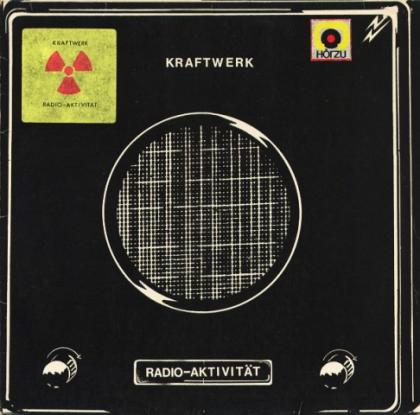
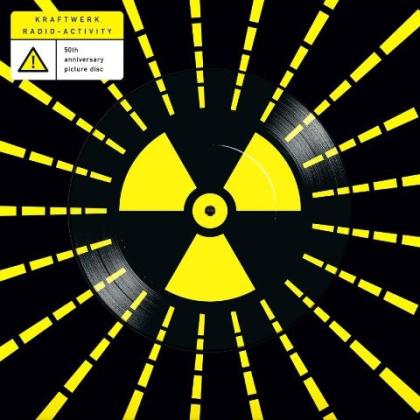
Radio-Activity has been regularly reissued since 1979, and the packaging here is in line with what first appeared in 2009 when the original sleeve image was replaced by the nuclear hazard warning image originally seen on the each of stickers on a sheet included with original issues of the album (pictured right). What has been marketed since 2009 is not as per 1975. There has never been any explanation for this change, though perhaps someone in the Kraftwerk camp had post-fact willies about the radio which was used on the front and back of the album’s sleeve. While in keeping with the album’s conceptual outlook, it was the Third Reich-era Volksempfänger set (the OMD album track “VCL XI” took its title from annotation on the radio as seen on the Kraftwerk album). The new version of the album wearisomely reconfigures the hazard logo to replicate a back projection used at live shows by the current iteration of Kraftwerk.
The new remixes are the catnip. The Dolby Atmos mix is mind-boggling. Everything is heard with a starling clarity and intimacy, yet the whole sound has not fallen apart or decoagulated. There is no whooshing back-and-forth or side-to-side. Everything is here, but in a new way – though it is deeply disconcerting to hear Ralf Hütter and Florian Schneider intoning alongside your left ear. Indeed, hearing the album like this stresses just how much it is about the vocals; the title track and “Radio Land” stand out especially. A vocal precision is newly detectable. As is the Farfisa organ, and how much the way it is played is revealed to resemble Cluster's 1974 album Zuckerzeit. Kraftwerk were not operating in a vacuum. The remixed “Radio Stars” is creepier than ever, and it is enlightening to appreciate the overall spareness of the instrumentation. The unnerving clarity allows a dig into Karl Bartos and Wolfgang Flür’s percussion – on “Antenna” they momentarily deviate from each other. While it's probable that fewer potential buyers have a Dolby Atmos set-up than a 5.1 system, the latter mix feels superfluous after listening to the former.
However, whatever the technical rejigging and its sensitivity, neither of the new mixes has the punch of the original, 1975, stereo mix. They are not a substitute, more an alternative. Nonetheless, if possible, it is worth making time to hear Radio-Activity as it has never been heard before.
- Next week: Quicksilver Messenger Service - Who Do You Love The Recordings 1967-1972. Seven-disc box set of the San Francisco legends
- More reissue reviews on theartsdesk
- Kieron Tyler’s website