Whichever Way You Are Going, You Are Going Wrong is the debut album by the London-based duo Woo. Originally issued on the Sunshine Series imprint in May 1982, it was subsequently picked up for a 1987 US release by the LA-based Independent Project Records label. After this, Woo's second album, It's Cosy Inside, came out in 1989 on Independent Project Records. There was no UK version of the follow-up album back then; a US reissue on Drag City followed in 2012.
When Whichever Way You Are Going, You Are Going Wrong appeared in the UK in 1982, NME’s review said “How strange that in a year so packed with rhythmic punches of one kind or another, the most enduring noise should come from quarters neither punk nor funk, but from a pair of brothers seemingly time locked into the spirit of ’67.” Melody Maker said “words like spiritual, meditative and reflective spring to mind, but – and I mean this as the highest recommendation – Woo, quite delightfully, defy all definition.”
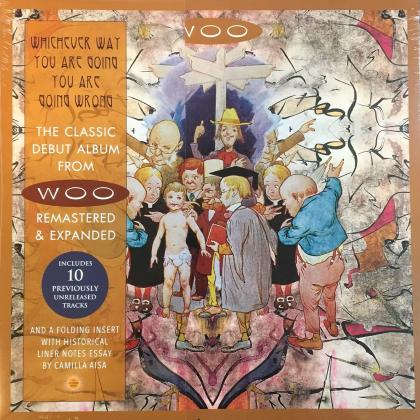
The album has now been reissued by long-time Woo champions Independent Project Records with ten bonus tracks: either appended to the CD version of the new edition, or on a 12-inch coming with the vinyl configuration. It is easy to hear why there was such critical interest back in 1982.
Despite a few musical touchstones, the mostly instrumental Whichever Way You Are Going, You Are Going Wrong sounds timeless. A couple of tracks, “Wah Bass” and “Razorblades,” evoke the more contemplative side of 1975’s Another Green World-era Eno – so a post-1975 origin seems fair. There are also shades of The Durutti Column, Harmonia’s 1975 Deluxe album and a nascent new agey-ness (later, Woo explicitly linked-in with the new age movement: a relationship resulting in their only live shows). Percussion can be pattering, yet insistent. There is an exotic edge. Some of the guitar sounds like a koto. The use of a synth is often more textural than as a melodic focus. Each track is a discrete entity, a mini trip. Quite something.
Woo are the still-active Putney based brothers Clive Ives and Mark Ives. The trajectory of their first two albums is typical of their individualistic – and borderline hermetic – path through the music business. So much so that until late 1980 – they had been recording together since 1975 – they had never thought anyone would want to hear what they were up to, and releasing anything was not considered. Although the brothers played instruments and had been in informal bands, their yen to record was spurred by the purchase in 1975 of a TEAC four-track tape recorder and the newly available Roland SH-3A synthesiser.

It was only when Mike Alway, then of Cherry Red Records, came knocking on their door in December 1980 that the brothers learned there was any audience their self-made music. It’s just possible to hear a parallel with the then-current quietude of Young Marble Giants or soon-to-be Cherry Red signees Eyeless In Gaza. Cherry Red picked up Woo’s music publishing but did not pursue a further relationship with them. So Woo ploughed on, on their own, releasing Whichever Way You Are Going, You Are Going Wrong. (pictured left, Woo in 2024)
In 2012, Clive Ives said of Woo “there is a simple pleasure in creating some sort of funky groove and then giving yourself freedom to play over it, and the freer you get with it, the more psychedelic it can become. It’s down to the relationship between Mark and me. Mark is jazz-influenced and frankly born with psychedelic DNA. For me, I love to dance. I’m funky, I love beats. I was really into Stevie Wonder, Prince, Barry White and even Simply Red. We’re both pretty spiritual, looking for the unspoken. I think when you combine all of that, it’s what makes Woo what it is: a multi-layered synthesis of all kinds of influences and inspirations from funky psychedelia to the unpredictable intimate expressions of our vulnerabilities and emotions.”
He also noted “Mark was initially the real spiritual seeker, studying the Theosophical Society, William Blake, Krishna consciousness, etc., which then opened my eyes to the new age movement, especially Raja Yoga and Spiritual Healing. I also became an Osho sanyasin. Mark went to India just before the release of the first album, and I went six years ago [i.e. around 2006] and our shared interest in spirituality has always influenced the music. The music became more intentionally spiritual when I became a Shiatsu Practitioner and wanted to create music to use during my sessions.”
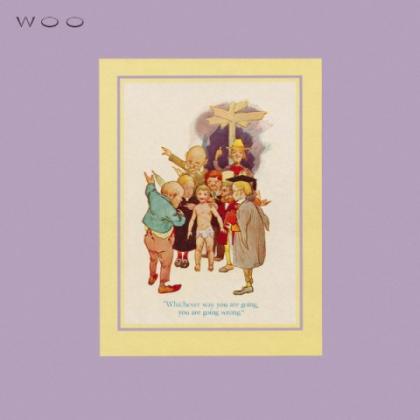
To date, Woo have physically issued 14 albums – arriving at an exact figure is difficult as there have been collaborations and releases combining earlier and newer material. There are also at least five digital-only albums. The last release to surface was 2024’s Music To Watch Seeds Grow By 001: Woo (Sweet Peas), which emerged on cassette and as a digital download. (pictured right, the original 1982 release of Whichever Way You Are Going, You Are Going Wrong)
Amongst all this, apart from the long-running, albeit intermittent, association with Independent Project Records the only other conventional label to link-up with Woo was Chicago’s Drag City who, as well as reissuing It's Cosy Inside, put out the When The Past Arrives collection of previously unissued tracks in 2014. There were also albums on New York’s Palto Flats label and the Florence, Italy imprint Quindi Records. In the UK, it is usually the Ives’ themselves who issue their music. Woo are, to a marked degree, overlooked in their home country.
Woo’s world is their own: one which – despite there being nothing inaccessible about their music – occasionally encounters the wider world. It’s fitting that their first album has been made available again as it’s a fine entry point, the setting of a very particular stall. Time, then, to celebrate a great British musical institution?
- Next week: Tilaye Gebre’s Tilaye’s Saxophone with the Dahlak Band – 1970s album from the Ethiopian jazz saxophonist
- More reissue reviews on theartsdesk
- Kieron Tyler’s website