The world music scene is hungry for new sensations - and Omar Souleyman, about to hit London and the Shambhala Festival, well deserves to be one of them. In the early 1980s the hunger for the exotic focused on anything that came from the parallel universes untouched by the pressures of commercialisation: polyphonic pygmy singing from Central Africa, ecstatic Sufi soul doctors from Pakistan, drone-drenched bagpipe players from Bulgaria or heart-invading praise singers from Mali. Souleyman is the singer in a small band that plays dabke music at weddings in Syria.
As the global village has shrunk, and languages, we are told, are vanishing with terrifying speed, music seems to survive, endlessly developing (almost counter-intuitively, given the globalisation of other aspects of human culture) and producing ever more hybrids and fusions. Dabke is common to much of the Middle East and provides the lively soundtrack to festivities, particularly the parties that accompany marriage ceremonies.
Souleyman and his fellow musicians hail from a deeply rural part of north-eastern Syria, a border crossroads area that brings together many influences – Arab, Bedouin, Turkic, Kurdish, Armenian and Chaldean. This cultural mix gives Souleyman’s music a distinctive flavour that distinguishes it from the dabke of Lebanon, Jordan or Palestine.
Watch Omar Souleyman performing "Leh Jani" (YouTube):
When I first saw Souleyman at a Bristol club over a year ago, I was swept off my feet. On the face of it, an Arab singer with a synth-driven band might display an affinity with rai, but this was something entirely different, super-charged with the energy and pace of club dance music, a frenetic party groove that drove the assembled punters to smiling ecstasy. The band that tours Europe is a paired-down duo of synth and baglama saz, the long-necked lute played in Turkey and much of the Middle East.
The synth is programmed with sounds that are typical of north-eastern Syria: the sensuously plucked oud, the piercing zurna, a reed instrument with uncanny psycho-physical power, the crystalline delicacy of the many-stringed kanun, the mind-bending distortion of the mijwiz, a reeded flute and a rich array of percussion. Souleyman’s Kurdish synth player, Rizan Sa’id, is a virtuoso. He started playing as a child and joined Omar when he was 15. He is apparently one of the architects of what Souleyman’s US manager and friend Mark Gergis describes as “new dabke”, an accelerated and very loud form of the traditional wedding music of the region. Ali Shaker, also a Kurd, plays the baglama saz with a mixture of technical virtuosity and musical sensitivity. The fluidity and intricacy of his soaring solos have a jazzy elegance to them.
As the two instrumentalists fire up the audience, Omar Souleyman, wearing a nattily folded keffiyeh, paces across the stage, brooding behind his super-cool shades. His vocal style is anything but cool though: a fierce yet subtle stream of melisma and quarter-tone playfulness, pumped out at an audience that could hardly care less what he is singing about. It’s clearly a case here of the breathtaking medium carrying more than enough of the Arabic message.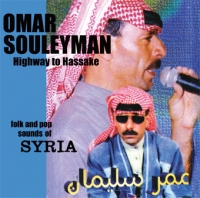 The lyrics of dabke are poetry, most of it about love and desire. Some of the material comes from a traditional form called ataba and other songs have been written by a poet – in Souleyman’s case it is often Mahmoud Harbi. The poet usually joins the band on stage and whispers lyrics to Omar, otherwise standing by with a slightly absent look as if is he were uneasy with the high-octane proceedings. Back in Syria, when the band plays for a wedding, they will usually be accompanied by a "drum boy", who plays the tabla, a powerful and large double-sided instrument common all over the East, guaranteed to rouse the hearts and souls of musicians and dancers alike.
There is something irresistible about the sound of Omar Souleyman. The lack of sophistication and almost manipulative way in which the musicians build up successive climaxes get the audience pumped up. This contagious party spirit – magnified by copious use of reverb and delay, has a clear affinity with the Dionysiac genres familiar to European club audiences and the aesthetic of Omar’s musicians most probably owes something to disco and house.
Omar Souleyman is a major star in Syria and in other parts of the Middle East, thanks to videos that are played on TV channels all over the region. His audience at home consists of construction workers, taxi and truck drivers and his main means of dissemination remains the humble audio cassette. This is Syrian popular music, not the more refined court or sufi music documented by ethnomusicologists and valued by cognoscenti of the maqam and other century-old traditions. While purists may blanch at Omar Souleyman’s rougher-than-rough street sounds and question his "authenticity", others will welcome this boundary-breaking wedding music as a genuine product of 21st-century hybridisation. The Seattle label Sublime Frequencies – who release Omar Souleyman CDs – have specialised in weird pop from Indonesia and other parts of South-East Asia and other off-centre planetary sounds.
In a post-modern globalised world, authenticity has lost its associations with pure tradition, essential as this was to a view of musical development that placed "progress" – for better or worse – at the heart of its unfolding logic. The sensational music of Omar Souleyman is as authentic as it gets – defiantly pop, fiercely hybridised and thoroughly of our times. Firmly rooted in the villages of north-eastern Syria – but able to play just as well in London, Rio or New York.
- Find Omar Souleyman on Amazon
- Omar Souleyman at the Corsica Studios in London SE17 tomorrow (28 August)
- Shambhala Festival, Barn Nova, Sunday (sold out)
Watch Omar Souleyman play live in Amsterdam (YouTube):