

A compilation on which Philip Glass and Terry Riley rub shoulders with Controlled Bleeding and Smegma is going to be interesting. Throw in Data-Bank-A, Dog as Master, NON and Suicide, and it becomes clear what’s striven for is an all-encompassing overview of something particular rather than a miscellany of random names included as attention-grabbers.
Over its four CDs, Third Noise Principle explores the world described by its lengthy sub-title as Formative North American Electronica 1975–1984, Excursions in Proto Synth pop, DIY Techno, Noise & Ambient Exploration. It’s the follow-up to 2016’s Close to the Noise Floor and 2017’s Noise Reduction System, each of which covered much the same musical ground over a similar period for, respectively, the UK and continental Europe.
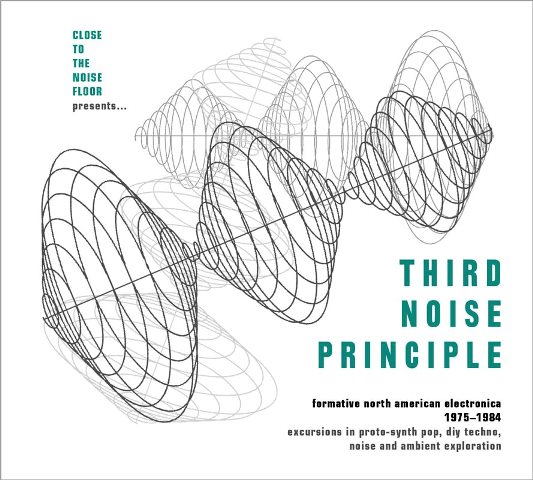 Third time out, the raw material includes two composer-musicians whose work changed how music was created and perceived globally. The influence exerted by Philip Glass and Terry Riley pushes beyond the boundaries of the genre classifications embraced by Third Noise Principle. The latter changed how The Who sounded, and the approaches adopted by the former have bled into, amongst others, U2. Yet the tracks included by each sit comfortably alongside the other 58 selections.
There are also contributions from names which broke through into a form of the mainstream such as Patrick Cowley, better known for his work with disco, Ministry and the almost-famous Executive Slacks. Perennial cult favourites include Chrome, F/i, Hunting Lodge, The Residents and Tuxedomoon. Third Noise Principle draws from a more attitudinally and stylistically diverse pool than the two predecessor sets, meaning it is a more enlightening collection than Close to the Noise Floor and Noise Reduction System.
 Inevitably, the less-well known or barely known names most make the case for themselves as worthy of further investigation. Galen Herod’s extraordinary “Lowdown” uses the morse code transmission made by US forces in the Philippines in January 1945 which was made as they were under heavy fire. The words are vocalised in a deadpan fashion and intermingled with a suitably bleak, synthetically manufactured sonic backdrop. Although recorded in 1979 or 1980, it remained unreleased until 2015.
The examples of atypical work are also fascinating. Patrick Cowley’s “Primordial Landscape” was drawn from a series of instrumentals recorded between 1973 and 1981. After being contacted by a gay porn film company, Cowley responded by sending reel-to-reel tapes of the impressionistic pieces, which were not intended to be widely heard. From them, “Primordial Landscape” has a familial relationship with John Carpenter’s soundtrack work.
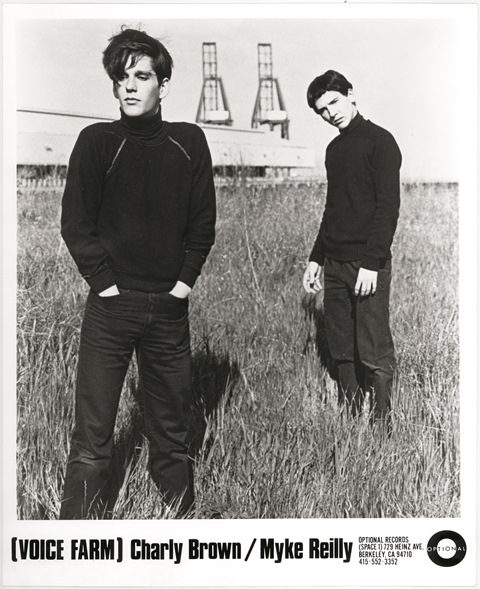
Cowley was from San Francisco and it is intriguing how much here comes from the city and its immediate orbit: amongst them – Chrome, Factrix, NON, The Residents, Rhythm and Noise, Tuxedoomoon, Voice Farm and more. As the bulk of the text in the package is a track-by-track commentary, this geographic peculiarity is not dug into. Indeed, the collection provides an overview rather than an interpretive framework drawing connections and parallels between what’s heard.
This, though, does not detract from the whole. With its handsome, well-designed casebound package Third Noise Principle is of a piece with the first two releases in the series. It is also a lot to take in. However, it is the most satisfying of the three.
- Next week: The sole album by Brit-psych oddities Rainbow Ffolly is expanded into a three-CD set
- Read more reissue reviews on theartsdesk
- Kieron Tyler’s website


