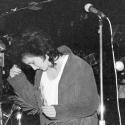
Their songs are some of the most joyous of the Sixties, their glistening doo-wop close harmony and pealing early rock 'n roll guitar sound heady with innocent romance and youthful energy. At the Barbican last night, Ronnie Spector, whose band The Ronettes haven’t been regularly releasing new work for nearly fifty years, effortlessly wound the clock back to the well-groomed early years of rock 'n roll when singing about mother kissing Santa was enough to earn her the title “original bad girl of rock”. She got everyone on their feet, and even though the audience was mostly about her age, there were plenty who wanted to be her baby.
It’s billed very explicitly as a nostalgia tour featuring “all the hits”, and Ronnie walked us down memory lane with some well-chosen anecdotes and evocative footage of posters and early gigs on the screen behind. She’s certainly a more confident and charismatic compere than the nervous girl she introduced singing on early Sixties’ music television, and the chat with the audience was packed with engaging anecdotes.
She grew up in Spanish Harlem, Manhattan, and the tales of early musical breakthroughs in local venues – from their first paid gig dancing in the window of a Hawaiian restaurant, to muscling in on other bands’ shows – were brilliantly vivid. She talked about the influence bands like The Flamingos, Frankie Lymon and the Teenagers, and The Students had on their playing; these flavours are clearly audible, but Spector adds intimacy and sensuality that helps keep these songs direct and effective.
All told, this was more historical reconstruction than edgy new gig
The band, however, made up for this skilfully, and the arrangements were clearly designed to support Spector’s voice with both backing singers and instrumental accompaniment. With at least eight musicians plus Ronnie, there was no shortage of cover, and it sounded bright and slick. While the bass and sax kept largely in the background, there was some lovely shiny solo work on guitar, in particular.
And it was all the hits. Spector took a couple of songs to warm up, but thereafter, it was gleaming melody after melody. “Paradise”, “Time Is On My Side”, “Do I Love You?”, “(Best Part Of) Breaking Up”, with, inevitably “Be My Baby” – albeit with a slightly too exposed vocal line – closing the formal programme, followed by an encore of “I Can Hear Music”. This last song was not especially successful on first release – not last night.
And it was all the hits. Spector took a couple of songs to warm up, but thereafter, it was gleaming melody after melody. “Paradise”, “Time Is On My Side”, “Do I Love You?”, “(Best Part Of) Breaking Up”, with, inevitably “Be My Baby” – albeit with a slightly too exposed vocal line – closing the formal programme, followed by an encore of “I Can Hear Music”. This last song was not especially successful on first release – not last night.
Fans wholly in love with the sound of her voice at its supple best may find the deterioration distressing, but it was managed well, and the rest of the band were gorgeous. As a compere, Ronnie Spector was utterly delightful. All told, this was more historical reconstruction than edgy new gig, but with performances as seductive as this, even a cynic couldn’t help be charmed by the Ronettes’ irresistible nostalgia.
- The Fabulous Ronettes conclude their UK tour at Colston Hall, Bristol, tonight