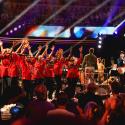
The stage of the Barbican is alive with black dudes in wheelchairs going bonkers. It's an extraordinary spectacle. To rocketing afro-funk, backed by a drum-kit of boxes and bells, Staff Benda Bilili's frontmen are rolling their chairs back and forth. Two of them face each other and perform loosely synchronized hand dances, another wearing an ecstatic grin clambers out of his wheelchair.
Despite having legs shrivelled by polio to almost nothing, he scuttles round the stage, his arms agile, his movements a surreal breakdance. The audience claps wildly, pockets of dancing breaking out at the edges of the stage, for Staff Benda Bilili emanate a barely contained energy that's thoroughly contagious. When I mentioned this concert to friends they asked who Staff Benda Bilili were and I told them. The response was universally one of disbelief, as if I'd made the group up. In all fairness to my friends, though, Staff Benda Bilili's background is a story that might have been conjured up by a particularly imaginative world music fantasist.
On the streets of Kinshasa in the Democratic Republic of Congo, there is a symbiotic relationship between street kids, known as shegues, and disabled street people, known as handicapes. The latter, wily and exempt from taxes, sometimes take the former under their wing. Thus is the case with Staff Benda Bilili. The band consists of four older, paraplegic street musicians who live in and near the grounds of Kinshasa Zoo, and when not playing music, ply piecemeal work, traversing the city on their customised tricycles, selling wares. This quartet are backed by a youthful rhythm section and feature teenage shegue Roger Landu on a one string guitar made from a dried milk can and electrical wire, an instrument he developed and named a satonge.
This group, however, are not the fever dream of Charlie Gillett. Here onstage for their first ever British date, the keening cry of the Landu's satonge scythes through the band's wild stew of sound and throughout the gig he performs solo after solo, occasionally dropping to his knees in full Hendrix rock god mode. Young, lively and clad in white, he provides a visual counterpoint to the, by necessity, more static leaders of the band, Ricky Likabu and Coco Ngambali, sturdy figures who've earned their stripes on some of the harshest city streets in the world and look the part. Wheelchair or no wheelchair, you wouldn't mess with them, but tonight they're in party mode and attack their microphones with gusto, their voices sparring and harmonising.
Staff Benda Bilili perform 'Je T'Aime'
The music is marinated in African funk but widely varied. "Mwana" has a hefty throb akin to George Clinton's funk-rock mutations, while "Sala Keba" is sweetly sung soul music that, excepting language differences, is redolent of Sixties Motown. There's blues and rumba in there too but the component parts gel so juicily it's nigh on impossible to see the joins. As the set goes on, it grows ever more frenetic. To the right of the stage the bespectacled Djunana Tanga-Suele, he of the ecstatic grin and breakdance moves, seems to be finding it increasingly hard to stay in his wheelchair. He keeps popping out onto the floor and his absolute enthusiasm is riveting. Next to him, propped on two giant wooden crutches, fellow vocalist Kabamba Kabose Kasungo, performs his own dance routines.
The final two songs, "Mama Frika" and "Staff Benda Bilili" (which means, "Put forward that which is hidden"), are a whirlwind and when the band leave the stage after the latter, a roaring standing ovation in the all-seated venue hauls them back for a brief encore of their eponymous title song. Exotic and extraordinary their history may be, but Staff Benda Bilili are not here for refined anthropological analysis, they're a thrilling live band ripe to tear up any festival or dancehall that their touring schedule throws at them.