

Lars von Trier wants us to see the big picture. When Terrence Malick similarly returned cinema to the cosmic with The Tree of Life, he tried to make us feel the terrifying wonder of creation as much as death. The prelude to Von Trier’s new film instead sees Earth smashing into an indifferent planet 10 times its size. What’s more, when that planet, Melancholia, hoves into view from its hiding place behind the sun, the famously depressive director has suggested the catastrophe is a symptom, even affirmation, of his heroine Justine’s malaise. You can imagine her saying with grim relish as she looks at the fatally altered sky, like the manic depressive Spike Milligan’s preferred gravestone: “I told you I was ill.”
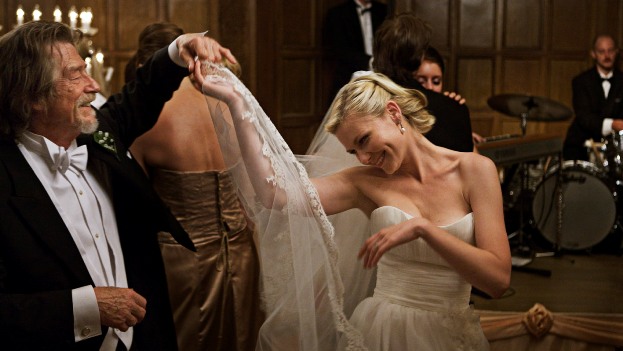
Melancholia’s first act then proceeds almost in ignorance of this looming oblivion, only a slight strangeness in the stars distracting the guests at the country house wedding of Justine (Kirsten Dunst) and Michael (Alexander Skarsgard). Von Trier’s Dogme co-conspirator Thomas Vinterberg’s bourgeois-skewering Festen comes to mind as Justine’s Dad (John Hurt, pictured below left with Dunst) steals the cutlery and leers at the bridesmaids, while Mum (Charlotte Rampling) pours poisonous scorn. Brother-in-law John (Kiefer Sutherland, pictured below right), who owns the place, seethes with uptight menace, and straight-laced sister Claire (Charlotte Gainsbourg) worries Justine will ruin everything.
 The dialogue is duff for farce, though there are laughs: the faithful old concierge wearily retrieving the latest guest’s bags to be thrown from the hotel by its owner, and the wedding planner (Udo Kier) shielding his eyes from the hateful sight of the meddling bride.
But Dunst incarnates Von Trier’s misanthropy. The ditzy blonde beauty that Hollywood lazily exploits becomes a cracking mask for bafflement, distaste then anger at the charade of her marriage to gently blameless Alex, in love and awe of her. She takes a long bath when she should be cutting the cake, and hitches her bridal gown on her brother-in-law’s beloved golf greens, to piss, then fuck a stray guest. She turns those famous looks into a harried accusation. Even a scene in the long tradition of gratuitous kit-shedding for European maestros sees her impatiently gaze back: have you seen enough? She’d be a serious favourite for an Oscar, if the Oscars were serious.
Though filmed with hand-held cameras, all this has had a stately gloss. But after the guests flee, the second act is chillier: science-fiction, a chamber-dystopia. Claire tries to heal her sister’s fathomless melancholy, heaving her like a dead thing towards a bath, with her husband and young son soon the only other people to be seen. A village that’s mentioned but never reached is their world’s limit. The greens and woods take on an enchanted cast, Claire finding Justine draped nude on a rock like a nymph. The sisters bicker and go about their business, and Von Trier’s hold slackens, as if the film is running on undirected, without him. Then periodically someone looks up, sees Melancholia filling the sky, and remembers they’re going to die. We can all idly wonder what we’d do in such circumstances. Von Trier knows we will have to find out, though the world won’t end with us. Justine, rallying at the sight of Earth’s nemesis, at least has that satisfaction.
 Von Trier directs in part to distract him from his depression’s vacuum, which consumed him during his last film Antichrist (2009). Melancholia is a discursive portrait of the condition (which Dunst has also suffered) and its healing. But he doesn’t stint on the terror of his science-fiction premise, Melancholia snatching at breath as it grazes Earth’s atmosphere, and cold winds whipping up on a soundtrack like a low, pulsing headache.
“The Earth is evil,” Justine tells her appalled sister. “We don’t need to grieve for it. Nobody will miss it.” But Von Trier the provocateur who couldn’t help giggling about being a Nazi and getting tossed out of Cannes is more audacious on screen. And perhaps against his normal judgment, he finds something sublime. Melancholia has longueurs, but also searing surprise. Its last image does justice to a lunge for love in the Earth's final second.
Watch the trailer for Melancholia








Add comment