Never have the Tudors seemed so real. After decades of TV and film characters keeping us at a teasing, ermined distance, Hilary Mantel's dazzling novel Wolf Hall brings it all to life as never before, and the Globe's still-running Henry VIII has vigorously built on that. But the Stuarts? You wouldn't expect James I to dominate in Howard Brenton's new play ostensibly about a tragic-heroic vision of the Tudor queen. Yet Brenton may have started something: the bisexual transvestite intellectual Scot with Tourette's and epilepsy, as spellbindingly played by James Garnon, could become the new historical-royal black.
Who's the central figure, then: James, Henry or Anne? None of them; it's the story of an English-language Bible which Brenton brings off best. Difficult task though that may seem, the scene in which bishops and Puritans thrash it out before an increasingly impatient James is the best and liveliest in the play.
Brenton's thesis is that Anne, animated by the faith in which she holds Tyndale's translation of the Bible, not only changed the face of English religion but ultimately paved the way for the King James version which has had as much of an influence on our language as Shakespeare.
If I've made that sound a bit dull, Brenton and the pace of John Dove's production between them certainly don't. But the playwright has to cram in an awful lot of history to take us from 1526 to 1604. The five years during which Henry's new lover lets him get no further than her knee pass in an artificial flash; then we're quickly on to the consummation after a further two years and a rapid denouement which clearly isn't the point of Brenton's take (though it would be helpful to have it made clear sooner that Anne is to lose her head because she finds out about Cromwell's misappropriation of funds. I can hardly wait for Mantel's viewpoint on this in her promised sequel).
The Boleyn girl kicks off and signs out as a very real ghost. Miranda Raison, who also takes the role in the Globe's putative Shakespeare history play, is small of voice - I missed a few crucial lines from way back under cover - but conveys a pretty grace throughout. Brenton honours the theatre's direct-to-audience tradition by having her take a packed house into her confidence, but the tradition so well established in the Rylance era of engaging projection sometimes falls by the wayside and the epilogue, in which Anne addresses the spectators as "godless demons of the future" is weak.
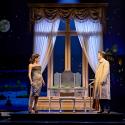
 We're made to understand throughout Anne's simple faith in the heretical William Tyndale texts; the play's fine symmetries feature two furtive forest meetings with Peter Hamilton Dyer's forthright Protestant. There's also a telling Act Two recall of the love scene with Anthony Howell's dashing, persuasive Henry (Howell and Raison pictured right) in which Brenton makes clever anachronistic use of a secular sonnet by Elizabeth's beloved Essex to contrast with the shared declamation of religious hymns and texts.
Yet the recitants remain obstinately two dimensional, wrapped up in Michael Taylor's gorgeous silks and William Lyons's sometimes over-insistent score (well played by the three expert musicians aloft). Somewhere between the bathos of common parlance and the smatterings of Tudor poetry lies the human truth, and what Mantel conveys so brilliantly in the stageworthy dialogue of her novel Brenton misses in his strip-cartoon tour of history (though you might argue that the Globe space needs broader brushstrokes). Since Howell's king merely seems a sincere lover, we're not at all prepared when he's ready to move on to Jane Seymour. Cardinal Wolsey (Colin Hurley) is a gluttonous, ranting caricature, not the sophisticated cosmopolite so persuasivaly presented by Mantel. Her complicated hero, Thomas Cromwell, is set up here as a villain pure and simple, though one of immense banked powers almost frighteningly projected by John Dougall.
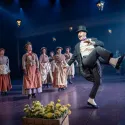
Which is why we need the Stuart strand. We might be quite happy for James Garnon just to play the fool, the real comic relief of a none too witty evening, but there's more to the characterisation than that. When he first hit the Globe fresh from RADA and lit up an otherwise unmemorable production of Dido, Queen of Carthage, he shone as destined for great things. They haven't quite happened yet, though he's had a very respectable career - but when do we get his Hamlet? He certainly has a knack of slipping from high comedy to complex humanity; the well-choreographed romp that launches the second half as he high-leaps in Anne's coronation dress with Villiers gives way to colossal anger and pathos. There's no conventional camping up between him and Deery's attractive Buckingham-to-be; so why is it you still get the odd noise of disgust among the whoops from the Globe spectators when two men kiss on stage?
There are gripping, fast-moving confrontations with the representatives of James's unimaginative court and passionate, loggerheaded chuchmen. His final meeting with Anne's ghost is even more compelling, but far too short as the knitted climax of the play. You feel there's more mileage in Brenton's superabundance of material. So watch out for The Stuarts, surely due soon for lavish television treatment.
- Shakespeare's Globe continues its Kings & Rogues season through 3 October. Read Matt Wolf's interview with Dominic Dromgoole
- Find Hilary Mantel's Wolf Hall on Amazon