

Howard Marks was a pothead Errol Flynn, living a life of remarkable escapades and hair's-breadth escapes. A Welsh working-class Oxford graduate in nuclear physics and philosophy, he’d be fascinating company even if he wasn’t once the world’s most successful dope smuggler, and an associate of the IRA, the CIA, the Mob and MI6. His autobiography, Mr Nice, has let Marks earn a living reminiscing about it ever since. But Bernard Rose’s adaptation casts inadvertent doubt on such cult heroism. Marks’s life here seems somehow inconsequential.
 Played by Rhys Ifans, he’s presented as an accidental master criminal. He smuggles dope as a favour to a friend and, finding it thrilling and easy, continues. Using connections in Pakistan he runs drugs for rogue IRA man Jim McCann (David Thewlis), which leads another college friend to make him an MI6 informant on the side. That’s his ace every time the law close in. Producing a fake Mexican policeman in court while committing perjury on a stupendous scale is pushing his luck, but the lure of the US drugs market makes him push more. A rich hippie Californian (Crispin Glover) and his blonde wife wait by the pool to do business, promising the good life. But Marks is in over his head, hunted down by the DEA, and sentenced to 25 years in a US high-security prison. His wife (Chloe Sevigny, pictured above with Ifans) and children wait, his teeth rot, and the price of his hubris seems about to be paid.
Rhys Ifans would seem born to play Marks, and does so by playing himself, with imposing physical charisma, slow-burning charm and amused interest - the sort of attitude that might well talk you out of an IRA kneecapping or Pakistani tight corner, as it does here. But like the shades and Mr Nice alias Marks favours, this supreme one-note performance doesn’t permit much insight or emotional drama. Even Marks’s physical collapse in prison and exile from his family only briefly registers as a problem. The shutters stay up on the interior life of a man who survives on cool.
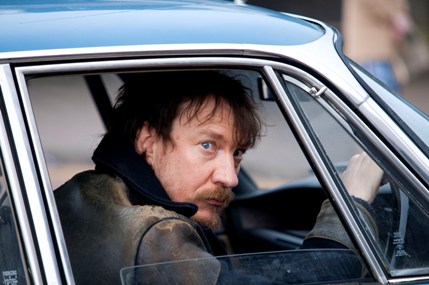 Perhaps realising this, Rose throws in a firecracker performance by David Thewlis (pictured left) as haywire IRA chief McCann. An explosively spluttering maniac and fraud, last seen throwing shamrock-green smoke bombs at the Boston police, he is highly amusing. That in itself shows the passage of time since the early 1970s when much of Mr Nice is set. Cinema currently sees the era as a golden age of radicalised criminality, from The Baader-Meinhof Complex to the upcoming five-hour Carlos biopic of super-terrorist the Jackal. Rose doesn’t attempt those films’ meticulous reconstructions, instead letting Marks saunter past back-projected footage of early Seventies Britain, a more ingenious and resonant solution.
The moral implications of trading with the IRA then are, though, barely examined. Marks affects dismay at McCann’s gun-running with his drugs money, letting any personal taint slide off him, as most things do. The rationale behind his actions, that dope shouldn’t be illegal, passes the blame for having to deal with terrorists, mobsters and spies to an iniquitous, moralistic legal system. There’s a lot of truth in that, but it doesn’t mean Marks’s associations with deadly men did no criminal harm - that all he is is a lovable rogue. There’s nothing else to see in Mr Nice, though. Bernard Rose has previously sounded dangerous depths with the extreme protagonists of Candyman, Ivans XTC and The Kreutzer Sonata. He stays in the shallows here, finding no weight in the true tall tales of a clever man who sold drugs, then wrote a book.
Watch the Mr Nice trailer











Add comment