

In a world obsessed with the next big thing, I was surprised not to see a larger crowd at last night’s Samling Showcase. Since this masterclass programme for young professional singers started 14 years ago, alumni have included Jonathan Lemalu, Anna Grevelius, Christopher Maltman and Toby Spence – a roster that speaks for itself and for the finely honed ears at work within the organisation. Joined by patron and course director Sir Thomas Allen as well as pianist Malcolm Martineau, four of the current Samling Scholars took to the Wigmore stage last night to present themselves and a full programme of music to a curious public.
The rules of a showcase are not those of a concert. Rossini; Handel; Liszt; Mozart; Mahler: that is just a portion of last night’s first half. Lieder, opera scenes, ensembles and arias all muddle along together, jostling and elbowing at times for dramatic space, dragging ear and heart behind them in the scramble. This is concert-making at its most functional and musical delight can occasionally get lost in all the activity. It puts the onus squarely on the young soloists. Not only must they shine in their chosen material, but they must do so without any of the benefits of context, atmosphere or narrative arc provided by a recital or opera role.
Welcoming us gently into proceedings with Schubert was tenor James Geer. In a short selection from Schwanengesang he displayed a nicely balanced lyric tenor that shows all the signs of later doing a Toby Spence and filling out operatically. Capable of some significant power (the climax of "Der Doppelgänger" was a pleasantly chilling surprise) he has yet to acquire that magical head-voice croon of which Thomas Allen later proved himself still the master. Geer’s is not the highest of tenors however, and despite some really solid technique at work, extracts from Così fan tutte and "Wenn der Freude" from Die Entführung aus dem Serail exposed the strain of the upper register.
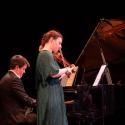
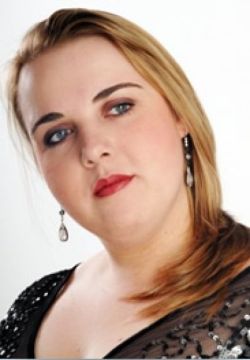 Winner of the 2009 Kathleen Ferrier Award, Sarah-Jane Brandon (pictured right) was perhaps the most familiar of the evening’s singers. Displaying the same glossy tone above the stave and elegant expressiveness that wooed the judges, there is so much to be excited about in the potential of this South African lirico-spinto soprano. As yet suffering from the same control issues as fellow Samling Scholar Katherine Broderick (though with a voice of slightly less weight), Brandon still tends to overblow and twist her vowels at the top of her range where all is not quite rounded-off. An otherwise sensational “Ah, je sui seule… dis-moi que je suis belle” from Thaïs struggled (forgiveably) on its closing D, and elsewhere both Mahler and Rossini suffered from similarly erratic control at moments of high drama.
Both mezzo-soprano Cecelia Hall and Baritone Philip Smith combined vocal maturity with a lively presence on stage. Undeterred by some rather lumpen accompaniment from fellow scholar Daniel Wnukowski (who failed to settle throughout the evening, pushing singers into unsympathetic tempos and spilling wrong notes every which way), Smith powered his way through the splendid “Nell mondo e nell’abisso” from Tamerlano and after a slightly stiff start captured the extremes of fragile ardour and outright comedy of Ravel’s Don Quichotte à Dulcinée. Hall is possessed of a gloriously rounded high mezzo, used perhaps to best effect as the pouting, posturing Rosina in an extract from Il barbiere di Siviglia, but later expanding persuasively for the greater demands of “Sein wir wieder gut” from Strauss’s Ariadne auf Naxos.
Clearly delighting in his role in proceedings (making a cheeky Figaro in the Rossini, and a perhaps too-sympathetic Germont for Traviata), Allen was also permitted a small moment in the spotlight. Choosing Wood of all things – not even Henry, but Haydn – he spread his ample charms over the classics “Roses of Picardy” and “A Brown Bird Singing”, delivering arguably an even more floated, magical ending to the latter than on his recording.
Musical satisfaction is never a given at such events, and it says much that the moments of quality were allowed the space and commitment by their performers to achieve connection with the rather tepid audience. These young singers – two of them British – represent the bright hopes of our opera houses and recital halls, and I can’t be alone in feeling comforted that Allen’s legacy is already securing their future.
- See what's on at the Wigmore Hall this season
- Find Thomas Allen on Amazon
- Find Malcolm Martineau on Amazon





Add comment