So many stage shows (musicals, mostly) are these days fashioned from films that the arrival of Rabbit Hole reminds us of the time-honored habit of plundering yesteryear's Broadway hit for this movie season's trophy-minded bait. And so we have Nicole Kidman Oscar-nominated for her turn as the grieving mum in a part that won Cynthia Nixon New York's Tony Award five years ago. Don't be misled, though, by the rather overemphatic talk of this comparatively below-the-radar venture as merely a comeback vehicle for Kidman; the virtues of the movie, modest though they are, extend without question to two particular talents with whom the film's self-evident name very generously shares the screen.
I'm referring, of course, to Aaron Eckhart as the improbably named Howie (someone that buff should surely be called Brad, no?), husband and partner-in-grief to Kidman's emotionally shattered Becca, and, especially, Dianne Wiest, her inimitably crinkly smile hinting at reserves of pain in the role of Becca's mum, Nat. (Tyne Daly won acclaim in the same part on Broadway.)
It turns out that Becca and her mother are linked by the one experience no parent should have to undergo, namely the death of a child - though in entirely different circumstances. Becca and Howie lost their four-year-old boy eight months before to a random, senseless road accident, whereas Nat's son - Becca's brother - was an adult embarked on the suicide course that comes with addiction. Their joint knowledge of loss ought to make for common empathy or at least a shared discourse but in fact does not: mourning works in mysterious ways, one of which is a tendency to pull people apart at the very moment that it should by rights provide some sort of balm.
The result is a film of creased brows, tight lips and sudden flare-ups of emotion, precisely the stuff that can be catnip on stage. On screen, one is more aware of the deliberately withheld information - it takes a self-consciously long time before we actually twig what has happened to Howie and Becca - and of the planting of visual symbols (one of which involves an actual plant) that might have worked at the conclusion of A Raisin in the Sun in 1959 but looks pretty hokey now. Indeed, you'd never clock Rabbit Hole as the work of the same actor-turned-director, John Cameron Mitchell, who made the sexually and cinematically freewheeling Shortbus (2006). This one wears its restraint like a badge of honour; Terence Rattigan, one feels, would approve.
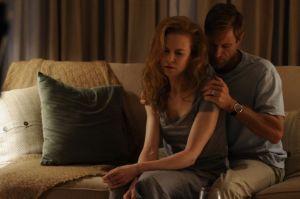 The British master might also admire the opportunities given actors to implode and then let rip, as dictated by material that, in Becca's case, finds her turning away from God, group therapy, sexual intercourse and Al Green and toward an unexpected rapport with the teenage boy (Miles Teller) who was driving the car that hit her son. Kidman's task, then, is to bloom like the human equivalent of the plant that she is seen carefully positioning at the start, the more impulsive, impetuous Howie sequestering himself away with the very memories of their son that Becca finds too much. Eckhart (pictured above right, with Kidman) communicates beautifully the fragility that co-exists with Howie's physical strength, leaving the sweet-faced Wiest to cut to the quick in the (too few) moments that belong to her. As both written and performed, Nat may tend toward the tipsy, but she is no one's fool.
Nor is Kidman, whose CV (Lars von Trier, not one but two movie musicals, her laurelled turn as Virginia Woolf, and that's just for starters) is infinitely more eclectic, even eccentric, than one might have thought possible when she first hit Hollywood. If the actress seems a bit tight this time round, that may be due to the constraints of a narrative that finds greater resonance in small gestures than in the putative Big Scenes, those last here including a violent supermarket encounter that reads rather desperately as an attempt to open up a house-bound play. The film fares better when it is scanning that famously smooth Kidman visage for the emotional and marital fissures afflicting Becca that are contained therein.
The film, to the credit of Lindsay-Abaire's adaptation of his own Pulitzer Prize-winner, concludes not with some sweeping, faux-optimistic flourish but on a gentle image of rapprochement that feels right. Will Becca and Howie ever truly accommodate the loss they have known? Perhaps not, though they can haul themselves out of a rabbit hole of despair and recognise that life does go on. And that they may choose to do so, too.
Watch the trailer for Rabbit Hole