This retelling of the Cymbeline story opened – or at least appeared to open – with the entire cast contributing their tuppenceworth on the issue of what the story of Cymbeline actually was. And fair dos. A “late” and abnormally tortuous Shakespearean number, Cymbeline seems not only to have been constructed out of the usual fragments of ancient British history and “borrowed” chunks of Italian literature, but also from itinerant bits of other Shakespeare plays! Romantic antics, warring dynasties, poison plots, nation-building myths, randy wagers, skulduggery in bedrooms, banishment, ill-gotten "proofs" of things, treachery, jealousy, man-love, clever servants, witch-doctors, the ghosts of dead fathers, cross-dressing, transparent Italian pseudonyms, divine intervention – you name it, Cymbeline’s got it. Oh, and parts of it are set in Wales.
If the play itself already feels like a multicultural parody (not to mention a parody of Shakespeare), then the venue was doing its best to rise to the occasion: a Sudanese theatre troupe performing – in the grey half-outdoors – an Arabic-language play about Italians and Celts to an audience of Sikhs and South Americans, grannies, backpackers, academics, hi-viz cyclists, American tourists and African embassy officials, all to the tune of a flautist playing Bach under a nearby railway arch and the thunder of Chinooks overhead. A matchlessly “London” welcome for the South Sudan Theatre Company’s first international gig.
It’s not worth taking Shakespeare too literally, even in your own language
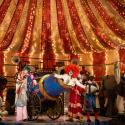
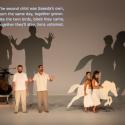
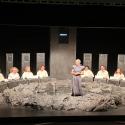
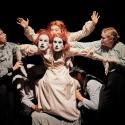
In and around the SSTC’s ebullient song and dance – complete with weaponry, day-glo cowrie shells, bead necklaces, bush-hats, rubber sandals, and acres of leopardskin – the play was delivered in the lingua franca of the nascent South Sudanese state, Juba Arabic, augmented by a rough and irregularly synoptic paraphrase thrown up on the supertitles and occasional grace-notes of English: “This woman, very crazy!” These oral/aural pull-quotes added much to the humour of the afternoon, as well as encouraging the risk of little socio-cultural mishearings that conformed to what you thought might be going on.
 At an obvious cost, the Juba adaptation offered some curious gains in terms of narrative clarity. Notwithstanding what already looks like a weird mish-mash of cultural references – culminating at the Python-esque paratitle, “Posthumus orders his servant Pisanio to kill Innogen at Milford Haven" – the jury, apparently, is still out on whether Cymbeline is a tragedy or a romance (if the latter, surely the only one in which one character plans to rape another on the body of a third and then marry her!). So the SSTC decided, with commendable enthusiasm and daring, to grasp the obvious third option – and play it as a comedy.
Big scheming monologues aside, it was pretty funny. Sitting in the Juba-speaking section of the audience, I was in absolutely no doubt as to which bits were amusing and which lamentable. I also knew when to murmur in agreement, when to yelp in mock horror, and when to clap my hands to my forehead in prayer. The canny reverse-scheming doctor (Francis Paulino Lugali, also playing Posthumus) got particularly big laughs, and well deserved. And if it did occasionally seem that there was more laughter than there ought to be (to wit: when the malign Cloten looks up the sleeping Imogen’s skirt, the native speakers fell about the place; everyone else, not so much), that only constituted evidence that a indigenous Sudanese version would, had it existed, have been told in a markedly different way.
Apart from the basic themes of internecine strife (and international war), a sneaky extra line about using “government position for your own benefit”, and a general question mark over the issue of rendering unto Caesar those brightly-coloured ostrich feathers which are Caesar’s, it was not entirely clear why South Sudan had landed this particular play for the Globe to Globe proceedings, so best not to read too much into it. Except to say that as Cymbeline accepted his vassal status before Rome, and proclaimed the great promise of peace in our time, another massive army helicopter thundered overhead.
- Find out what the cast and crew make of Cymbeline on the South Sudan Theatre Company blog.
- Globe to Globe continues until 9 June
- Read theartsdesk's coverage of Globe to Globe
- See more photographs of Globe to Globe productions on theartsdesk's Facebook page