Let's say Greek tragedies exist in a multiverse where the same stories play out simultaneously in thousands of ways. And let's say we're given free rein to argue over those stories, debate their morals and characters and disagree fundamentally over the story arc itself. This is what the German playwright Roland Schimmelpfennig explores in his take on the Greek general Idomeneus, who led the Cretan armies to Troy and also inspired a Mozart opera (Idomeneo). His 70-minute play embraces the possibilities of story-telling rather more than the story itself.
Translated by David Tushingham and directed by Gate associate artist Ellen McDougall, this modern-dress version of Schimmelpfennig's play begins with the audience crawling through a bright white portal (essentially a hole in the wall) onto the darkened stage. Ana Ines Jabares Pita's set shows a capsized warship hovering ominously above a shiny black surface. At this stage, the surface represents the dark ocean, but it will soon turn into a Slip 'n' Slide when the actors argue over the story in an almighty water fight, the elements raging against the body.
 Revered commander Idomeneus is returning to Crete after 10-years fighting at Troy when his fleet is caught in a storm. To save himself he promises Poseidon that he will sacrifice the first living thing he sees when he arrives safely at the coast. And so it is that he steps onto the empty beach to find his son, Idomantes. What happens next is told via a five-person chorus playing multiple characters who enact competing scenarios of what could have happened. Does Idomeneus kill his son straight away? Does he kill himself? Does Idomantes fight for his life? And what will Meda, Idomeneus's wife, make of all this? In some accounts, she goes along with the promise to kill the child; in others, the parents are seen flirting (and rather more than that), not to mention spinning all over that soaking wet stage.
McDougall has taken lines intended for "10 to 14 men and women, possibly more", and handed them to a much smaller cast - a welcome act of pragmatism given the Gate's small stage space. But in an ambitious gambit that doesn't really play out, the cast attempt to include the audience in their debates in a largely pedestrian manner. The front row are given cups of water, and individuals are pointed at and cheerfully asked "Did you know that?" as we are told yet another version of Idomeneus's fate. And since we're not actually invited to give an opinion, we remain spectators to the raucous goings-on.
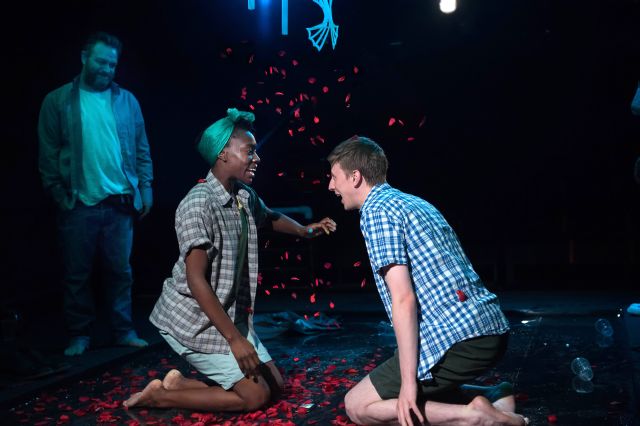
The actors pass the roles around as they discuss what may or may not have happened. Susie Trayling makes a feisty Meda who is sometimes nervous to confront Mark Monero's imposing Idomeneus. Ony Uhiara really comes to life as Idomeneus's nameless girlfriend: the daughter of a fisherman, shy and young and always fighting for the underdog. Alex Austin turns Idomantes into an excitable manchild who moves swiftly from his fisherman-girlfriend to the much more powerful Electra, again played by Uhiara (pictured above centre). Beyond the game playing is a meditation on the value of life, Idomeneus's arrogance made more so by his years in Troy and a refusal to let drowning at sea be his sorry fate. By the end, he has become a more modest hero, clinging to life with ferocity and refusing to let go. The problem is that by this time we have heard so many wild accounts of his story that it is hard to distill which one - if any - really matters.