“Tragedy reminds us how to live,” declares Moira Buffini’s democratically elected heroine, Eurydice. It’s a reminder the playwright herself and her latest work, Welcome to Thebes, is eager to provide. Following on the well-worn heels of last season’s Mother Courage at the National comes a new play that once again places women in the front line. Leaving to Brecht the barren fields of Western Europe, Buffini sets up her stall in the fertile dramatic ground of contemporary Africa – a place where gang-rape and murder are just the prologue.
Within this political reaction chamber Buffini collides the myths of Ancient Greece – the stories of Antigone, Oedipus, Theseus and Pentheus – with the stories of present-day Liberia, Uganda, Rwanda: creation myths all, each telling of the birth of a nation in blood. Taking as her starting point the character of Eurydice, condemned to knit in silence and look on while her husband Creon destroyed nation and family, Buffini creates an epic drama of might have been, a subjunctive parable for our times that sees Creon dead and Eurydice as the ruler who must guide her ravaged nation out of civil war.
Brought out from the mythical shadow of their menfolk, Buffini's women are delivered from their traditional options of suicide or silence into a world of choice and terrible responsibility. Referencing President Ellen Johnson Sirleaf’s Liberia (though keen to stress the non-specific "somewhere" of her location) Buffini sets up a choice for Eurydice, Theban president-elect, between accepting the loaded political aid of the democratic and civilised Athens (an America substitute) and that of Sparta (shades of China). It’s a transposition that fits neatly. perhaps too neatly, walking the fine line between myth and parable at times a little too closely for dramatic comfort.
To invoke both the epic and the painfully mundane, to reframe ancient myth while simultaneously interrogating contemporary political legends is a huge task and something inevitably has to give. That something is language. Determinedly, aggressively banal, each phrase lands with the blunt impact of an axe blow. Buffini’s is the brutalist architecture of language, eschewing beauty with the unerring precision of a town planning authority. The elegant aphorisms of Greek tragedy are rewritten for our time – “If you intend to fuck with the god of power then make sure you don’t fall asleep beside him” – and revenge becomes a matter of casting someone as your “bitch”. I kept thinking of Debbie Tucker Green’s East/West parable Stoning Mary, the language of its child soldiers and barely educated characters, and longing for just a moment of the brutal beauty of their contorted lines.
Comedy is also a problem here. Leaving aside the obligatory Oedipus gag (I won’t spoil the fun – it may be the most you have all night), Buffini’s humour seems to belong to a different genre. “On a scale of one to ten, just how fucked is this place?” Far from the awkward-poignant weaponry of tragedy, this comedy is an altogether more stolid exercise in tension-breaking, pulling the tone from awkward extreme to extreme – Loose Women one moment, Sophocles the next.
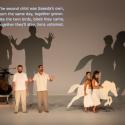
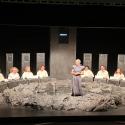
Set against a single backdrop of a ruined palace, the simplicity of this production reflects a faith in the quality of the play (quite a contrast to the all-singing, all-dancing approach of Marianne Elliott and the team behind the first-rate production of Middleton's second-rate play Women Beware Women, running in repertory in the same theatre). With the focus already firmly on the actors, director Richard Eyre has little to do other than shape the tension/release arcs that dominate each act, and after an awkward start (the less said about meta-theatrics the better) his understated, naturalistic approach yields a pacier Act II.
Rarely bettered in ensemble theatre, the National once again proves its strength. Led by Nikki Amuka-Bird as a strong - if occasionally strident - Eurydice and David Harewood as Athenian Blair-Obama composite Theseus, the sexual politics of the piece are the equal of its ethical dilemmas. This pair are, however, outdone by the powerful duo of Chuk Iwuji as warlord Prince Tydeus and his hard-eyed consort Pargeia (Rakie Ayola), with further support coming from Tracy Ifeachor’s carefully brittle Ismene and the trio of Alexander McCall Smith-esque female ministers.
“The myths are where we risk what we would never risk in life” - Buffini’s is a brave choice of topic; greater than all but a handful of playwrights, such themes as she invokes come with fatal flaws as standard. Framed securely by the conventions of mythology, the play never risks collapse; neither however does it risk greatness. Cushioned by its allusive structure, it is also dulled by it, Buffini herself never quite committing to the risks she demands so strenuously of her characters.