Sixteen-year-old Bernadette is determined to write short stories. She's a promising writer, describing her own feelings, the strangers and friends who cross her path in telling detail. Occasionally, the similes are a little forced: an old man has a face like wet Kleenex; the disappearance of her boyfriend's mother "looms over everything like a dinner plate glued to the wall". She admits she gets into trouble for including too many similes, but her descriptions could never be accused of lacking colour. Most of all, like any teenager, she needs an audience.
Bernadette's life is going through a patch which she knows makes good material. She is pregnant; her boyfriend, a narcissist with his own family problems, may be losing interest in their relationship; her father has left home for a statuesque air stewardess and her pill-popping mother spends her days distractedly watching the Shopping Channel. Bernadette takes the train to New York and has a sexual encounter of sorts with a stranger. And - importantly - in a school production of Genet's The Maids, in which two servants role-play their mistress and plan to kill her, she is to be Claire, one of the murderous plotters.
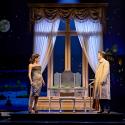
The action of The Edge of Our Bodies takes place on the stage of the school theatre set for The Maids. In Lily Arnold's atmospheric, claustrophobic design, antique mirrors serve to represent both the theatrical nature of The Maids, in which the main characters act out scenes displaying jealousy of their mistress and her selfish hauteur, and also the self-absorption of the teenager.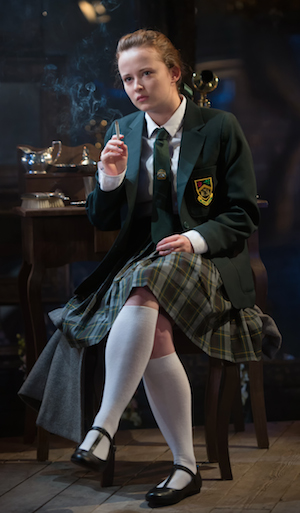 The only other character to enter Bernadette's Technicolor world in our presence is the school maintenance man (Trevor Michael Georges) who really needs to clear up and go home after the lone teenager's moments of wild abandon when she dances to loud music and chucks the furniture about. The interaction between the two lasts a few moments, but Bernadette's place in the world changes instantly as an adult sweeps up around her. She is suddenly small and vulnerable, a problematic child. And this, of course, raises the possibility that her point of view is highly coloured, that she is an unreliable narrator. Whether or not events occur exactly as she reports, her combination of complete immersion in the melodrama of her own emotion, her ironic writer's detachment and her sense of dislocation, of being, as she puts it, on the edge of her body, ring absolutely true.
Adam Rapp's play, the first of three in the Gate's "Who Does She Think She Is?" season to celebrate the theatre's 35th anniversary, finds the female teenager's voice with some panache and Shannon Tarbet inhabits Bernadette with absolute conviction. She speaks for all but five or ten of the 75 minutes, mainly as precocious, music-mad East Coast Bernadette, occasionally as Bernadette the American teenager playing Claire playing the mistress in a strained approximation of posh English. For perhaps a third of the time she is reading from her writer's notebook. Although there are moments when this threatens to stretch the patience of the audience, the storytelling under Christopher Haydon's crisp direction is never less than gripping. Rapp and Tarbet make all the characters - her boyfriend's dying father, strangers on a train, Tanya the bar hostess and Marc the unappetising pick-up - loom into life. However she copes with becoming an adult, there is no questioning Bernadette's (and Rapp's) gifts as a writer.