

Casting existing partners is no guarantee of artistic success – for every Burton/Taylor, there is a Bennifer. Hannah Price has taken a risk, too, by pairing the revered Dame Harriet Walter with her comparatively unfamiliar American husband, Guy Paul, in Clara Brennan’s exposing two-hander. But it’s a risk worth taking, as the couple’s deep-rooted rapport lends a frisson to this stroll down memory lane.
It’s 30 years since their first meeting, and troubled transatlantic lovers Louis (Paul) and Boa (Walter) are interrogating their shared history to uncover truths. The couple (pictured below) initially delighted in idealising one another – Boa lusting after the rugged war correspondent, a Pulitzer Prize-winner with a kayak on his wall; Louis transfixed by the casual glamour of the bendy British ballerina. With equal fervour, they unpick those fantasies, as Louis questions Boa’s liberal appropriation of suffering, while she labels him a danger junkie. She expresses too much, he too little. When personal and professional challenges pile up, their marriage reaches breaking point.
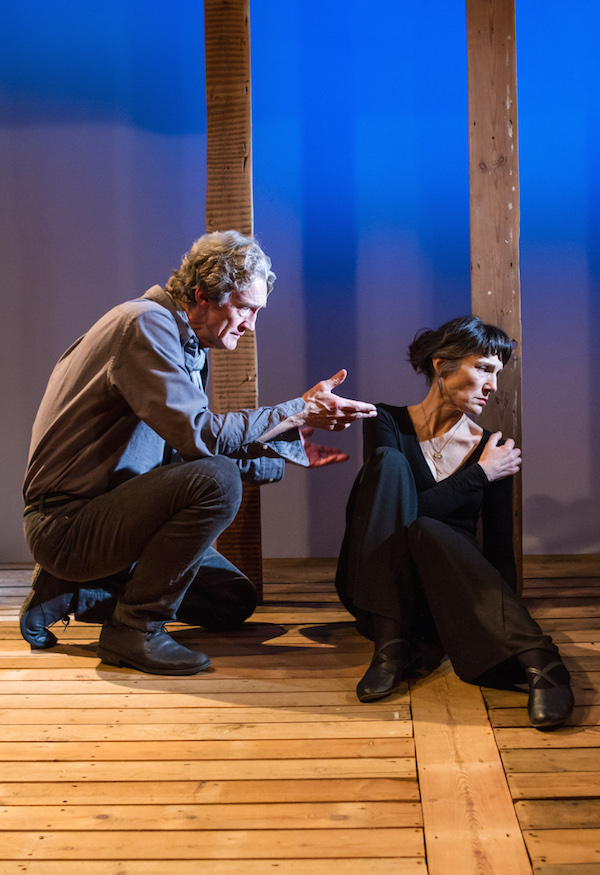 Brennan’s 85-minute piece flashes back and forth as the dual reminiscences take flesh, signalled through lighting and sound cues, but truly sold by the pair’s seamless transitioning. Walter is magnetic as the younger Boa, a nickname earned by resemblance to both feather boa and constricting snake. At once sinuous and pugnacious, she stalks her prey, holding his Pulitzer hostage in exchange for a striptease. Fragments of that past self, ruled by reckless passion, remain in the present, although she has mellowed with wisdom. So, too, has Paul’s wry Louis, his stylish swagger receding as deeper knowledge takes hold.
These beautifully detailed portraits, visible up close in the Trafalgar’s intimate space, are the selling point of a piece that is rather a non-starter dramatically. Brennan’s largely conflict-free narration dulls the impact of her winding tale, and even within the flashbacks, there is a tendency to filter the action through a therapist’s interpretation of it. Later revelations explain the reasoning behind this, but we’re still distanced by analytical nostalgia. Too much is explained, too little experienced, and Price’s brisk production seldom lingers. It’s both compliment and criticism to say the densely written Boa might work equally well on radio.
Yet Brennan does boast an excellent line in caustic epigram, smartly delivered by Paul. In something of a meta-commentary, Louis halts Boa’s overwrought description with “Similes truly are the sarcophagus of an image”. He dismisses her earnest political dance creations – “Nobody on Earth takes spandex seriously” – and when she sinks into boozy depression, observes that she’s swapped the barre for the bar. Boa’s dismissal is the less sophisticated, but unarguably pithy label “Smug Yankee fuck”.
Amidst the analysis, a few raw moments stand out: Louis’s "hero myth"-debunking Vietnam draft interview (drawn from Paul’s own experience); a cathartic East Asian pilgrimage; and Boa reaching a visceral understanding of the Chilean cueca, danced solo by lamenting women. Love is imperfect, difficult, maddening, but, in this all-consuming liaison, ultimately transcendent.











Add comment