

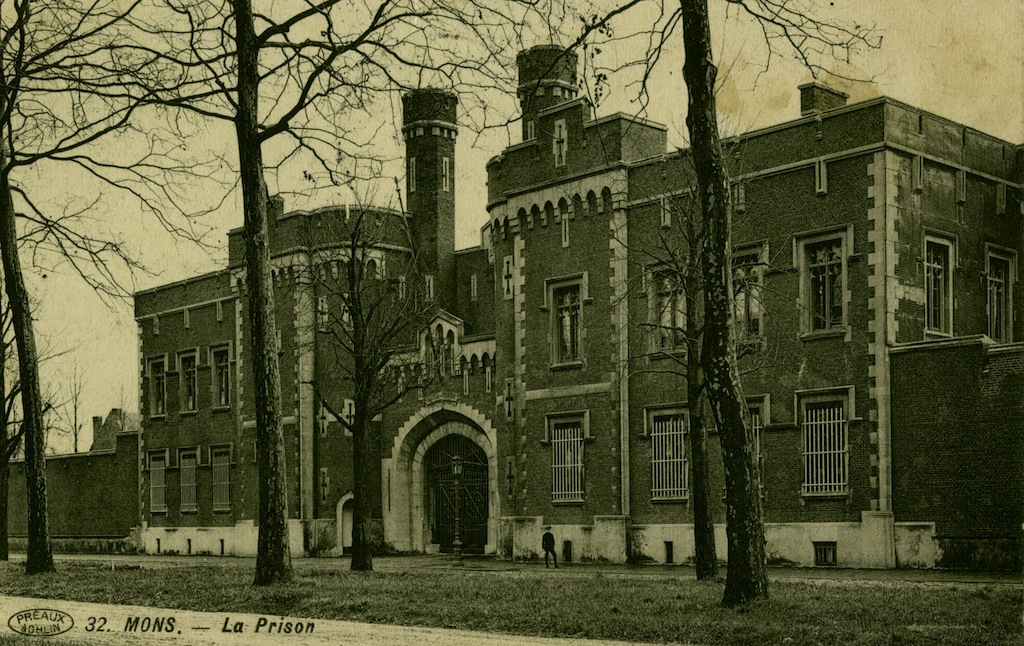
Poetry is everywhere in Mons, with 10 kilometres of verse painted along the city streets. You’ll even find it on the walls of the city’s imposing 19th-century prison, at odds with the arrow slits, the crenellations, and the towering nets preventing family or friends throwing contraband into the exercise yards.
But the poetic muse can come and go as she pleases, and a number of poems written inside these walls have entered the literary canon. Between 1873 and 1875, the city’s most famous inmate was Paul Verlaine, who shot fellow poet Arthur Rimbaud, but was banged up for a number of reasons which emerge in gripping fashion at Beaux-Arts Mons.
This year’s European Capital of Culture is laying claim to one of the greatest stories in French literature: the unhappy love affair between two of its foremost poets. Mons honours both with individual shows in its revamped Musée des Beaux-Arts. And so now the blinding white gallery promises to transport you as securely as the 1870s police van by the entrance, seemingly vacuum-sealed in a plastic bubble.
Several newsworthy coups highlight the importance of this display
But even the most colourful writers pose problems for curators. Letters and manuscripts don’t generally wow an audience in the same way painting or sculpture does. And the Verlaine show features some 220 of these documents, most displayed for the first time. If you have difficulty reading faded 19th-century handwriting, this may be frustrating, no matter how good your French. Luckily a number of transcripts accompany them – and the concrete evidence that both legendary poets corresponded, with great mutual affection, is captivating.
Several newsworthy coups highlight the importance of this display. It is, for example, the first time we can see a newly discovered photo of Verlaine aged 22. While the jutting brow and gimlet eyes are present, the baldness is yet to come. What is most remarkable about the poet’s appearance is the degree to which he was able to caricature himself in a wealth of inky sketches. Many letters take the form of sharply observed cartoons.
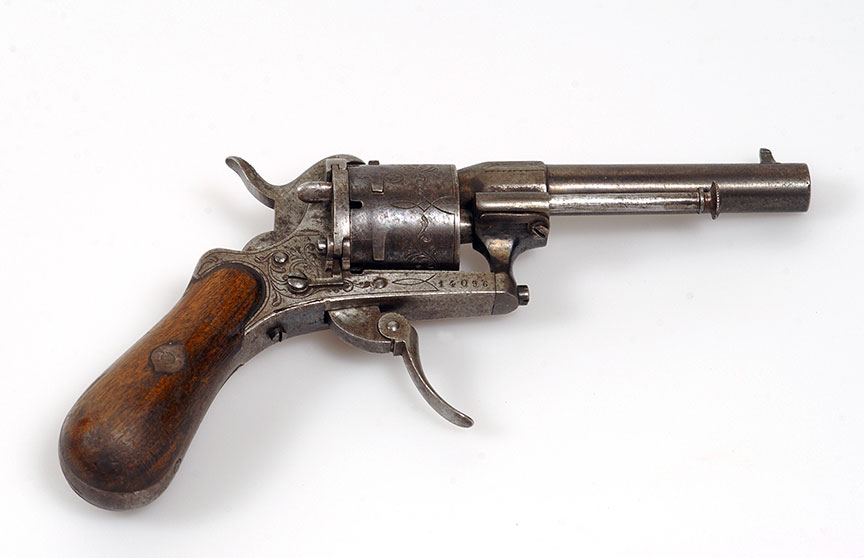 And then there is the gleaming 7mm pistol (pictured right), tracked down by the curator and shown for the first time. Verlaine fired it twice in a hotel room in Brussels. One bullet hit Rimbaud’s wrist; the other embedded itself in the floor. He was drunk, of course, absinthe the poison of choice. Rimbaud never pressed charges. So it is likely the conviction came about through Verlaine’s involvement in the Paris Commune and unfortunate spousal abuse, as much as the lovers’ tiff.
Prison (pictured below) offered a chance to sober up. It was from here Verlaine published Romances Sans Paroles and went some way to break free of the strictures of rhyme and metre, if not cell 252. The prison register is another key artefact in the exhibition and, in its terse way, this too tells a story. (“Conduct: regular; trades learned: none; religious practice: religious in later months”.)
 Not only is this exhibition authoritative, but it is beautifully designed too. Lighting is low and sepia. White pages ripple overhead; black ones hang like a cloud. In another evocative touch seven of the original prison doors confer with one another in a sculptural circle. Half a dozen of the poems are naturally available as handouts. By sending you from the gallery to the page, this show does everything a literary exhibition should.
Back in the town centre one finds another footnote to the lives of Rimbaud and Verlaine. Mons is where, in 1901, collector Léon Losseau found a cache of several hundred first editions of Un Saison en Enfer. (This despite the fact that Rimbaud is said to have burned all remaining copies of his best-known work.) So now at the Maison Losseau, a short walk from the museum, you can see a rare example of the original imprint. It lies in waiting for you, still smouldering like coal from the hot place.
- Verlaine Cellule 252: Turbulences Poétiques at Beaux-Arts, Mons until 24 January




Add comment