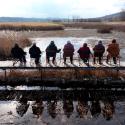
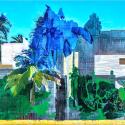
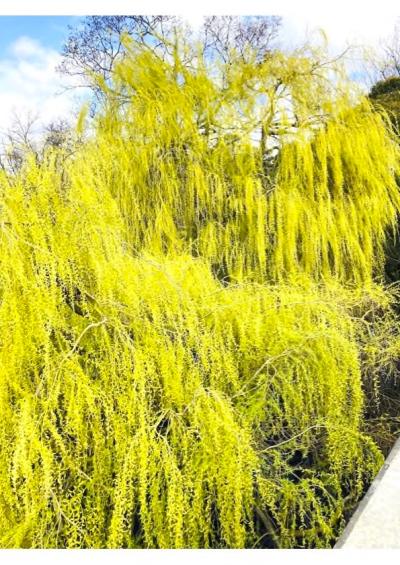
My walk through Hyde Park was an absolute joy. Spring is in the air, the weeping willow is in leaf (pictured below right: photo by S.K), the narcissi are in bloom and the sun was shining, yet the Serpentine Gallery is plunged into darkness.
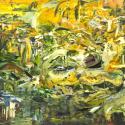
The lights are dimmed to enable you to see David Hockney’s frieze of iPad paintings which wrap around the gallery walls in a continuous strip. Of the 200 or so pictures he made in the course of a year following the changing seasons in Normandy, where he has a studio, roughly 100 are on show (main picture: detail). But even when your eyes have adjusted to the dim lighting, the pictures don’t begin to match the experience to be had outside – of the flowers, the trees and the clouds scudding across a blue London sky. The exhibition leaflet likens Hockney to the French Impressionists, but these pictures would surely have Monet turning in his grave.
Hockney was once a brilliant draughtsman but, fascinated by developments in technology, he has sacrificed his skills in order to play with a new digital toy – the Quantel Paintbox. Even though the company has designed some brushes specially for him, the range of marks they can offer is still crude. The lines, squiggles, dabs, dots and blobs available are just not subtle enough to encapsulate the glories of a landscape; nor are the colours varied enough to suggest depth or to capture the fleeting changes in natural light.
So not a breath of air animates these lifeless scenes. The skies are a uniform blue, the grass is bright green flecked with dabs of colour that fail to alleviate its flatness and, hanging as heavy as a loaf of bread in the sky, an occasional cloud looms overhead.
Hockney is like the Alan Bennett of the art world; but while the playwright turns colloquial commonplaces into dramatic gold, Hockney does the opposite. He reduces the richness and complexity of the real world into faux naive truisms.
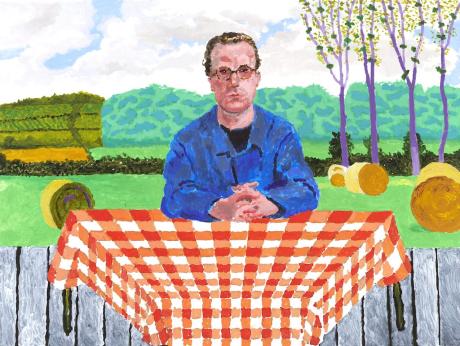
On show with A Year in Normandie is a series of portraits of friends and carers (pictured below left: Jack Ransome Resting on an Orange and White Checkered Tablecloth, 2025). Each poorly painted figure sits at a table covered in a gingham cloth rendered in reverse perspective which makes it seem as if table, man and cloth are about to slide out of the canvas into your lap. It’s as though Hockney were pretending to be an amateur artist who hasn’t yet grasped the basic laws of picture making.
Accompanying the portraits, though, is a set of still lives which are much wittier and more astute. Perched on top of the same table (still rendered in reverse perspective) is an abstract painting in the style of a famous artist such as Mark Rothko, Gerhard Richter or Frank Stella. So a conversation ensues between abstraction and figuration in which Hockney’s cock-eyed realism provides the mis en scene for the display of another artist’s work.
A colourful Richter look-alike, for example, rests on a grey gingham table cloth; but abstraction has infiltrated the surroundings in the form of horizontal bands of grey representing the floor boards and a grid of cream squares suggestive of wall tiles. The two languages were once considered polar opposites but here, it seems, they’ve finally made friends.
Hockney obviously hasn’t lost his mischievous sense of humour. I just wish he would also revisit the wonderful graphic skills that so bewitched us back in the day.