American photographer Catherine Opie took her first self-portrait at the age of nine with a Kodak instamatic she’d been given for her birthday. There she stands in the garden, a little toughie flexing her biceps like a muscle man.
And there she is again, twenty four years later. This time she presents herself as Bo (pictured below right), a persona developed among her queer friends in California. Her stance – chest square on, feet apart and thumbs in pockets – makes her look like an off-duty cop, an idea enhanced by what could be a baton dangling from her belt. She looks to camera with a neutral expression, but with her closely cropped black hair, full moustache and tattoo it makes her seem confrontational.
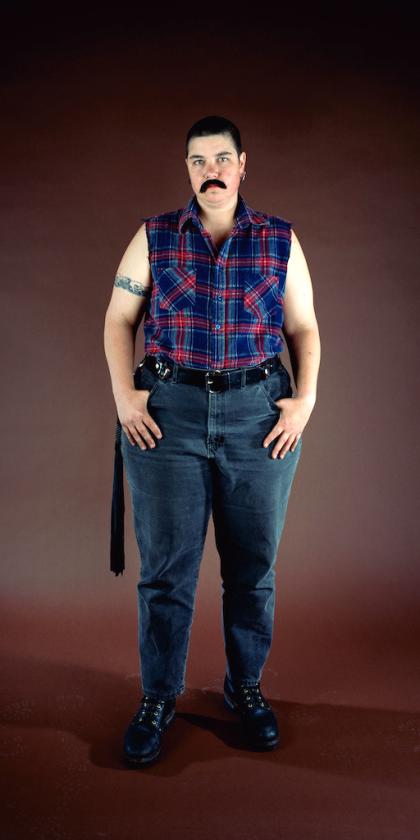
And it makes you realise how rare it is for a woman to stand her ground and look you straight in the eye without tilting her head and smiling accommodatingly – so rare, in fact, that it’s unnerving. The photograph is a straightforward record of Bo’s androgenous appearance, but it also invites you to consider how you declare your sense of self to the outside world through your choice of dress, make-up (or lack of it), gesture, posture, facial expression and so on.
Bo appears again in Being and Having 1991, a set of 13 photographs of the artist’s friends presenting their masculine alter egos, mainly through the adoption of stick-on moustaches or beards. “We’re women occupying a masculine space,” says Opie of the series, which suggests a sense of transgression that felt dangerous back then and, what with the repressive attitudes currently sweeping the United States, could be courting danger once again.
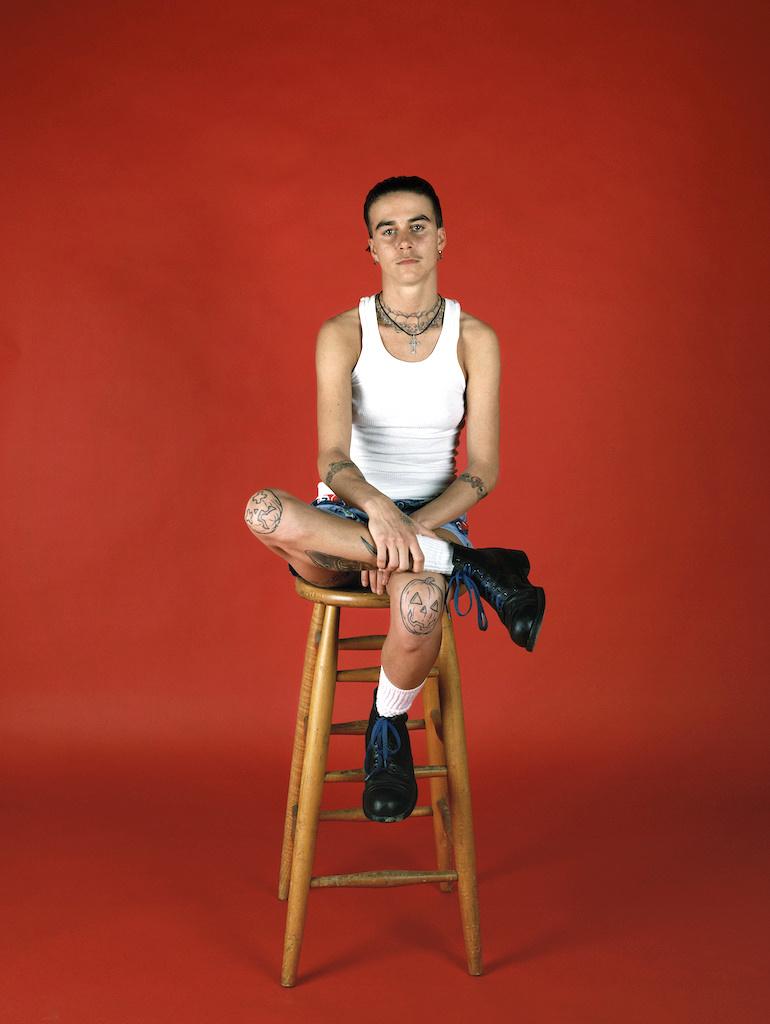
Despite sporting an exaggeratedly droopy and obviously fake moustache, Pig Pen is pretty convincing. In another shot taken two tears later (pictured below), her moustache seems real. She sits on a stool, looking hyper cool in a white vest and shorts over white socks and black boots. Every detail of her immaculate appearance is considered down to the single earring, and the crucifix that hangs over the skulls tattooed round her neck which, in turn, chime with the halloween pumpkins tattooed on her knees.
Taken with a large format camera, the portrait is one of a series made when HIV/AIDS was ravaging the queer community. Inspired by Hans Holbein’s paintings of Henry VIII and his court, Opie posed her gay friends against brightly coloured backdrops so as to honour them as her “royal family”.
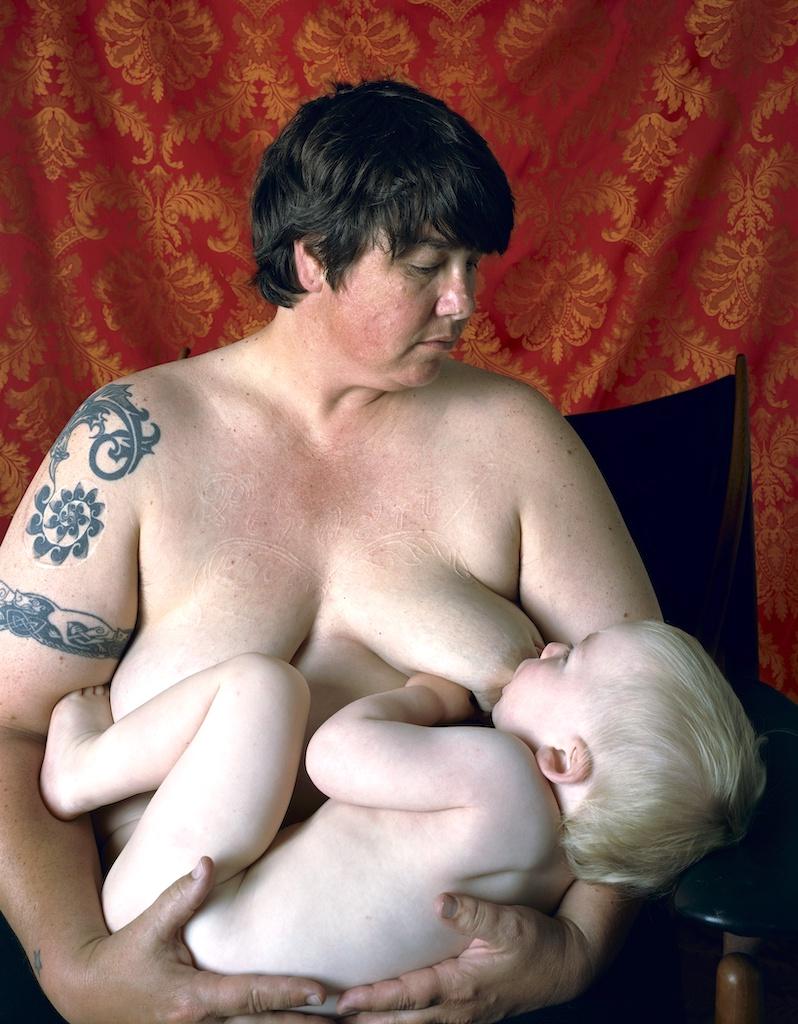
In 2001 Opie had a baby and three years later photographed herself breast feeding her son. Self-Portrait/Nursing (pictured below) is a moving antidote to all those Madonna’s whose perfectly spherical breasts give succour to the infant Jesus in Renaissance and Baroque paintings. Opie looks calmly down at the child cradled in her sun-burned arms and he returns her gaze. Curling around her ample torso, his pale little body is unmarked by time while her lived-in flesh not only has blemishes and tattoos, but the word “pervert” is inscribed across her chest.
The scarification dates back to an S&M portrait of Opie wearing a leather hood. Freshly cut, the word pervert adorns her chest while rows of needles pierce her arms. Ouch! The year before that she had a child’s drawing cut into her back. It shows a “happy family” but with both parents wearing skirts; they’re a lesbian couple!
Self-Portrait/Nursing doesn’t just challenge beauty norms, then, it also questions who should be considered worthy of motherhood. Today when sexism and homophobia are rearing their ugly heads once more, these photographs feel as necessary and as important as they did in the 1990s.
Recently, though, the artist has changed tack. As if to prove that photography qualifies as art (an argument won decades ago) in the 2010s she began to imitate old master paintings. Inspired by pictures such as Jan van Eyck’s Portrait of a Man 1433, she started to pose her sitters in front of black velvet backdrops; and the results are extremely spooky. Spotlighting makes her subjects appear so exaggeratedly three dimensional they seem to loom right out of the picture frame. Melodrama takes centre stage to the point where the pictures come across as a parody that reveals nothing about the sitters but everything about Opie’s desire to be seen as significant – an accolade that she has already won !