Last spring, Imagining Ireland took a fresh, shamrock-free look at contemporary Ireland’s cultural scene, with spoken word and alt-folk mixing with indie rock and jazz, classical, gospel and rap, with the line-up led by Bell X1’s Paul Noonan and Lisa Hannigan.
One year on, and Imagining Ireland returns, but with a new brief – to examine the Irish life in England – and a new line-up. And for contemporary Irish folk fans, this line-up will be your ticket to heaven – led by The Gloaming’s genius fiddler Martin Hayes and sean nos singer Iarla O'Lionaird, alongside two of the best younger singers on the scene, Lankum’s Radie Peat and singer-songwriter Lisa O’Neill, as well as one of Ireland’s finest poets, Martina Evans, novelists Timothy O’Grady and Joseph O’Connor, Nigerian-Irish short story writer Melatu Uche Okorie, and documentarian Fergal Keane.
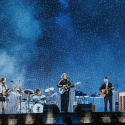
O’Lionaird, accompanied by Liam Byrne on the viol, opened with a 16th-century Gaelic song, “Tiurihm Mhic Fhinin Dhuibh” (“The Black-Haired Lady’s Lament”), as haunted and compelling as that title suggests. You could spot O’Lionaird’s Gloaming bandmate Martin Hayes, the evening’s MC, glimmering in the darkness beyond the spotlight, listening intently, his long hair and lean figure making him resemble some Renaissance troubadour under layers of varnish in an old master’s picture.
The prose readers poured their words like smooth, silky stoutFergal Keane followed, with a poem of his father’s written on his first night in England, as well as a piece of Brexit-related verse (timely or impossible to ignore – take your pick) responding to a Tory grandee’s growling for "Ireland to know its place". London-Irish troubadour Michael J Sheehy delivered the first of two slow, languid solo performances, while Lisa O’Neill, whose new album Long Gone Song is on the new Rough Trade folk label River Lea, was captivating on “England Has My Man”.
She later duetted with Lankum’s Radie Peat, whose voice can be as abrasive as unplanned timbre and as rich and dark as molten tar, often supporting herself with the deep dark flow of a harmonium’s drone. Their showpiece, an unaccompanied account of “The Factory Girl”, was a highlight, alongside Martina Evans’ poetry, her three superb and vividly human pieces distilling more than any other Imagining Ireland’s focus on the Irish in England. The prose readers, including Tim O’Grady’s London Irish remembrances, and Eimear MacBride’s often hilarious account of London-Irish bohemianism, poured their words like smooth, silky stout, while Evans’ poems were the purest of single malts.
In between them all were tunes from the Martin Hayes Quartet, some drawn from the excellent 2018 album, Blue Room, and likely as not the kind of tunes that would have been played in the pubs of Camden, Holloway and Kilburn in the decades following the war.
If there was a caveat to this night’s Imagining, it was the overly languid pace. Readings tend to drain close attention from an audience after 15 minutes or so, whoever it is – and the songs and tunes, too, tended towards slower tempos, towering drones, and sombre airs. At times you cried out for an energy boost – a drum machine and slap bass, perhaps? Many of the songs were of loss, yearning, and more loss, though whenyoung’s Pogues cover (“Dark Streets of London”) and Radie and Lisa’s closing duet on “Old Main Drag”, another McGowan masterpiece, proved to be ebullient, hard-lived and darkly romantic closers to reel us out into the chilly winter’s night.