This is one play by Shakespeare ripe for tinkering. It's well nigh impossible now to take it at face value and still find romance and fun in the bullying: the physical and psychological abuse as a supposedly problematic wife is "tamed" into submission. And there have been experiments. Earlier this year, the Sherman Theatre in Cardiff presented a new play by Jo Clifford based on this source but set in a matriarchal world, and in 2003 Phyllida Lloyd directed a sparky all-female version at the Globe with Janet McTeer as Petruchio caricaturing male crudity to hilarious effect.
If something radical isn't done, there has to be a heroic effort on the part of the actor playing Katherine: having equalled Petruchio in wit and suffered humiliation and abuse, she emerges the ironic winner in the final trial scene, even falling in love with her controller - or else she is utterly crushed by the misogynistic rules of society. Otherwise, the Induction, the introductory story of drunkard Christopher Sly, might just allow the main action to be an outrageous dream sequence experienced by an poor alcoholic sod who is made the butt of some posh boy's practical joke. With luck, whatever line is taken, some of the comedy might survive.
 In this Royal Shakespeare Company production, first seen in Stratford, director Justin Audibert goes for broke. He dispenses with the Sly story but keeps Shakespeare's language (given a few gender-changed nouns and pronouns), investing authority and power entirely in the women. Mother Baptista is trying to marry off her two boys, recalcitrant Katherine and sweetly submissive Bianco. (Names are changed to fit, except for Katherine's). Along comes attractive, strong-willed, rough-tongued Petruchia and the usual plot unfolds with genders swapped. It's a timely experiment and one which does offer a different perspective (and a welcome opportunity for far more female actors than usual) but there are difficulties. For one thing, we are left with the original problem: someone, albeit a man, is very badly treated and obliged to behave according to another's will while still apparently enjoying a happy ending. Abuse is just as unattractive when the abuser is a woman.
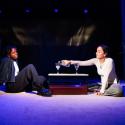
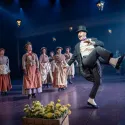
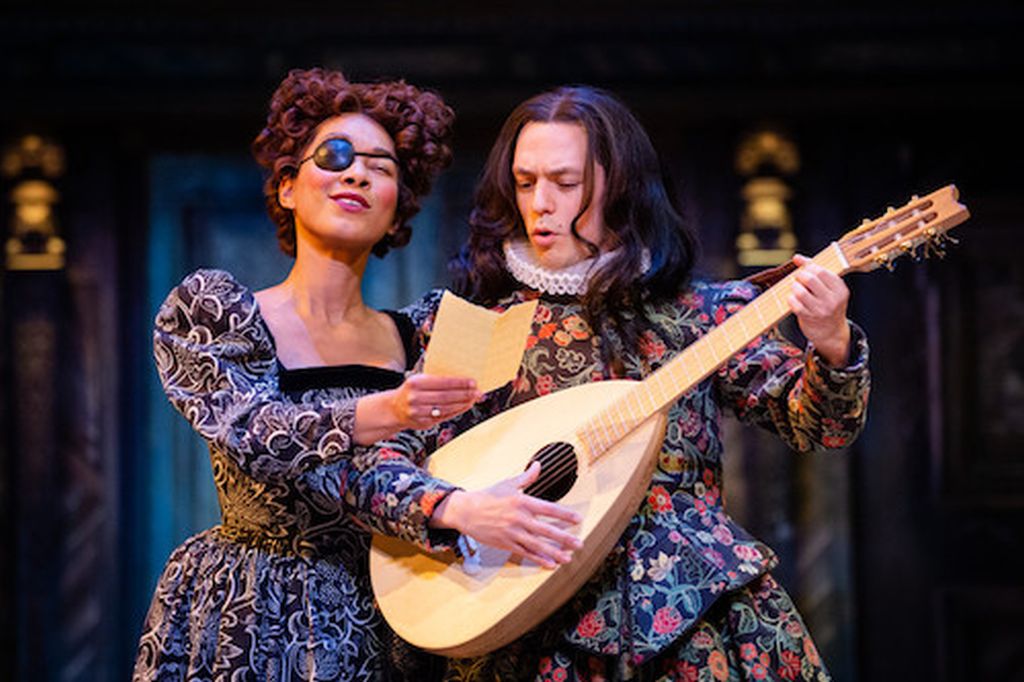
As Petruchia, Claire Price fizzes with sunny energy, however, and the women generally fare well. As Bianco's older suitor, Gremia, Sophie Stanton seems to glide on comic casters and Laura Elsworthy's Trania relishes the opportunities provided by standing in for her mistress, Lucentia, putting on an exaggerated upper class accent and thrusting her arms in the air, a winner - for the moment. The men have a tougher time bridging the gap. Joseph Arkley's Katherine is more quickly tamed than most female equivalents. In his final speech of submission - which moves Petruchia to whisk him off to bed - he seems to stand outside the action, to be apologising for the patriarchy. As Bianco, James Cooney (above with Amelia Donkor as Hortensia) tosses his long tresses provocatively as if to suggest a matriarchal world where men are judged on their appearance. Alas, this merely looks like a caricature of female behaviour.
The strong women here have not chosen to escape the constraints of their Elizabethan-style clothing, despite sometimes carrying swords, although it is telling that Petruchia turns up to her wedding in breeches and wears loose male attire during the taming scenes. Hannah Clark's costumes - velvets and brocades in jewel colours - are gorgeous, however, as is the panelled set by Stephen Brimson Lewis, with its many doors and balcony. Ruth Chan's music, which she describes as "rock Renaissance", provides a soundscape to a world neither then nor now, but gratifyingly something of both.
All in all, this is a sumptuous production with some original touches, but it doesn't make this play any more likeable.