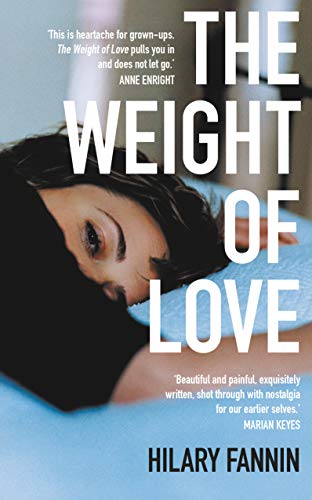
The relationship between Joe, Robin and Ruth is far from your average love triangle. On the face of it, Robin loves Ruth, but after introducing her to his charismatic friend Joe – an artist and renegade – their affair reroutes all of their lives forever.
We know Robin and Ruth end up married, and as a reader we must piece together how we got from A to B. But at the core of the novel is the belief that life isn’t linear and causality certainly isn’t that clean-cut. A story which initially seems anchored in a London pub slowly unfurls into a collection of memories that, when slowly puzzled together, form a just-out-of-reach picture of why life has turned out the way it has.
 Fannin’s ingenious structure – which jumps between 2018 and 1995, London and Dublin – complicates such a simplistic sense of cause and effect. The present is always ruthlessly plodding forward and the past diving inexorably backwards. Fannin is clearly trying to capture the knotty, complicated essence of a life lived, the heartbreaking difficulty of learning how to live as you go along.
Through-lines, such as the progression of the troubled and mysterious Joe, generate a mounting sense that we are working towards a moment of crisis from which the story has erupted. He is disturbingly absent from scenes set in the present day; a sense of what has or hasn’t happened always feels just within reach.
How to deal with life’s uncertainty, and the flashes of tragedy that pockmark a life, is best exemplified by Robin’s serene mother, Ushi, whose “discarded” pottery attempts aren’t discarded at all. In fact they’re the crooked mugs out of which she usually drinks. When it becomes clear she is ill, she tells Robin, “I am not afraid.” It is her ability to look at her past and face her mistakes – like her pottery – that gives her an anchoring presence in the novel’s constant flux.
A novel about familial love, friendship and romantic love – this is a window into the inner workings of unremarkable lives. Robin is a teacher and Ruth helps refugee children. They live a middle-class suburban life – which turns the mundane into something spectacular. Even the most apparently ordinary scenes probe deeply into the grand internal lives of those around us, affirming the inconceivable bustle of humanity, making us feel at once alone and home.
Tackling universal themes such as aging and love with such a microscopic precision, and without reducing them to platitudes, is no mean feat. Fannin does not miss a single beat.
- The Weight of Love by Hilary Fannin (Doubleday Ireland, £13.99)
- Read more book reviews on theartsdesk