

This sober French space movie is concerned with what a female astronaut leaves behind on Earth, not what she finds in the cosmic dark. Sarah (Eva Green) has been selected for a European Space Agency mission towards Mars, realising a childhood dream. Punishing training prepares her for separation from Earth, and from eight-year-old daughter Stella (Zelié Boulant-Lemesle).
Green’s layered performance of female strength rebukes Hollywood's erotic exotic typecasting, letting rage and tears ripple through her then striding on. Men aren’t Sarah’s enemies, but privileged, different and to be negotiated: American crewmate Mike (Matt Dillon, pictured below right with Green) is a rangy, challenging cowboy whose space sexism is blatant, her German ex-husband Thomas (Lars Eidinger) sarcastic and grudgingly supportive. Dillon and Green’s eventually touching though chaste relationship strikes intimate sparks.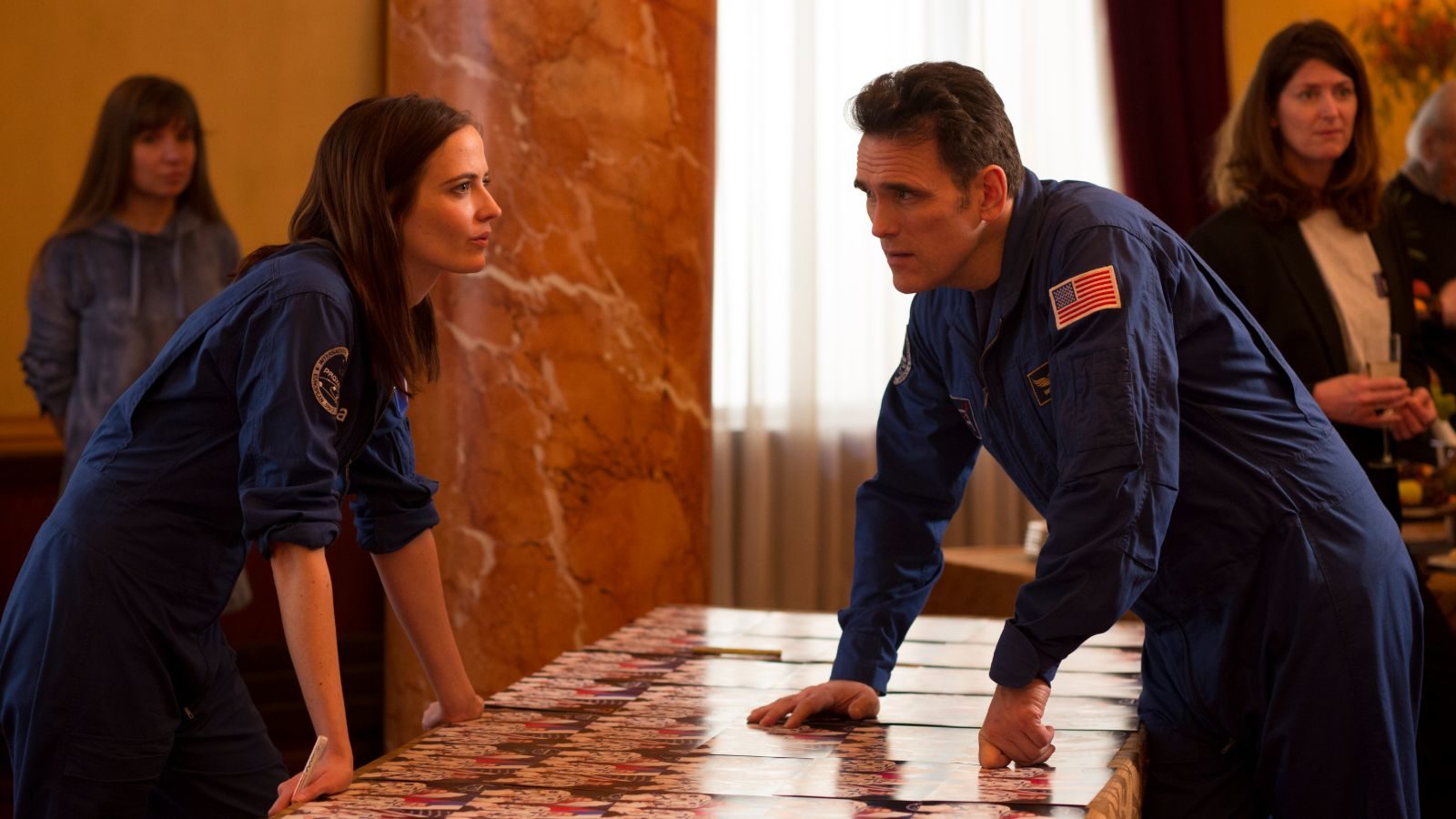 Early interiors are lit dull lunar blue, emphasising earthbound apartments' enclosure. Director Alice Winocour filmed subsequent training at ESA’s real Cologne facility and Russia’s Star City. When Sarah’s car glides into the latter’s showpiece sprawl, as pine forests and blue minarets pass by her window, we are already in another world. Ryuichi Sakamoto’s score replaces dreamy synth washes with orchestral grandeur as this portal is passed.
The pressure of the looming mission makes lives bifurcate and translate themselves in other ways. Staying with Thomas in Cologne, Stella speaks German, to French Sarah’s dismay. The crew meanwhile find common cultural ground, with cosmonaut Anton and Mike swapping national poetry over a campfire. Sarah practises for an inverted life outside gravity, reading books backwards, and saying farewell to tears and sweat, though choosing to keep periods. Winocour has suggested Cronenberg as a comparison, and shows space voyaging as a process of cellular change. Sarah will be a literally different woman when she returns. Norman Mailer’s epic book on the Apollo 11 moon landing, Of a Fire on the Moon (1969), saw its crew as super-WASPs, ultimate avatars of disciplined, straight America during a time of hippie ferment. First Man similarly made Ryan Gosling’s Neil Armstrong super-cool, with sacred levels of sacrificial discipline. Proxima’s space hero requirements are less grand, and enmeshed with the domestic. Sarah spews blood after G-force testing, then calms Stella on the phone; the peace of space simulation contrasts with schoolgirl anguish. Raising a daughter and exploring space are a single, inseparable goal. Only Sarah's farcically sentimental, mission-endangering late favouring of the former betrays the film's previous careful work, and its feminism.
Stella meanwhile watches and worries. “You knew your mother would go away one day?” she’s asked, lift-off and death linked. “First-stage separation” and “cutting the cord” add to the script’s shared metaphors for growing apart. We still powerfully sense that Mum is Stella’s hero, a female pioneer embodying their mutual ache for freedom. The few lyrical scenes studding Winocour’s often prosaic film show this. In one, Sarah stands in full spacesuit in a lake, grinning for Stella’s camera, surreal and stupendous. Later Stella walks across a lunar tableau, picking rocks, the first little girl on the moon.












Add comment