

For 75 captivating minutes, Ralph Fiennes digs deep into TS Eliot’s Four Quartets, the poet’s interlinked reflections on time, faith and the quest for spiritual enlightenment – in what is the first solo adaptation of Eliot’s work for the stage, a co-production between Theatre Royal Bath and the Royal & Derngate, Northampton.
The quartets were written between 1935 and 1941 (published as a collection in 1943) but their insight and humanity – not to mention humour – still ring true to today’s audiences. And Covid has given us another prism through which to view two of the most famous lines in English literature: “Time past and time future/ What might have been and what has been”. Fiennes himself has said that in any modern reading of the poems there are "very strong' reminders of what the world has suffered – is still suffering – in the pandemic.
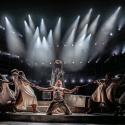
Hildegard Bechtler’s simple set consists of two massive stone blocks, a chair on one side of the stage and a table and chair on the other, with just a glass of water and the kind of microphone Eliot would have used when he recorded this work for radio in 1947. It’s a subtle nod to the author, used just for one short section.
Fiennes enters, barefoot, with the house lights still up. He sits for several moments and warily considers the audience before launching into Burnt Norton. One wonders what Fiennes will bring that simply reading Four Quartets at home (or indeed listening to Eliot’s recording) won’t, but any doubts are soon dispelled as he conjures a world – and Eliot’s otherworld – based on religion and folklore from both eastern and western cultures.
This is no showing-off-his-chops actorly exercise, though, as Fiennes injects fresh life and humanity (and not a little humour) into the work, moving in a beat from tender and unsure to shouty and intense.
His physicality adds a great deal to our enjoyment and understanding of what even Eliot acknowledged was in part an unknowable text, with pleasing vignettes; kneeling at a chair, he evokes a man in prayer, or crossing his hands across his chest as if he were a medieval representation of a saint and acting out the bawdy, Breughel-esque dancing scene in East Coker with some vigour. But then, fans of Fiennes’ work in A Bigger Splash will already know he has the moves....
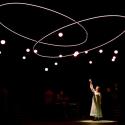
It’s no disrespect to say that the evening would have worked as a magnificent piece of theatre with just Fiennes’s magnetic voice and Eliot’s compelling words, but a tip-top design team adds to our enjoyment. Bechtler’s panels shift on their axes, as if to offer glimpses into those other realms suggested by Eliot, while Tim Lutkin’s lighting conjures fire and ice, sunrise and winter landscapes (and most strikingly, there's a complete auditorium blackout for the line “O dark dark dark”) and Christopher Shutt’s clever sound design is evocative but unobtrusive.
A compelling evening.
- Four Quartets is at Bath Theatre Royal until 5 June; then touring until 24 July
- Read more theatre reviews on theartsdesk

Add comment