

Ageing Mick wakes up on Portobello beach with two gold rings in his pocket, and embarks on the bender to end all benders in order to work out what or who they’re for. Young Gilly has a poorly pug named Mr Immanuel Kant, but can’t face having it put down. Gaynor has suffered from fibromyalgia for decades, but must put it aside if she’s to see her newborn granddaughter. Dougie and Ciara are preparing for their life-changing arrival with one last hedonistic night on the dance floor.
On the face of it, Frances Poet seems to be following a well-worn path as the five Edinburgh lives in her quietly moving play intersect, collide, and begin to add up to a picture bigger than any of them individually. But if you’re expecting Still to be a puzzle play, in which all the elements and references eventually slot seamlessly into each other, you might be disappointed. It’s something more subtle and more elusive than that, bouncing themes and ideas across its web of storylines, and slowly revealing its luminous meditations on love, loss, suffering and, most importantly, death.
No, Still doesn’t end up as the sunniest of plays, despite the joy that Poet finds amid and despite the various demises – some shocking, others inevitable – in her intricately constructed, elegantly crafted narrative. Nor does she offer easy solutions or neatly tied-up endings: there are plenty of links left half connected, or ideas that resonate teasingly from story to story, lingering in the memory after the show is over and triggering later realisations. But Still is all the richer for that, and for the work Poet entrusts in her audience to do to make sense of it all. And there is, it has to be said, a fair amount of work to do.
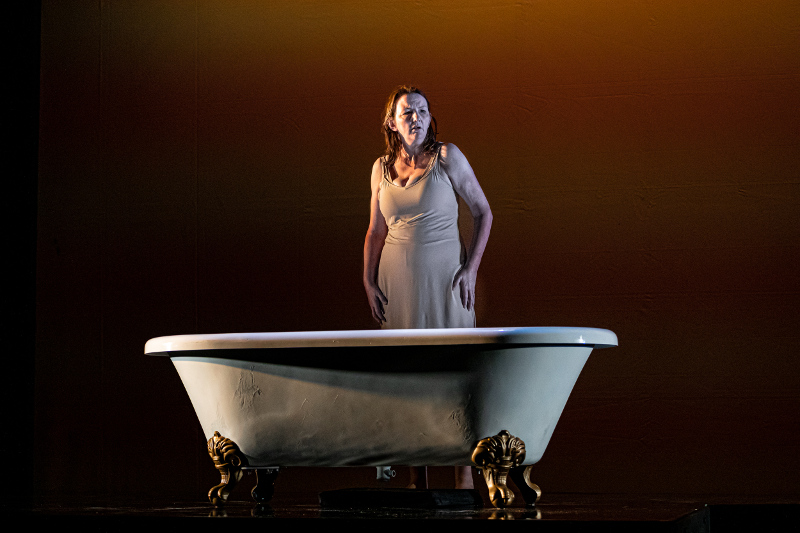
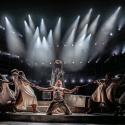
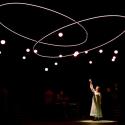
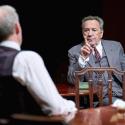
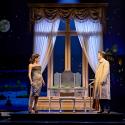
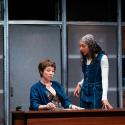
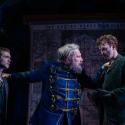
Nonetheless, by the end of its 90-minute span, it’s a wonderfully tender, human reflection on loss, evoked in Poet’s succinct yet quietly poetic (sorry) writing. And it’s given a brilliantly vivid, nimble, visually striking staging from director Gareth Nicholls and designer Karen Tennent. Their five-strong cast – well, six-strong, counting fluent multi-instrumentalist Oğuz Kaplangi who contributes greatly to Still’s foot-stamping tunes – deliver sharply etched performances, from Molly Innes (pictured above) finding both strength and fragility in long-suffering Gaynor to Gerry Mulgrew all swagger and bravado shot through with frailty as Mick. Still is a bold, thoughtful, compassionate offering for the Traverse to choose for its return to live, in-person shows – with reduced audiences carefully distanced within the auditorium. And while never referencing the pandemic, it nevertheless provides an appropriately empathetic space in which to reflect on some of the underlying issues of our current times.



Add comment