

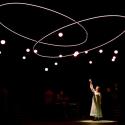
In many ways, The Stones is what the Fringe is all about: a new theatre company (London-based Signal House); a single actor; a small black-box space; just a chair, a bit of smoke and some almost imperceptible lighting changes for a staging. And with those modest ingredients, it generates a work that’s really quite unnerving in its quiet power, and magpie-like in its references.
Out of the blue, Nick receives a text from an old schoolfriend – well, someone he used to taunt with sinister messages in the hope of attention. As a result, he dumps his boyfriend, quits his job, and – almost as if it were destined to happen – runs into a mysteriously powerful woman who persuades him to tutor her two unnaturally gifted children in a remote country house.
Though to be honest, The Turn of the Screw is only one of several sources that writer/director Kit Brookman seems to doff his cap to consciously in his slippery but remarkably potent work – there’s a bit of Wicker Man-style folk horror in there too, Shirley Jackson, Eyes Wide Shut, climate crisis foreboding, probably plenty more besides. You quickly begin to wonder how much of Nick’s narrative you can really take on face value – especially following the supposed opening of his "third eye" by a protractor hurled by one of the unruly pupils at the school he’s just left. But more than that, it’s as if half-remembered narratives from elsewhere have seeped into his mind via Brookman’s own elegantly written text, bleeding into each other in unexpected and often faintly fetid ways.
Yes, The Stones is a good old gothic horror tale, but in place of jump scares, Brookman delivers unstable, shifting realities and a dense web of cross-references, seldom explained, that suck the viewer into his fast-developing text, suggesting a world of obscene opulence and casual societal breakdown – unless it’s all in Nick’s head, of course. Luke Mullins gives a suitably hypnotic performance, smooth and assured, arrogant in his pronouncements, increasingly deranged in his perceptions, and tossing aside with feigned disinterest mentions of the countless mysterious stones of the play’s title that unaccountably appear within his cottage.
The Stones is a slow-burn show, but one that quickly captures your attention, then mercilessly plays with it. With its dream-like, fleeting images and its sense of decay and collapse, even impending doom about which children seem the only ones concerned, it’s an intelligent, decidedly creepy response to our current precarious times.



Add comment