

How do you cram a thousand-page novel, a cast of dozens and profound philosophical ponderings on love, fidelity, class and freedom into a two-and-a-half hour stage show? If you’re Lesley Hart – adapter of Tolstoy’s Anna Karenina at Edinburgh’s Lyceum Theatre (from where it hops down south to Bristol Old Vic in June) – it’s with nimbleness, clear-sighted focus, and really quite a lot of swearing.
We’ll come back to the profanities. In terms of adaptation, though, Hart’s stage version has a lot going for it. Okay, it inevitably feels crammed-in at times – the famously tone-setting grisly end for a railway guard is over in a matter of seconds, for instance. And you have to ask not only how it’s been adapted, but also why. Surely what as a doorstep novel might have taken weeks or months to read (and to properly ponder its themes) produces a rather different experience as a whizz-past-you theatrical show.
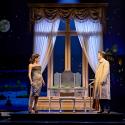
But that said, Hart’s Anna Karenina is precise, clear and detailed, and delightfully slippery at times in director Polina Kalinina’s sometimes barely noticed segues from scene to scene. It’s a fluidity that matches the smooth opulence of the Russian high-class society that’s such a crucial factor in Tolstoy’s tale, evoked beautifully in Emma Bailey’s rich, colourful designs, and also the sometimes dream-like, soap-style comings and goings of its characters.
Lindsey Campbell shines in the title role, commanding the stage with such magnetic assurance that you’re behind her all the way when she demands the freedom to love whoever she wants to, but fracturing movingly after the interval as her world cracks apart, displaying a needy vulnerability.
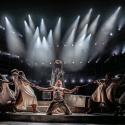
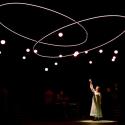
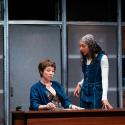
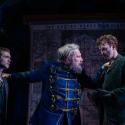
Elsewhere, however, the actors’ very distinct and different styles are quite striking. Robert Akodoto struts around as Vronsky, delivering every line as though it’s a profound pronouncement – nicely in keeping with his character’s youthful pomposity, though it gets a little wearing. Ray Sesay is the voice of reason as country boy Kostya, providing a touchingly uncertain moral compass for the other characters’ romantic voyages of discovery. Angus Miller’s Stiva is a bit of a clown, though a likeable one, while Tallulah Greive doubles up brilliantly (and very convincingly) as a Sloaney Kitty and Vronsky’s gritted-teeth horse Frou Frou (pictured below, centre).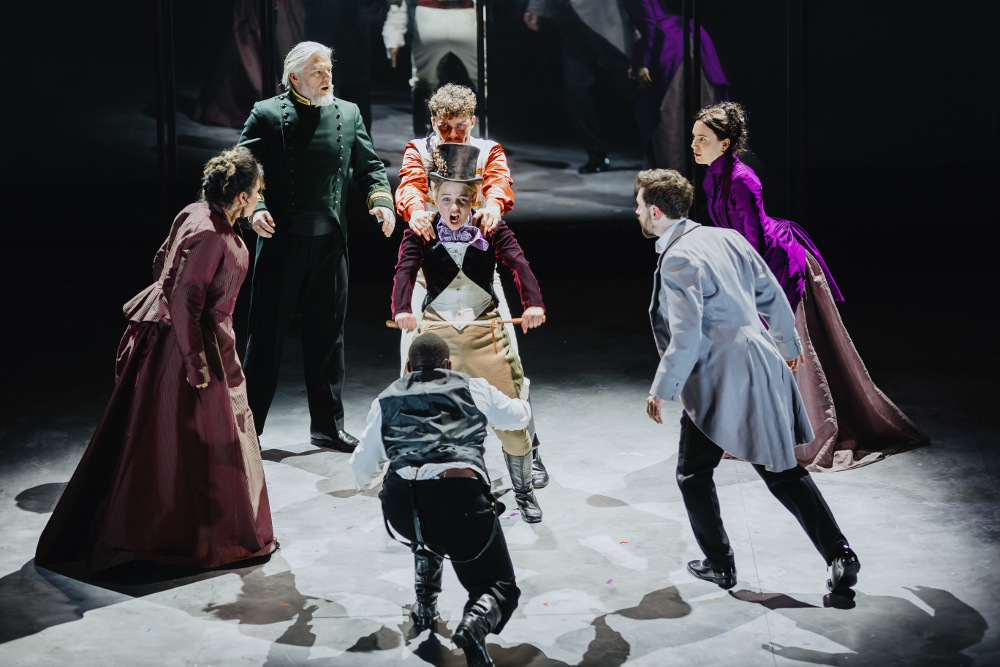 In stark contrast (intentionally, presumably) to the period decor and costumes are the clattering industrial dissonances of the show’s music by composer Xana, not only pretty jarring in themselves, but also distracting from the dialogue at times – it feels like a bit of a mis-step. As does the enigmatic, golden sculpture dangling from the ceiling, like a corn on the cob with protruding spikes, whose symbolism only becomes clear towards the very end (by which stage you’ve almost forgotten it’s there).
Talking of anachronisms, let’s go back to that swearing. There’s really quite a lot of it in among Hart’s thoroughly modern-day language. On one level it makes sure things are refreshing and immediate. On another, though, it butts up rather unconvincingly against the buttoned-up high-society propriety so central to Tolstoy’s conception. Together with Xana’s noisy sounds and some harsh, unforgiving lighting effects from Mark Henderson, all that profanity nonetheless generates a sense of alienation that keeps you questioning what exactly it is you’re watching (something emphasised with a classic Theatre of Cruelty trick at a crucial juncture towards the end).
Hart’s theatrical reversioning of Tolstoy’s iconic novel probably raises more questions than it answers. And Kalinina’s production might be a little over-ambitious at times. But their Anna Karenina a fascinating, gripping show all the same, full of power and passion, and thrillingly audacious.
- Anna Karenina continues at Edinburgh’s Lyceum Theatre until Saturday 3 June, and runs at the Bristol Old Vic from 7 to 24 June
- More theatre reviews on theartsdesk



Add comment