Tchaikovsky's Wife review - husband material

Discord drowns out gay composer's marriage in Kirill Serebrennikov's biopic

share this article

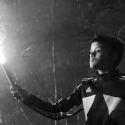
Alyona Mikhailova (right) as Antonina Miliukova eavesdropping on her husband Pyotr Ilyich Tchaikovsky (Odin Lund Biron)

The movies haven’t been kind to Pyotr Ilyich Tchaikovsky. The Nutcracker Suite was a highlight of Walt Disney’s Fantasia (1940) perhaps, but the 1969 Soviet biopic directed by Igor Talankin was tedious and Ken Russell’s The Music Lovers, released two years later, worse than that.

Tchaikovsky’s Wife, written and directed by the talented Russian filmmaker Kirill Serebrennikov, tells the story of Antonina Miliukova, who married Tchaikovsky in 1877 and then went mad because she couldn’t reconcile herself to the composer’s homosexuality.

It should have been obvious to the smitten Miliukova (Alyona Mikhailova) that Tchaikovsky, intriguingly played by Odin Lund Biron as a blimp haunted by demons, wasn’t exactly husband material.

Shortly before she proposes to him, Tchaikovsky tells Miliukova that he could only ever love “as a brother” – and then he flinches after kissing her during their marriage ceremony. “I wouldn’t call that a wedding,” says one of the guests. “Felt more like a funeral.”

Serebrennikov’s film captures the oppressive weight of Russian tradition that continues to make the lives of gay (and straight) people so difficult. The director’s brave opposition to Putin’s anti-LGBT ideology, among other issues, resulted in two years’ house arrest.

Yet the writer-director struggles to engage the audience in what is essentially a non-relationship. And the film is so lavishly dressed and shot (by cinematographer Vladislav Opelyants) that the human story gets lost in all the handsome but inert costume drama.

Sometimes the inertia is offset by an outburst of screaming or a dance fantasia involving Mikhailova and half a dozen naked Guards officers. Serebrennikov’s nutcracker may be visually striking but, as an account of the heroine’s descent into isolation and madness, it’s a poor substitute for storytelling.


Add comment

The content of this field is kept private and will not be shown publicly.

Plain text

  • No HTML tags allowed.
  • Lines and paragraphs break automatically.
  • Web page addresses and email addresses turn into links automatically.
Serebrennikov's lavish film captures the oppressive weight of Russian tradition

rating

2

share this article

the future of arts journalism

You can stop theartsdesk.com closing! 

We urgently need financing to survive. Our fundraising drive has thus far raised £33,000 but we need to reach £100,000 or we will be forced to close. Please contribute here: https://gofund.me/c3f6033d

And if you can forward this information to anyone who might assist, we’d be grateful.

Subscribe to theartsdesk.com

Thank you for continuing to read our work on theartsdesk.com. For unlimited access to every article in its entirety, including our archive of more than 15,000 pieces, we're asking for £5 per month or £40 per year. We feel it's a very good deal, and hope you do too.

To take a subscription now simply click here.

And if you're looking for that extra gift for a friend or family member, why not treat them to a theartsdesk.com gift subscription?

more film

Love, loss and belief collide in rural India in Aribam Syam Sharma’s 1990 feature
Bing Liu directs a lukewarm adaptation of Atticus Lish's novel
Underwhelming parody of ‘Downton Abbey’ and its ilk
A tale of forced migration lifted by close-knit farming family, the Conevs
A chiller about celebrity chilling that doesn’t chill enough
The Iranian director talks about his new film and life after imprisonment
Inspiring documentary follows lucky teens at a Norwegian folk school
Seymour Hersh finally talks to a documentary team about his investigative career
Jafar Panahi's devastating farce lays bare Iran's collective PTSD
A queer romance in the British immigration gulag
The French writer-director discusses the unique way her new drama memorialises the AIDS generation