This entertaining, gorgeous-looking film within a film, directed and written by multi-talented Turkish-Italian Ferzan Özpetek (he’s also directed operas and written several novels), starts in the present day with a large, noisy lunch party. Özpetek plays himself, a director who’s planning a movie, Diamanti, with this company of actresses - a vaginodrome, as one calls it. It’s about the power of women, he tells them. “Is it science-fiction?” asks one, sarcastically. He hands out scripts and everyone reads quietly.
Özpetek moved to Rome from Istanbul in 1976 and his meta-film, based on his own experiences when an assistant director, takes place in a theatrical costume atelier in Rome in the Seventies. Shades of Phantom Thread, but far more overcharged and flamboyant. It’s also a divine fashion plate, an homage to some legendary Italian costume designers whose dresses are shown in the film: Piero Gherardi's for the singer Mina, Piero Tosi's for Visconti and Danilo Donati's for Fellini's Casanova.
There are several telenovela-ish storylines infused with the melodrama of the romantic ballads that punctuate the action. The main one is the relationship between the two sisters who run the atelier: Alberta (Luisa Ranieri), who was jilted and is cold and harsh (watch her cut a young would-be costume designer down to size: “There is no I here, only We”) and Gabriella (Jasmine Trinca; pictured below right with Ranieri), who’s soft, dreamy and grieving for her daughter who was killed in a road accident five years previously.
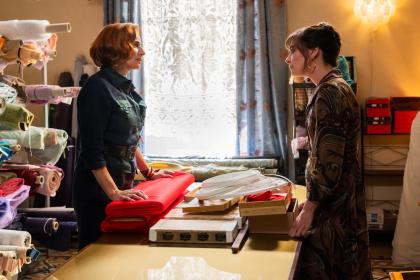
Both are fabulously well dressed, spend a lot of time smoking and drinking and are in charge of a chattering team of seamstresses, all with problems of their own. The seamstresses love teasing hapless male delivery boys or extras standing about in their underpants – “you’ve got a peasant’s ass” - and sometimes launch into a rousing Mina song with the boys. “We are nothing but we are everything when we care for each other,” is an underlying motif.
But what’s most important is the work, which centres round the eighteenth-century costumes for an Oscar-winning designer, the volatile, visionary Bianca Vega (Vanessa Scalera) who has genius ideas about using sweet wrappers as ruffles. She’s given to making pronouncements such as, “If only Cristobal {Balenciaga} was here, he would have helped us, but sadly he died.” One of the film’s stars, the overbearing Alida Borghese (Carla Signoris), is dubious about her costume with its enormous cage skirt. “It reminds me of withered grass.” She must at all costs be kept away from the much younger, hipper Sofia Volpi (Kasia Smutniak), who inevitably steals her thunder.
Then there’s Nina (Paola Minaccioni) whose son Vittorio (Dario Samac) is suffering from depression, won’t eat or leave his bedroom (this resolves without explanation) and Paolina (Anna Ferzetti) who is broke, can’t afford school supplies or childcare and has to bring her little boy into work. “This is not a kindergarten,” responds Alberta. He has to hide in the button room, while Eleanora (Luneta Savino) is put in a similar predicament by her niece, who’s been beaten up by the police while on a demo and wants to hide out. She’s confined to the locker room but lo and behold, turns out to be whizz at modifying costumes and is brought on board by Alberta.
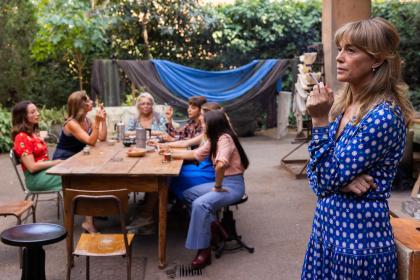
The most dramatic thread belongs to Nicoletta (Milena Mancini, pictured left). She’s married to the hideously violent, abusive Bruno (Vinicio Marchioni) who threatens to push her down a well if she doesn’t get back from work early enough to cook him better dinners. She manages to extricate herself in an unusual, far-fetched way, though this fits in well enough with the general vibe. Diamanti is a fine piece of ensemble acting. But Özpetek’s appearance in the last scene is self-indulgent and unwelcome - he should have left the final word to the vaginodrome.