Ana Mendieta’s work gives me the creeps. This is a deeply unfashionable view, so much so that I may well be cancelled for it. Mendieta is so highly regarded that The Guardian devoted a four-page feature to her while their art critic Jonathan Jones gave her Tate Modern exhibition a five-star review. For me the job of a critic is to be as honest as possible and, although I would love to like her work, it – or rather, the work for which she is most revered – makes me cringe. But more of that later.
Having died in dubious circumstances at the horribly young age of 36, Mendieta has become a feminist icon. She fell from a window on the 34th floor of her New York apartment block after a row with her husband Carl Andre. He was tried for her murder but acquitted on the grounds of insufficient evidence. And, as a result of the tragic incident, his reputation suffered while hers has soared.
Mendieta was born in Cuba in 1948 to a well-connected family; when Castro seized power, her lawyer father was imprisoned for collaborating with the CIA and she and her sister were airlifted to safety in the United States. At the age of 12 she became an exile shunted between orphanages, foster homes and reform schools. “I decided,” she said, “I was going to become an artist or a criminal,” and in 1972 she enrolled at the University of Iowa to study art and archaeology.
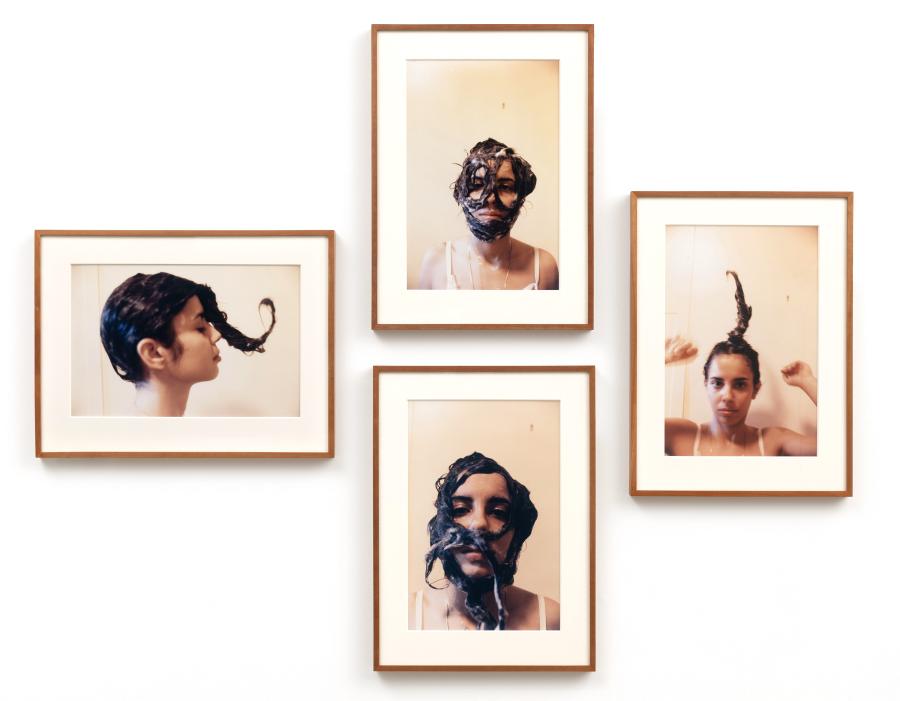
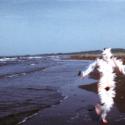
Most student work is embarrassing but, from the off, Mendieta was making innovative performance-based art that explores issues around gender, identity and concepts of beauty. One set of photographs records her draping her soaped hair around her head in sculptural shapes (pictured above: Untitled, 1972) another shows her pressing her face against a sheet of glass to create “ugly” distortions. In a third series she transforms herself into a convincing semblance of a man by glueing clippings from a friend’s beard onto her upper lip and chin.
Horrified by the lack of concern shown by the local community for the rape and murder of a fellow student, Mendieta decided to stage another murder. Pouring blood onto the pavement outside the building where she lived so it appeared to seep from under the front door, she recorded the bemused reactions of passers-by to the apparent bloodshed.
Sweating Blood 1973 is a video made in response to the same murder. The camera focuses on her face as droplets of blood slowly accumulate on her forehead and gradually trickle down towards her closed eyes. With its mixture of simplicity and drama, the piece is absolutely mesmerising.
Body Tracks (1974) is equally powerful. The artist stands with her hands and arms pressed against a white wall. Slowly sliding down the wall, she leaves two blood-red slashes – gestures of rage and defiance at the violence suffered by women.
The work was very much of its moment; feminist artists such as Judy Chicago, Valie Export and Helen Chadwick were exploring similar issues in America and Europe. But Mendieta soon began to feel alienated from a movement she later described as “basically white middle class”, which did not address issues she confronted as a Latina, who was regarded as a second class citizen. “As non-white women our struggles are twofold,” she wrote, adding that her work, “points not necessarily to the injustice or incapacity of a society that has not been willing to include us, but more towards a personal will to continue being 'other'.”
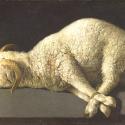
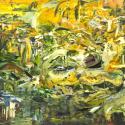
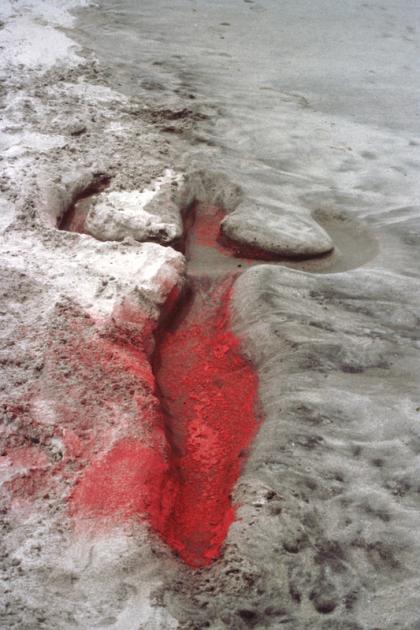
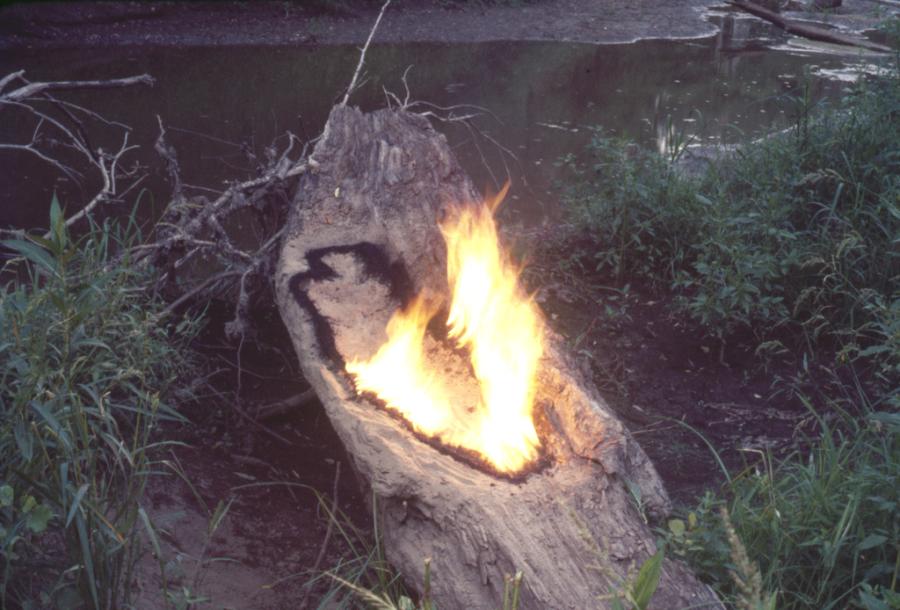
She turned for inspiration to the art of indigenous peoples and began visiting Mexico where she performed her first Silueta, Imagen de Yagul (1973). Lying naked in a Zapotec tomb, she covered her body with white flowers. It was the beginning of a decade-long exploration of her relationship to the earth during which she made some 200 Siluetas – imprints of her body in soft earth, mud, grass or sand left to slowly disappear over time. They were often outlined with flowers, rocks or pigment (pictured above right: Untitled Silueta Series, 1976) or were seared into the ground with fire (pictured below: Untitled Silueta Series, 1977). She described these ritualistic traces as “a communion with nature”, but despite the beauty of the photographs recording them, their resemblance to burial sites makes them feel more melancholy than celebratory.
![Ana Mendieta, Untitled (Guanaroca [First Woman]) 1981. Ana Mendieta, Untitled (Guanaroca [First Woman]) 1981.](/sites/default/files/styles/image_left_medium/public/2026-07/Ana%20Mendieta%2C%20Untitled%20%28Guanaroca%20%5BFirst%20Woman%5D%29%201981%2C1994.%20%C2%A9%20The%20Estate%20of%20Ana%20Mendieta%20Collection%2C%20LLC.%20Licensed%20by%20DACS.jpg?itok=ZR4upbKW)
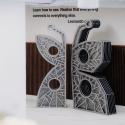
In 1980, she was able to return to Cuba, where she researched the Pre-Columbian Taino culture and the petroglyphs they carved into rocks, and in some limestone caves outside Havana she began making rock carvings that resemble the ancient artefacts. Vulva-like shapes and silhouettes resembling fertility goddesses such as Guacar, the Goddess of lunar cycles, are given titles such as Esculturas Rupestres: Our Menstruation or Esculturas Rupestres: First Woman (pictured left: Untitled (Guanaroca [First Woman]) 1981).
During a year spent in Italy, in 1983, on a Rome scholarship, Mendieta began exploring ways of making permanent, indoor versions of the Siluetas. Curvaceous forms reminiscent of the Venus of Willendorf are burned into wood or created on the floor with mud or sand mixed with binding agents. And this is the point at which the work makes me feel queasy.
With its evocation of woman as nature – fertility goddess or mother earth – the work reinforces the woman nature/man culture dichotomy voiced by Aristotle and later reaffirmed by the likes of Jean Jacques Rousseau and Claude Lévi Strauss. For centuries this form of gender essentialism has been used to relegate women to the domestic sphere – to deny them education, to exclude them from the academies, guilds and institutions that would have enabled them to hone their skills, sharpen their intellects and enter public life as artists, scientists, doctors, academics and so on. It has been used by so-called Christians to exclude women from their idea of heaven on the grounds that, like animals, they have no souls and by the Taliban to treat women as chattels with fewer legal rights than animals.
You could argue, of course, that Mendieta was seeking to remind us that humans are part of nature and that until we acknowledge this fact and learn to respect the natural world, we will continue to destroy our planet. But that is to suppose that the female form can be used to represent mankind when, throughout history, humanity has been represented by the male of the species and, even in medical circles, the female body has been regarded as an aberration or anomaly representative of nothing but its inferior self.
Ana Mendieta probably had no intention of embracing the secondary status accorded women because of their biology; but that is the historical context in which her work exists and my response – of visceral unease – alerts me to the fact that these ideas are far from dead and are implicit in the work, even if she did not consciously espouse them.
- Ana Mendieta at Tate Modern until January 17 2027
- More visual arts reviews on theartsdesk