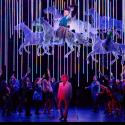
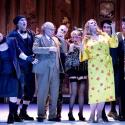
It’s more than a decade since Opera North had a new production of The Marriage of Figaro, and 30 years since the one before that had its premiere, so it’s certainly time for a fresh look at it. And bringing the story into the present day (or something near it), and locating it in an English country house (or something like one) was no doubt too good an idea to ignore. It’s not Downton Abbey, as American director Louisa Muller sees it – rather something a bit lower down the financial scale – but still a place where the old-fashioned ways have some clout left in them.
Think about Beaumarchais’ story for a minute, though, and it’s not obvious that a plot based on the survival of droit de seigneur (in the sexual sense) can feel real in today’s world. But there’s a rather neat solution to that: this time Susanna is herself almost one of the nobs, not a humble servant. Muller imagines that she and the Countess were at school together; she dresses stylishly and as befits someone who’s pretty well-healed. A randy modern minor male aristo might well fancy her if his relationship with his wife was getting rocky. You might even imagine a Jilly Cooper world within those walls.
It’s also the first time the company has had the opera sung in Italian, which helps in a way, because (although an English translation is displayed on sidescreens) the precise meaning of the words sometimes doesn’t matter so much as the atmosphere and demeanour of the participants.
Opera North’s Susanna, this time, is also quite capable of being musically dominant in the whole performance, making “Deh vieni non tardar” a lovely summit of her contributions.
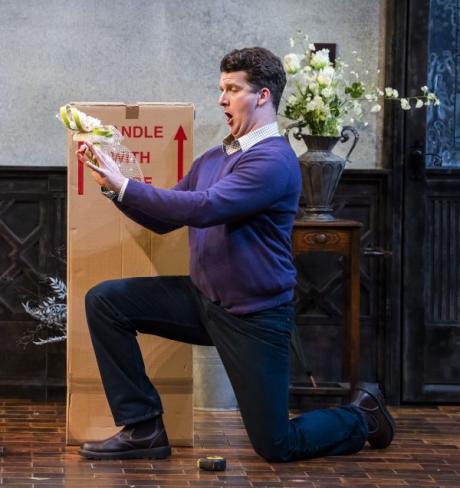
She is Hera Hyesang Park, new to the company but Julliard trained and with an impressive track record, including taking the role at Glyndebourne. Her combination of accuracy, flowing line, lovely tone and sustaining power are aristocratic in themselves, and her acting is of someone who may have missed out on being milady but is no one’s inferior and treats her employer as an equal. (Her place is taken by Claire Lees for the Nottingham and Salford performances).
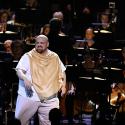
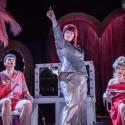
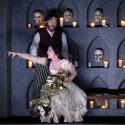
She is not the only singer making a company debut in the opening casting of this show. Liam James Karai (pictured above right) is Figaro – a bass-baritone with steely power in his voice and a worthy partner to her. He takes his character on a journey from bitterness in “Se vuol ballare” via good humour in “Non più andrai”, to a real highspot in “Tutto è disposto …” in the final Act. (Emyr Wyn Jones takes over Figaro for Newcastle and Hull).
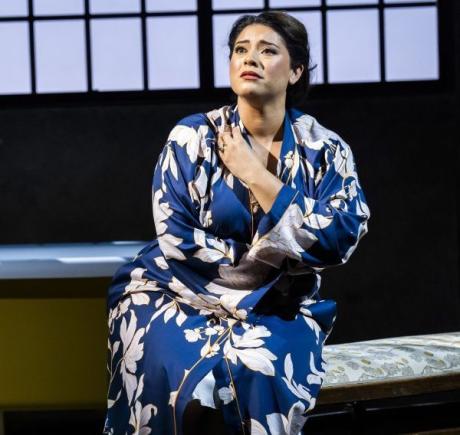
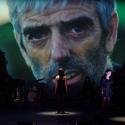
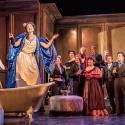
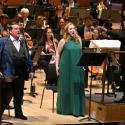
Gabriella Reyes (pictured left) is the Countess and her “Porgi amor qualche ristoro” and “Dove sono?”, each sung with touching nostalgia and beautiful phrasing, are a delight. James Newby, returning to Opera North as Count Almaviva after his likeably gormless Demetrius in A Midsummer Night’s Dream, contrasts nicely with Figaro: his keener voice, at first seemingly less confident than his assertive acting, came into its own in the later parts of the opera.
Cherubino is not an easy role (one of the best was Alice Coote in the 1996 Opera North production) and Hongni Wu acts the part delightfully, singing “Non so più cosa son” sweetly. “Voi che sapete” was like it, though without the kind of chest voice that can make it sound as if we’re hearing a teenager in love. (Frances Gregory sings Cherubino in Leeds on 14 and 20 February and also in Hull).
The supporting roles are cast from strength – Jonathan Lemalu is Bartolo, and his “La vendetta” is a highlight of the first Act; Katherine Broderick, a wonderful character player, is great fun as Marcellina; and Daniel Norman as Basilio and Jamie Woollard as Antonio bring liveliness and vocal quality in spades, Charlotte Bowden is delightful as Barbarina, while Kamil Bien makes an incisively smart lawyer as Don Curzio.
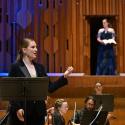
They are all given sensitive and effective support in Valentina Peleggi’s conducting – she knows how to speed things along when appropriate but also gives time for the slower tempi to create their magic; the ensembles were beautifully balanced, and the Act Two finale wonderfully paced. (Her place will be taken by Oliver Rundell on 7 February in Leeds and also in Nottingham).
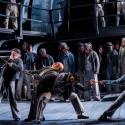
Louisa Muller’s production is detailed in its business – sometimes a little puzzlingly (why does the opening scene have to be in the boot room on the lower floor, if Susanna and Figaro’s marital accommodation is to be alongside the master and mistress, why is Antonio a bee-keeper, not a gardener, and why should a gang of hikers and tourists suddenly tramp through the house in Act Three?), but I like touches such as the use of mobile phones to summon those who need to be summoned, the fact that Figaro has not forgotten his barber skills when it comes to getting Cherubino ready for military duty (though would he use a cut-throat razor today? – that’s quite surreal), and the idea that the Countess is pregnant and that she and Susanna are busy creating a nursery as we hear the sublime letter duet.
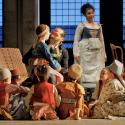
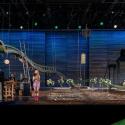
Madeleine Boyd’s design provides a nicely observed and created country house that’s probably got financial problems coming – including a split set for Act Three, a very sensible solution – along with a variety of costumes for the varied crowd of employees and contractors who turn up from time to time (thus populating the chorus, who as ever give their all, including in the hilarious wedding dance – choreography by Rebecca Howell).
- Further performances on 1, 7, 14, 18 and 20 February at Leeds Grand Theatre, and on 5 and 7 March at Theatre Royal Nottingham, 12 and 14 March at Lowry Salford, 19 and 21 March at Theatre Royal Newcastle and 26 and 28 March at Hull New Theatre