Phyllida Lloyd’s production of Peter Grimes, first seen 20 years ago, is still one of the jewels in Opera North’s treasury. It was revived in 2013 for their “Festival of Britten”, and now is back with a fresh top music team and a cast of (mainly) young British singers, several in company debuts, which bodes extremely well for them and for us.
Chief of this new generation is John Findon in the title role. I admired Jeffrey Lloyd-Roberts’ quality as Grimes in the original and the first revival, but Findon’s performance equals and in some respects excels it.
The revival is co-directed by Karolina Sofulak and Tim Claydon, who is also the movement director, and Opera North’s music director, Garry Walker, conducts the score in vivid primary colours, at times devastatingly powerful, always atmospheric, often heart-rending.
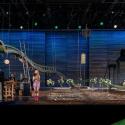
In its first appearance, the production (from a director as noted for her opera stagings as she was for her West End production of Mamma Mia!) seemed strikingly minimalistic. In Anthony Ward’s designs, there is hardly any scenery in the conventional sense: what there is becomes symbolic as well as evocative – some wooden platforms either assembled to make a court room, walked over as a storm hits the Suffolk fishing town that is the setting, or built to form the exclusionary limits of the pub and its accepted clientele; a huge net that’s lowered and hoisted to show the community as it works (as it must) to keep its common livelihood afloat; a platform built before our eyes to show Grimes’s bachelor hut on an edge that’s eroded by the sea. (The choral prayer “O tide, spare our coasts” seems even more apposite now than ever).
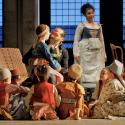
The cast become scene constructors, often during the famous “Sea Interludes”, originally conceived as entr’actes to frame the narrative in its unfolding tragedy. When they’re not doing that, Lloyd’s production emphasizes aspects of the story in mime; at one point – the construction of Grimes’s hut – affording a flashback to a time when he was an accepted member of his community. It also begins with the ending: we see Grimes’s drowned corpse discovered on the shore, at first by children, as a silent overture to the whole.
The time setting is contemporaneous with (or a little bit after) the creation of the opera in 1945. “Dr Crabbe”, a figure from the crowd who represents the detached observer of it all, sports a stylish Trilby hat: the sluttish Nieces of the publican, whom all know as “Auntie”, wear daringly short skirts.
One reason why the opera creates its impact in almost any realization is that librettist Montagu Slater spelled everything out so clearly from the start. It’s about a misfit, almost a child in a man’s body for one thing, suspected of physically abusing one prentice boy he took to sea and who never came back, and instantly labelled a murderer when he takes on a second lad who also disappears.
It’s a clever piece of work. From the beginning we know that Swallow the lawyer in the coroner’s court and also the mayor, is not to be trusted, as he tells Grimes to recall what happened “in your own words” – except that the fisherman never gets a chance to put a word in edgeways, as Swallow (gravely sung by James Cresswell) dictates his answers.
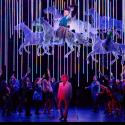
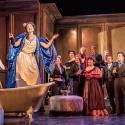
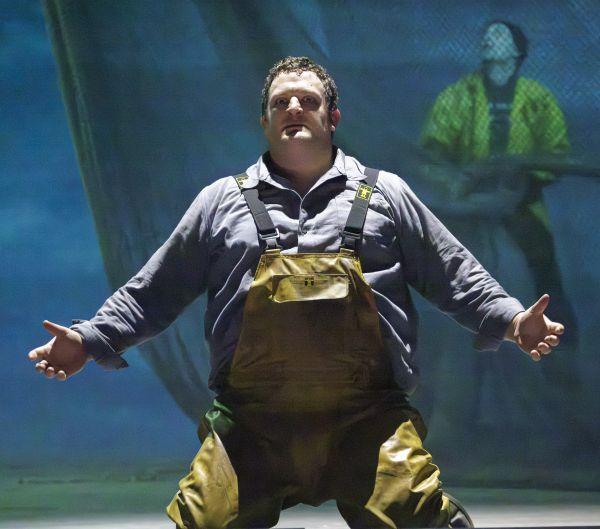
John Findon’s Grimes (pictured above) is superb – bright and ringing at full pelt, spot-on with intonation, and wonderfully delicate at other times. His “Now the Great Bear …” was outstanding, the tone tender and pure (and beautifully accompanied by the Orchestra of Opera North under Garry Walker’s baton), and his scene with the new boy prentice revealed a complex personality of cruelty and longing for a warmth he never experienced himself.
The schoolteacher Ellen Orford, whom Grimes hopes one day to make his bride (though more as a mother figure to care for him than for any other reason), is a key character.
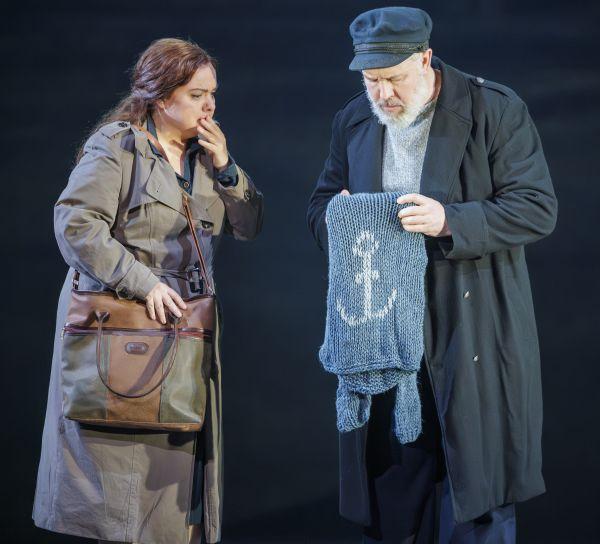
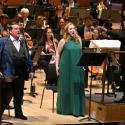
She’s tellingly sung by Philippa Boyle (pictured above with Simon Bailey), whose spinto soprano tone gives her at times a tougher edge than apparent in some interpretations, and complements John Findon’s variety of tone and contrasts of power and tenderness extremely well. She’s generous to a fault but strong enough to know her own mind – and her “Embroidery in childhood …”, with its tender harp-led accompaniment, is simply a beautiful song.
Casting of the character roles is near-ideal throughout. Simon Bailey (Captain Balstrode) makes his impact vocally and in stage presence as the old sea dog who tries his best to help the young fisherman, leading the chorus in “Now the flood tide …” to real effect.
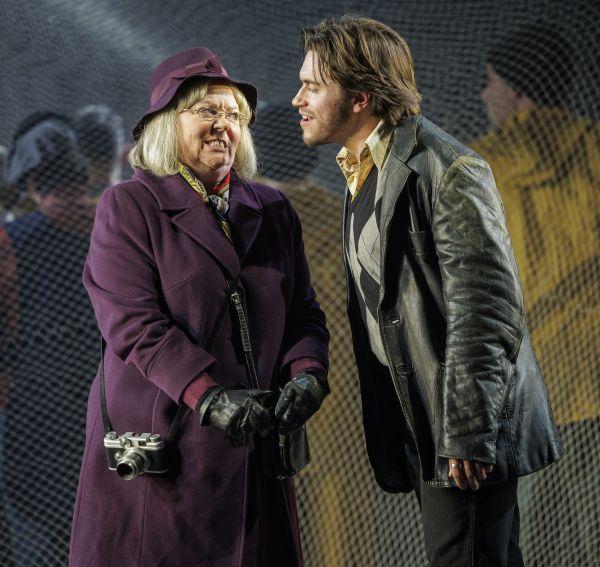
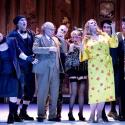
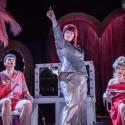
Hilary Summers as Auntie is a strong woman with a strong voice and runs her pub as she wishes, but blends warmly in the women’s quartet. Ned Keene, the “apothecary” in the libretto, is presented as a minor drug-pusher, which is logical enough despite the label, and Johannes Moore makes him real. And Claire Pascoe, as the elderly widow and gossip Mrs Sedley, makes her seem quite sprightly and comical, with exemplary diction (pictured above).
Bob Boles, the open-air Methodist preacher ever ready with a condemnation, is hardly a sympathetic character (and one that doesn’t easily translate into the second half of the 20th century, when there were much fewer of them about) but gets a wild-eyed impersonation from Stuart Jackson, whose tenor is a less heroic and virtuosic one than John Findon’s and blends well in the Act One quintet. He’s not a nutter, though – he’s the one who condemns the whole apprentice system as against the teaching of the Bible.
Daniel Norman, as The Rector, Mr Adams, is a comically ineffectual parson with faults of his own such as an eye for young women and a liking for drink – another nice piece of character acting from the Don Basilio in The Marriage of Figaro, touring with this opera.
The Opera North Chorus are, as ever, a joy to hear and eager participants in every task they’re given. Their sea shanty “Old Joe” was so rhythmically enthusiastic they could have been hauling a boat up a real shore.
Further performances on 19 and 21 February at Leeds Grand Theatre, and on 6 March at Theatre Royal Nottingham, 13 March at Lowry Salford, and 20 March at Theatre Royal Newcastle