It’s such a pity that the more striking elements in Franz Lehár’s orchestration are heard so fleetingly, such as the tiny glints of cimbalon which give the best parts of the score an authentic bohemian - or Pontevedran - flavour. But too often the relentless parade of waltzes and polkas begins to grate, and you’re about to nod off when suddenly something ear-catching happens – a sequence of gorgeous string portamenti, a languorous violin solo, or stopped horn chords that sound as if they’ve escaped from a Mahler symphony. Then you recall that The Merry Widow was first performed in Vienna in 1905.
Librettists Victor Léon and Leo Stein set the operetta - an adaptation of an 1861 stage comedy - in the Parisian embassy of the mythical Balkan state of Pontevedro. Near bankrupt, the nation’s elite desperately scheme to ensure that the merry Pontevedran widow Hanna Glawari marries a Pontevedran man in order that her fortune remain in the country. Naturally things don’t run smoothly, and we’re treated to a lightly farcical sequence of events as Hanna is reunited with her former lover Danilo.
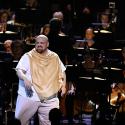
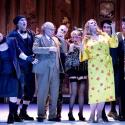
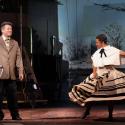
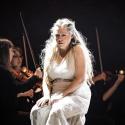
Hanna’s humble origins are amusingly suggested by Stephanie Corley’s Northern accent, and there’s a satisfying brassiness about her, in contrast to Amy Freston’s Valencienne, superficially far more refined despite her chorus-girl origins. Geoffrey Dolton’s pompous Zeta invites proper sympathy when he suspects he’s being cuckolded by Allan Clayton’s Camille, and William Dazeley possesses the requisite louche charm as the slightly gone-to-seed Danilo. Wittiest is Nicholas Sharrat’s engagingly deadpan St Brioche.
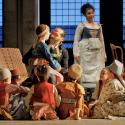
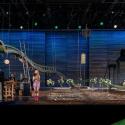
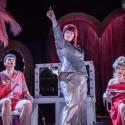
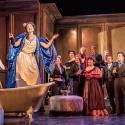
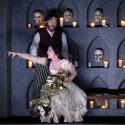
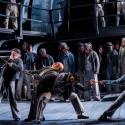
Opera North’s production is typically inventive. Leslie Travers’s witty detailing firmly locates the action in fin-de-siècle Paris, filling the stage with luxuriant purples and reds. Chandeliers painted onto strips of dark fabric descend magically and a set of Art Nouveau-styled statues are moved around to inventive effect. Director Giles Havergal and choreographer Stuart Hopps fill the theatre with movement and the large set pieces are a joy to watch, particularly the mens’ septet in Act Two, deservedly encored. Alas, Kit Hesketh-Harvey and Giles Havergal’s frequently inaudible English adaptation would really benefit from surtitles so that the ingenuity of the translations could be appreciated, and too many of the passages of spoken dialogue feel laboured, replete with unfunny topical jokes about banks and bankers.
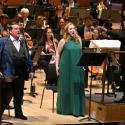
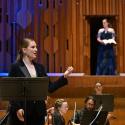
The orchestral playing is lively and idiomatic under Wyn Davies’s direction but I was ultimately left unmoved and only moderately amused; last season’s brilliant Ruddigore providing a far more successful blend of comedy, music and drama.
- The Merry Widow in rep at the Grand Theatre, Leeds until February, also touring to Nottingham, Newcastle and Manchester