Joshua Harmon knows how to stir and excite an audience and does that and more with Admissions, newly arrived in the West End as part of the ongoing tsunami of American theatre across the capital just now. Opening the same day as news reports of financial bribery and malfeasance deployed to gain admissions to America's top universities, Harmon's portrait of a family poleaxed by their teenage son's fraught route to college comes with an unexpectedly topical urgency. But neither this writer nor his exceedingly smart director, Daniel Aukin, needs to coast on headlines to make their point.
If anything, Aukin is on even firmer turf this time round, thanks to a few casting upgrades in supporting roles that lend greater weight to the whole. And while Jessica Hecht was very special as a mother who can't always reconcile parental instincts with liberal passions, Alex Kingston here makes a blazing return to the London stage in the role. She's lucky to have a fine sparring partner in Ben Edelman, the cast's lone New York survivor, playing an angsty, impassioned adolescent ready to burn down multiple houses (metaphorically speaking, or maybe not) to make his point: on this evidence, Edelman (pictured below right) should soon be getting the roles to which the comparably intense Timothée Chalamet gives a pass. 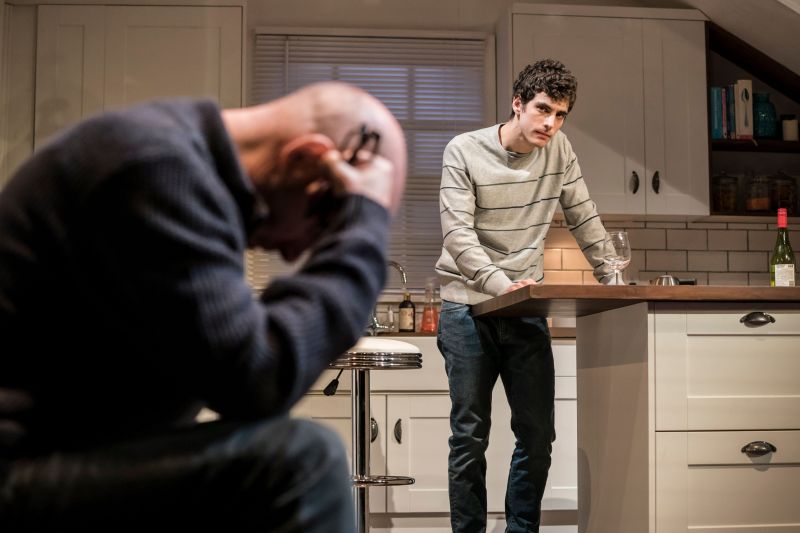 Edelman brings a scarcely containable bravura to the role of Charlie, who turns 18 during the play and is the firebrand son of left-leaning parents so committed to inclusivity that he has been given a middle name (Luther) in recognition of Martin Luther King. Mum Sherri (Kingston) is the admissions officer at a fictional New Hampshire prep school, Hillcrest, that sounds like a wannabe Phillips Exeter Academy and where Charlie's dad, Bill (Andrew Woodall), is the headmaster, no less.
Amid such academically heady surroundings, it doesn't go down well when Charlie finds that his application to Yale early admission has been deferred. The decision comes to rest with particular unease given that the same Ivy League citadel has offered a place to Charlie's longtime friend, Perry, who comes from a mixed-race background and so may satisfy quotas for diversity even if, to look at, Perry doesn't in any way read as black. (Perry also remains unseen in the play, as he must: Harmon's focus is on both the extremes and the limitations of liberalism on Charlie's home turf.)
 Add to the mix a neat (some might say too neat) framing narrative that involves representations of diversity in a new school brochure being put together by the beleaguered Roberta (Margot Leicester does wonders with a none-too-plausible role), and Sherri finds herself caught between her best hopes for a broader, more diverse student body and the enflamed passions of a son whose refusal to follow his parents' dictates leads to a gut-busting finale. The two generations go vocally mano a mano in the mother of all showdowns across Paul Wills's antiseptic set, while Woodall more than holds his own as a father with limited patience for Charlie's extravagant theatrics. (Woodall is especially funny imagining his son's active sex life as and when the kid hauls his resistent self off to college.)
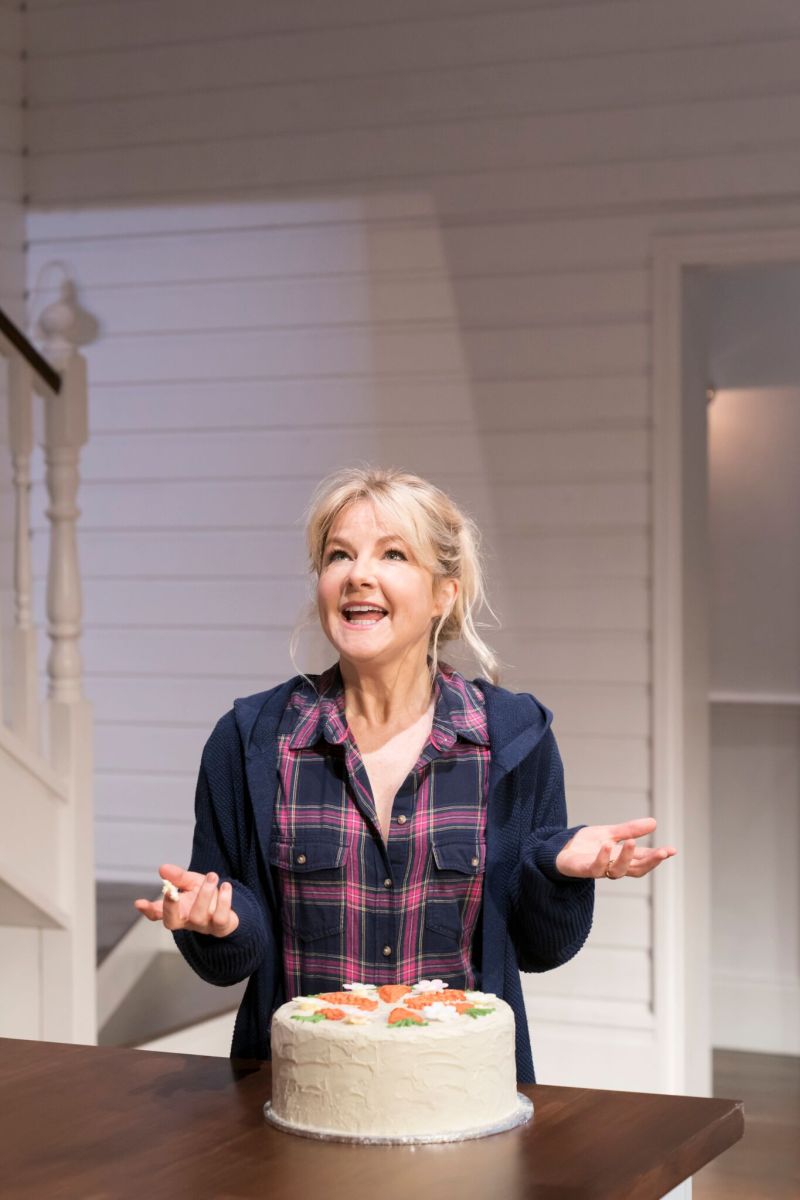
On second viewing, one might wish for fewer solo set pieces shared among the characters, who include Sarah Hadland (pictured above) in gently moving form. She plays Ginnie, mum to Perry and a woman with her own take on a world where empathy doubtless extends beyond an ability to roll one's Rs when pronouncing Nicaragua. But as a liberal American abroad (and a Yalie to boot), I hope I'm not the only one transfixed by Harmon's take-no-prisoners perspective on the widening fault lines that roil even the most best-intentioned of households just now. Whether Charlie gets into Yale remains the tip of a vast and amorphous iceberg in a play demanding that we admit to ourselves all manner of uneasy truths that risk tearing what remains of the social fabric inside out. Those admissions, surely, are the most difficult of all.
- Admissions at the Trafalgar Studios until 25 May
- Read more theatre reviews on theartsdesk