Motherhood is a high stress job. Ask any woman and they will tell you the same: sleepless nights, feeding problems and worry. Lots of worry. Lots and lots. Writer John Donnelly, who has also experienced the stresses of parenthood, devotes his new play, Apex Predator, to turning this everyday event into a vampire story.
Staged at the Hampstead Theatre, the play is original and initially appealing, and stars Sophie Melville and Laura Whitmore in the main roles, but soon loses its gloss. It’s his first stage play for 12 years and, because I have liked his previous work such as The Pass and The Knowledge, my expectations were high – but, sadly, not for long.
The plot begins with Mia (Melville), who has a new baby as well as a 10-year-old son, Alfie, feeling the strain of sleepless nights, not helped by a neighbour who plays pounding music at 2am. With a husband, Joe, who works long hours, Mia feels lonely and vulnerable. When Alfie gets into trouble at school, she meets his teacher, Ana (Whitmore), who offers to breast feed Mia’s baby. A strange moment that seems to align with Joe’s work, which involves police surveillance in a case of murdered bodies being drained of blood – it’s pretty obvious who the vampire is. But can she help Mia solve her problems?
Vampire stories are common in novels, film and television, but rare in the theatre (apart from adaptations such as Dracula and Let the Right One In). Donnelly plays with the metaphorical resonances of vampirism by asking who, in any relationship, is feeding on whom? At one point Mia says, “My body’s not my own.” But when it rapidly becomes clear that the play will be a literal, rather than a symbolic, account of bloodsucking, the challenge arises of making the mechanics of the medieval myth coherent and convincing for a contemporary age. Disappointingly, Donnelly fails to fully imagine the situation he has created so I find myself constantly questioning his plotting. The publicity calls the play “genre-busting”; a more accurate word is “messy”.
This is a pity because Donnelly’s idea about women being the protagonists as well as the usual victims of vampire stories is very suggestive and potentially fascinating. Likewise, the disquieting sense that Ana is grooming Alfie could have been explored more fully. Instead, the playwright shows how motherhood drives you crazy, and his vision of parental protectiveness embraces monstrosity. His image of women today is heightened to a ludicrous degree: maternity here is seen as involving passionate protectiveness, vicious vengeance, and a kind of monstrous Medea-like madness. His women are angry – but so over-the-top that they are literally laughable. This completely defuses the sinister side of this supernatural story.
Instead of exploring the ambiguity of vampirism through metaphor and suggestion, Donnelly not only takes a literal approach, but also adopts a larky and cartoonish tone, which turns horror into a running joke. One-liners bounce off every shiny surface of Mia’s flat. So potentially interesting ideas about maternal desperation, female solidarity and empowerment are lost in the exaggerated extravagance of the piece. This is not helped by Donnelly’s writing, which constantly states the obvious, seldom avoids clichés and prefers to tell rather than show. Characters, especially Mia, stop the action to gives us speeches of preachy banality. Realism drains away.
This short play of 100 minutes (including interval) starts by stressing the physical aspects of motherhood, such as uncomfortable breast feeding and toilet habits, with lots of bright dialogue, but soon turns into oddly discordant scenes, such as one with a doctor which clumsily satirizes the medical profession, and clunky declarations, such as “cities make people feel invisible”. Mia’s backstory of a disappointed life is spelt out too explicitly and Ana is prone to cheery didactic homilies that distract from some of the more troubling ideas of the play, such as its vision of humanity as a food chain. Climate change threatens human beings as a species, thus depriving immortal vampires of their sustenance too.
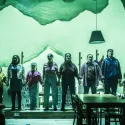
Despite these drawbacks, Apex Predator gets a vividly memorable production from director Blanche McIntyre, with some excellent work by sound designer Chris Shutt and lighting by Jack Knowles. Both create a strong audio and visual ambiance for Tom Piper’s versatile set, which however also includes a lot of scaffolding which never gets used. Here the focus is more on interiors, such as the kitchen, the school room and the penthouse flat (the scene of the show’s one successfully shocking moment). Other scenes on a train or in a park are less successful, partly also because of preposterous writing and plotting. But what about the acting?
Well, Melville’s performance as Mia is so bright, so lively and so blessed with cracking jests that it’s impossible, for me at least, to believe that she really is an exhausted mum on the edge of a breakdown. Whitmore is cooler, but also lacks nuance. More impressive is Bryan Dick, but he is burdened by a dialogue about being unfaithful, another unexplored and unnecessary avenue. Leander Deeny plays a series of bit parts, usually with too much unfocused energy, and the role of Alfie – who often wears a sinister mask and has his own undeveloped line in supernatural powers – is shared by Callum Knowelden and Lorcan Reilly. This is a fun vampire show, but its surface glitter hides a heart completely drained of sense and sensitivity.