Wars in the Middle East provoke furious arguments. Red hot. So why is British theatre so cool, distinctly chilly, about staging new work about these controversial issues? If any proof is needed that current new writing is meek and mild then it must surely be this. Even the exceptions are not exceptional: written by Yousef Sweid and Isabella Sedlak, Between the River and the Sea, first seen at the Maxim Gorki Theatre in Berlin last year and now comes to the Royal Court via Edinburgh, is a likeable autobiographical one-man show about Middle-Eastern identity which insistently avoids the political to concentrate on the personal. Only the title is provocative – and the subject of a joke at the start of the evening.
Sweid was raised as a Christian-Arab-Palestinian-Israeli kid in Haifa, married two Jewish women and is now bringing up two Jewish-Arab-Austrian kids in Berlin. Phew. This situation allows him to discuss the complexities of mixed heritage and identity in today’s world, all the time swerving away from the temptation to take sides or make ideological points. So the story of this rather slender 65-minute play is all about his character, Yousef, currently in a custody battle with his second wife, who’s Jewish and wants to “move back” to Israel, and to take their daughter with her. As he prepares to meet his divorce lawyer, Dr Leonie Ascher-Köpfel, he ruminates about his life and times. And its paradoxes. Is he an Israeli Palestinian or a Palestinian Israeli?
Despite the show’s title, Yousef tells us that his monologue is not political. But, of course, his life cannot avoid the conflict that his existence is caught in. No sooner has he introduced himself to us as an Arab from Israel, whose family never left in 1948 when so many other Arabs were ejected from the newly formed state, than his father’s voice objects: “You are not a Palestinian Israeli – you are a Palestinian with an Israeli passport.” Although this is meant to be a monologue about divorce and children, Yousef’s father, Sliman, insists that his son presents a lecture on “the many kinds of Palestinians”, in the West Bank, in East Jerusalem, in Gaza, in refugee camps in Jordan and Lebanon. You see, Yousef says, “it’s complicated.”
As part of the Palestinian diaspora, Sliman is in Canada (not because of his activism but because of tax fraud) while Yousef is in Berlin. And every time the son attempts to tell us about his marital problems, he keeps getting drawn back into the past, usually his own upbringing in Haifa, an Israeli city where Jews and Arabs were living “together in peace”. Well, up to a point. Yousef goes to a Jewish kindergarten where another child, Avi Hadad, calls him a “stinky Arab”. This incident awakens the child’s first perceptions of his identity, consciousness which grows as he attends both a Jewish school and an Arab Christian school. By the time he experiences excruciating stage fright in the middle of a speech during an event designed to bring Arab and Jewish kids together, he swears he’ll never go on stage again. Ha!
This joke gives a flavour of Yousef’s humour as he remembers the people in his childhood, how he meets them later in life, how they want him to take a stand, to choose a side, to be political. But the play does something less ideological, more humane: it explores the liminal space between sides, and cultures, as Sweid switches between English, Arabic, Hebrew and German. But events are not kind to him: his stance that becomes increasingly difficult after the Hamas attack of 7 October 2023 and subsequent Gaza War. Now, as the disaster explodes and the deaths and casualties pile up, the refusal to join one side over another begins to look like indifference, or paradoxically inhuman. How can you not empathise with your fellow Palestinians in Gaza; how can you not demand revenge for the 7 October attacks?
Strong as these passages are, the text by Sweid and Sedlak constantly returns to a more comic tone, a wry understanding that ideology is too crude a way of understanding the world, a very blunt way of conducting your life. As Yousef argues with both his best friends Daniel and Salma, the only way out is a kind of utopian ideal of a world without borders, without passports, without prejudices, which is articulated by his son. This dream is a powerful intervention, yet of course it cannot cure the insoluble violent antagonisms of the real world. But then, you have to sympathise with Sweid – he is an actor, not an activist. You can be both, but surely that’s not obligatory.
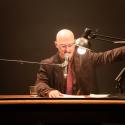
In fact, it’s very easy to warm to Sweid the actor. He is charming, he flirts with the audience, he smiles richly, he guffaws and he imitates the other people in his life with precision and empathy. As directed by Sedlak, on a bare stage with a chair and a mic which stands in for other characters, he seems to effortlessly dominate the evening, emphasizing, sometimes gently, sometimes more insistently, that reality is complex and the only hope lies in resisting slogans and knee-jerk animosities. The result is a rather sweet show which uses humour to disarm: “We are a completely normal family.” He says, “An Arab-Palestinian-Jewish-Israeli-Austrian-Romanian-Christian family.” If this angers those who prefer to be politically engaged then so be it.