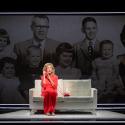
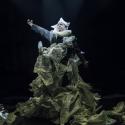
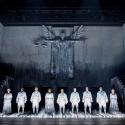
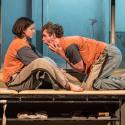
War Horse was without a doubt one of the boldest experiments in the National Theatre’s history. As Tom Morris, co-director with Marianne Elliott of the original production says in the programme, “Essentially putting a non-speaking central character on the Olivier stage was going against everything that everyone understood about that space. The design is for epic theatre in which text makes the space come alive. In this show, it’s movement, it’s puppetry.”
Almost 19 years later, after more than 7,500 performances around the world attended by around nine million people, it’s all too easy to think that War Horse’s success was inevitable. Yet sitting in the auditorium at the Olivier just before it started I felt, once more, a sense of the risk that had been taken when the show first opened in 2007.
How, after all, could a puppet convey both the empathy and the gravitas necessary to carry a narrative about World War I? Was it the novelty factor that had allowed us all to be so seduced? Would an audience dealing daily with headlines from Ukraine and Iran be as receptive to this story of a friendship between a boy and his horse as an audience from the Noughties? Or this time round would we dismiss it as a piece of whimsy?
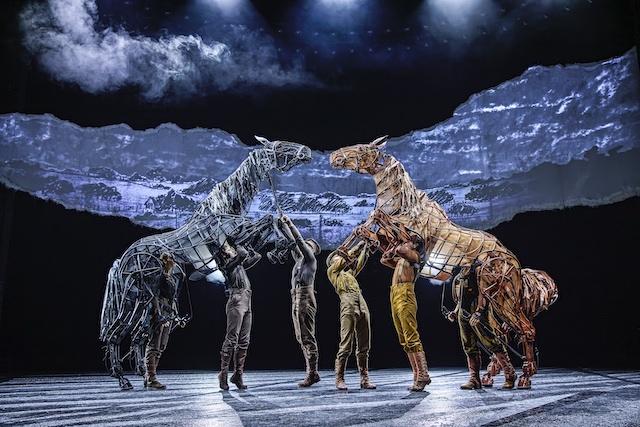
It took about two minutes for the scepticism to melt. In this production – for which Morris is now the director, and Katie Henry the revival director – the extraordinary detail of the way the horse is animated captures you from the start. Joey the foal, who – like the adult Joey – is made from cane, aluminium, stretch net and a synthetic material called Tyvek, lurches unevenly after he is born, before taking off at an experimental gallop. The puppeteers – Jordan Paris, Eloise Beaumont Wood and Anita Adam Gaby – manipulate him to show every twitch of fear, uncertainty, hope, and exhilaration.
There’s no perceptual jolt between the moment you’re thinking, “That’s great puppetry” and the moment you’re thinking “That’s Joey.” The transition may happen at different times for different people, but by the time that Joey was being auctioned – after the foal had been displaced by the adult horse – I was invested. As Joey’s teenage trainer, Albert, Tom Sturgess – who’s been playing the role with the production on tour – strikes a persuasive balance between emotional openness with the horse and angry defiance of his alcoholic gambling father. Puppeteers Matthew Lawrence (assigned to Joey’s head), Lewis McBean (heart) and Felicity Donnelly (hind) – overseen by Puppetry Director Matthew Forbes and Director of Horse Choreography Toby Sedgwick – let us feel every nuance of the horse’s emotions, which flicker and flare as Albert’s father becomes increasingly determined to exploit him for money.
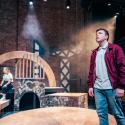
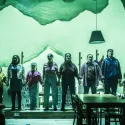
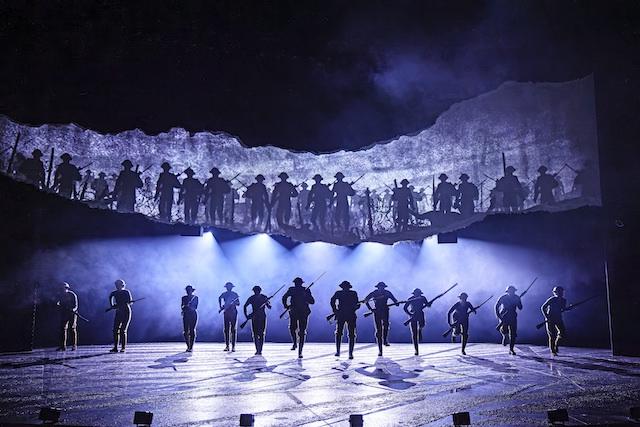
One upside of familiarity with the remarkable puppetry is that it allows you to appreciate other extraordinary aspects of the production. Not least Paule Constable’s astonishing lighting design - re-devised by Rob Casey - which becomes like a character in itself as it shifts from the dappled bucolic backdrop of rural Devon to the nightmarish shadowscape of World War I. On Rae Smith’s starkly beautiful set, dark clouds are divided by a crack of white light. Throughout the evening, 59 Studio’s projections onto the white crack take us from the rural rooftops of Albert’s home village, to military ships going across the Channel (wonderfully sketched by Smith), to Otto Dix’s expressionist visions of life in the trenches.
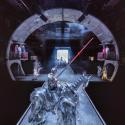
The scenes after Albert’s father, Ted (Stephen Beckett) sells Joey to the army, and Albert runs away to find him in France, show the Olivier stage exploited to its full epic potential. Silhouetted ranks of soldiers ride in slow motion across the stage, as animations on the backdrop show the broader impact of the enemy bombs. At one point the sinister outline of a massive tank appears, simultaneously chronicling its first appearance on a battlefield and its hellish emotional impact. Bodies of both humans and horses are shown being blown apart in slow motion – the moment of a horse’s death is indicated as its puppeteers walk away like departing spirits.
This adaptation by Nick Stafford in association with Handspring Puppet Company is – on so many levels – a tour de force, heightened by the performances of actors who hold their own against the stunning visuals. Manuel Klein is particularly moving as Friedrich Müller, the German soldier who doesn’t want to be in the army, and Jo Castleton is an emotional rock as Albert’s mother Rose, trying to stand up for her alcoholic husband at the same time as she fights to protect her son. The music of Adrian Sutton – who, tragically, died last year – sensitively heightens the transition between the play’s bucolic openings and the industrialised annihilation of the trenches. Critics normally restrain themselves from standing ovations, but on press night everyone leapt out of their seat at the end. This is going to be a hit all over again.