Yo, I'll tell you what I want, what I really, really want. Er… another nostalgic play about growing up in a Yorkshire post-industrial city?
Hard on the heels of John Godber’s Leeds-set Do I Love You? running last week at Wilton’s and Kat Rose Martin’s marvellous Bradford-set £1 Thursdays at the Finborough (my best new play of 2023), we take a 30-mile trip south to Doncaster (Donny to friends) for Children of the Night. Is it something in the air? Besides the coal dust of course.
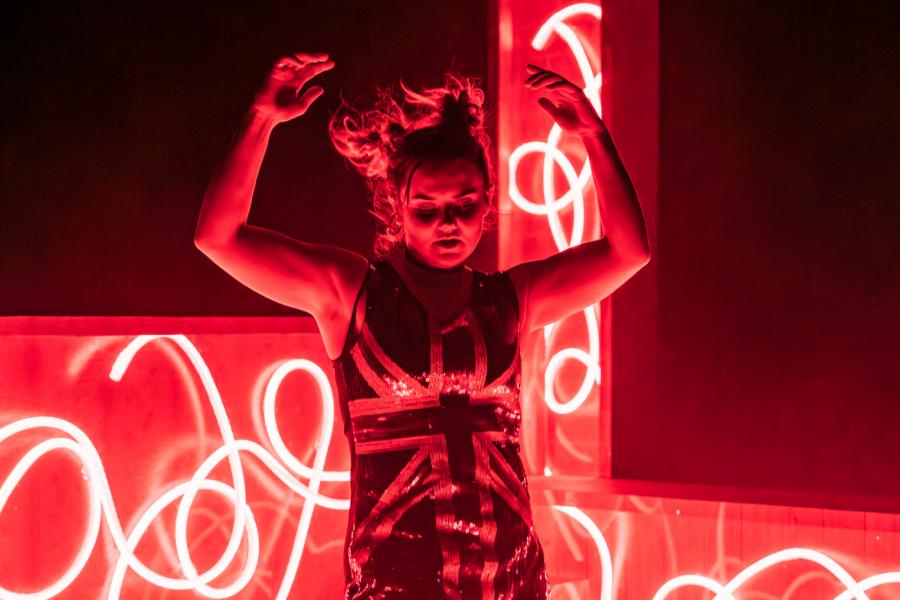
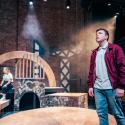
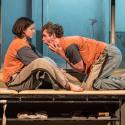
If those earlier productions traded primarily on the tradition of northern plays’ gritty realism, refracted through a lens of poignant wistfulness, Danielle Phillips’ (pictured above as Lindsay) debut play leans into a more explicitly political agenda, a cry for another generation not to be left behind. There’s humour sure, but the anger at the hand dealt to Lindsay, Terry and Jen is the stronger theme. So, less Jack Rosenthal and more Alan Bleasdale. It’s a shame that there’s only really booze used as an intoxicant by the kids, as Girls from the Whitestuff would have made for a splendid title.
Lindsay (also played by Phillips) is a girl plenty bright enough to stay in education, but decides to take a job in a shop to fund her real passion in life - clubbing it in Donny’s very own version of the Magaluf Golden Mile. Her excitement about the prospect of a first trip to the legendary Karisma nightclub is only bolstered by the afterglow of the “Things Can Only Get Better” 1997 General Election and the Britpop phenomenon. With hooks from hits punctuating the action, you can't help wondering if there's a mid-sized jukebox musical inside this drama that would work well in the Playhouse's larger space.
Jen is more wary, the daughter of small business owners, headed for uni, but they’re best friends, and she’s keen enough to party. She's the one who makes sure she has the emergency fiver and the meeting place if they get lost. She also suffers almost off-hand racist remarks and, British Asian mixed race, can't meet the expectations of either side of her family. Terry, Lindsay’s father, is a coughing ex-miner - and we all know what that means.
The play is at its best when Phillips’ extraordinary energy is front and centre, her portrayal of Lindsay’s spiralling into a vortex of low self-esteem and her extreme need for affirmation making huge demands on the actor's physical and emotional reserves. There’s no hiding place in the smaller of this venue's two houses, and she needs none, never letting up across the 100 minutes or so runtime without an interval. She does start loud though and, since Lindsay is also our narrator, when Phillips is required to portray her in traumatic scenes, she has fewer places to go. Director, Kimberley Sykes, rightly establishes a youthful exuberance from the start, but sets the emotional pitch too high for her lead in those expository opening minutes.
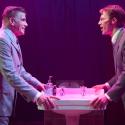
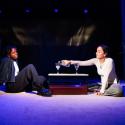
Gareth Radcliffe gets the gruff, toughish love of a single parent just so and finds pleasure in his daughter’s love of the 90s version of the rave culture Terry lived for back in the day. Charlotte Brown catches Jen’s dilemma perfectly, caught between her best friend’s wild hedonism (Jen’ll snog for a ciggie, but Lindsay'll ride for a ride) and her parents’, and, increasingly, her own sense that there’s more to life than Donny’s pubs and clubs. The recommended route out in the 90s was Education, Education, Education. How naive we were...
Phillips’ writing is clearly rooted in extensive research (she is too young to have lived any of Lindsay’s life herself, but she’s sensitive enough to see its backwash) and there are many laughs, for some of which it does help to have a little northern DNA in one’s blood. The spectre of the HIV crisis forms a backdrop to much of the second half’s sex and booze and rock’n’roll nightlife, but it's not central to the narrative. Indeed, there's an unspoken vindication that there wasn’t much else to do as a hormone-saturated teen and, even with risks known and helplines available, it was, in many ways, if not a rational lifestyle choice in the cold light of day, certainly one entirely unworthy of condemnation.
The wider point of the play relates to hot button topics today. When a community has its identity carved out of its heart, the impact resonates from one generation to the next. The question, “What are we for?” at both the collective and individual levels, bubbles ever closer to the surface, demanding an answer - any answer. Jen, with her greater social capital and shallower self-doubt can (in a pre-social media age) find a solution - a boyfriend and a three-year course in how to be middle class at Durham University - but Lindsay and her father are trapped, no solution visible.
He continues to swig lager and smoke even after a mini-stroke; Lindsay continues to find self-worth in the attention of unsuitable men and casual sex. It’s not awareness and support these individuals need, it’s answers to an existential question.
In the 2016 EU Referendum, Doncaster voted 69% to 31% in favour of Leave and when that answer didn’t work out, in 2025, the council went from having no Reform seats at all in its 55 member chamber to seeing 37 falling into the hard Right’s hands.
What will the Lindsays and Terrys of today do when that second answer also fails?