“Am I for t’ see mi own lad bitted an’ bobbed? Theer’s more blort than bustle i’ this world - an’ ‘er’s a clat-fart”. Welcome to the old curiosity shop of English drama, from which Manchester Library Theatre director Chris Honer has dusted down one of DH Lawrence’s mining plays, written a century ago, around the time of Sons and Lovers, and not even published, let alone performed, in his lifetime. Lawrence didn’t have much luck with his plays, not being a la mode. Even today, they are not often seen. After all, who wants to sit for just over two hours in a collier’s kitchen listening to the everyday bickering of mining folk? And in Nottinghamshire dialect?
That opening quote roughly translates as: “Am I to see my own lad tricked and cheated, trifled with? There is more bellowing than action in this world – and she is a gossip.” Hearing it, without the benefit of a glossary, can be testing, even though I have the advantage of being a Lancashire lad brought up with a northern dialect. No wonder that Harley Granville Barker, manager of the Royal Court Theatre in London, rejected Lawrence at the time, preferring the likes of Ibsen and Shaw. More than 50 years later, in 1968, The Daughter-in-Law was produced at the Royal Court by Peter Gill, with the young Judy Parfitt in the cast.
 In reality, the play is a taut and powerful drama, rich in language, funny and touching. The story is simply told and yet explores deep-rooted relationships – between mother and son, husband and wife, miners and masters, and, crucially, mother and daughter-in-law.
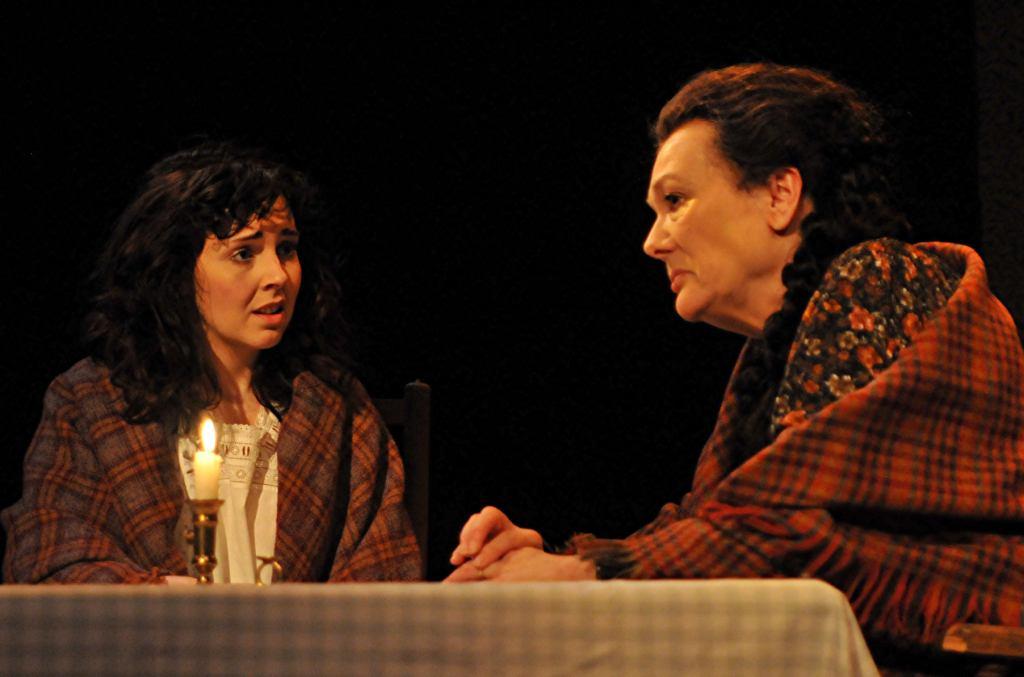
Mrs Gascoigne (played by Diane Fletcher, pictured right with Natalie Grady) is a dominating miner’s widow, now with two of her six grown-up sons, weak-willed Luther (Alun Raglan) and the younger cheeky-chappy Joe (Paul Simpson), both miners, still around, although the former, newly wed a bit above himself, has set up his own home. His wife Minnie (Natalie Grady) is, according to his vindictive mother, “hoity-toity”, having been a governess to a gentleman in Manchester: “She wasna for ‘avin’ Luther... she’s after a town johnny, a Bertie-Willie an’ a yard o’ cuffs.”
Unlike traditional miner’s wives, Minnie has some money of her own, £100 inherited from her uncle, and a sense of her own independence. She challenges her mother-in-law to let go of her sons. She challenges her husband to stand up for himself, against his controlling mother and his overbearing bosses, and to be a proper man of the house. There’s a telling scene in which Luther is still in his pit dirt at home even though supper is ready to be put on the table. Genteel Minnie forgives the lapse. “You don’t look such a tame rabbit in your pit-dirt”, she says, and kisses him even at the risk of smudging her crisp blouse. Conflict and resentment, yet underlying love and loyalty, abound.
 The play is set in Eastwood, where Lawrence grew up. The story is told against the background of a bitter miners’ strike and the complication, moral and practical, of Luther (pictured left) discovering that he has put a local girl in the family way. Her mother, Mrs Purdy (Susan Twist), comes to break the news to Mrs Gascoigne and the two old biddies plot a vengeful way of dealing with it by confronting Minnie.
The action moves between the two kitchens of the Mrs Gascoignes - mother and new wife; one a decent collier’s home, the other more cottage-like. Designer Judith Croft cleverly realises both with a sliding double set.
Honer directs deftly. He has a strong cast in which Alun Raglan and Natalie Grady capture splendidly the tension and feistiness of their troubled relationship. And the two women finally find their way to mutual respect. After all, it’s the men who are the trouble. “Children men is a’ the days o’ their lives,” says mother Gascoigne. “But they’re masters of us when they get their dander’s up.”